
The short answer
What does a C-peptide test show?
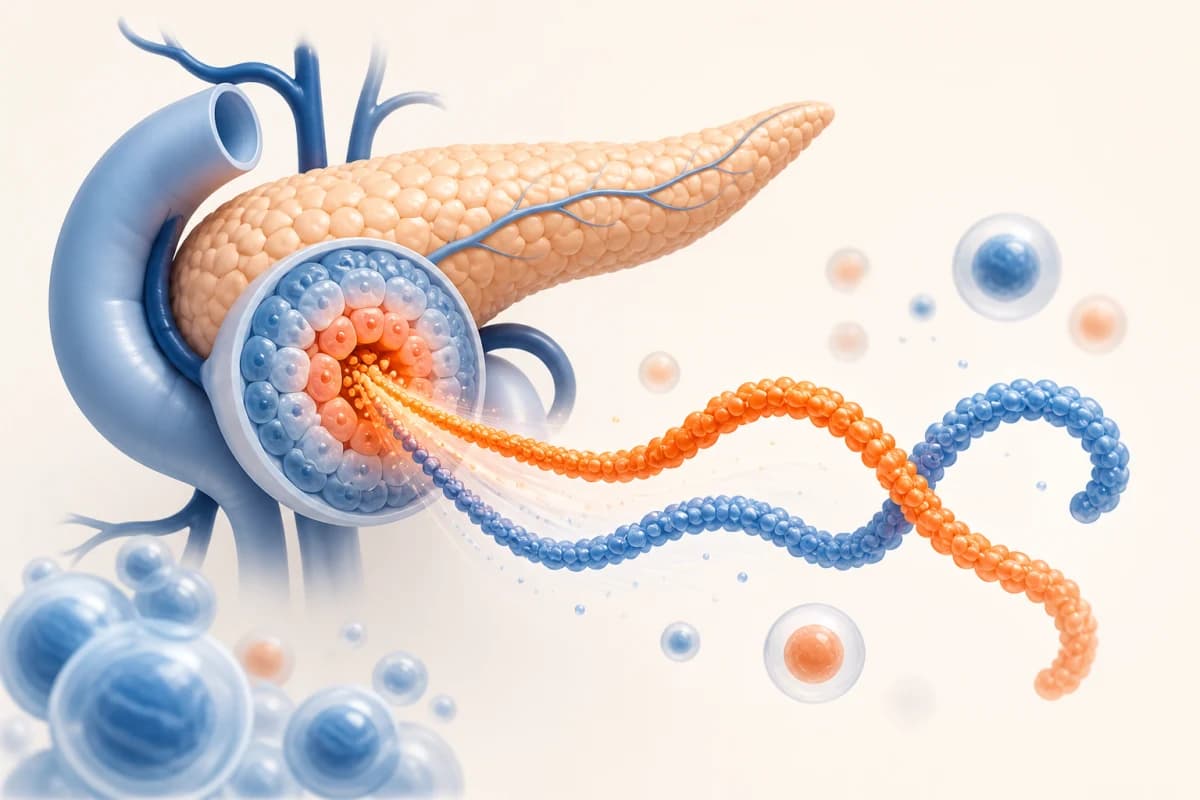
C-peptide is the connecting fragment released when pancreatic beta cells process proinsulin into insulin. It is released with the body's own insulin, so it is mainly a marker of endogenous insulin secretion rather than a glucose measurement. Ordinary injected insulin generally does not add C-peptide. The result still needs the glucose drawn at the same time, fasting or meal timing, medicines, kidney function, assay method and reason for testing. C-peptide does not diagnose diabetes by itself or tell you to stop insulin.See reference 1,See reference 2,See reference 3,See reference 4
Key points
- Keep the concurrent glucose, collection timing, unit, laboratory interval and assay with the C-peptide value. A number without that context is incomplete.See reference 1,See reference 3,See reference 4
- Fasting, stimulated, random and hypoglycaemia critical-sample results answer different questions and should not be compared as if they were the same test.See reference 1,See reference 3,See reference 4,See reference 6
- Injected insulin generally gives measured insulin with low C-peptide, while a sulfonylurea can stimulate the person's own insulin and C-peptide.See reference 3,See reference 4,See reference 6
- High C-peptide can occur with insulin resistance, endogenous hyperinsulinism, secretagogue exposure or reduced kidney clearance. High is not automatically good.See reference 3,See reference 5,See reference 6
- C-peptide has a selective role in ambiguous diabetes classification or residual secretion. Glucose, CGM and HbA1c remain the routine glycaemic monitoring tools described by the laboratory guideline.See reference 1,See reference 2,See reference 3,See reference 4
- For suspected hypoglycaemia, C-peptide is one part of a clinician-led critical sample, not a home diagnosis or fasting experiment.See reference 6
- Laboratories use different methods and intervals. Preserve the original unit and reporting interval instead of applying a copied universal range.See reference 2,See reference 3,See reference 4
- Do not change insulin or another medicine because of a C-peptide result without the treating clinician's plan.See reference 1,See reference 8
What C-peptide measures
The pancreas first makes proinsulin. When proinsulin is processed into mature insulin, the connecting portion, C-peptide, is released alongside it. That co-release makes C-peptide useful as an indirect window into endogenous insulin secretion. It is not a direct measure of blood glucose or a direct measure of how much insulin a person should use.See reference 3,See reference 4
Because ordinary injected insulin does not contain C-peptide, clinicians can compare measured insulin and C-peptide when investigating an unexpected insulin pattern. The usual exogenous-insulin pattern is measurable or high insulin with low C-peptide, but insulin antibodies and assay interference can complicate interpretation.See reference 3,See reference 4,See reference 6
C-peptide is substantially removed and metabolised by the kidneys. Reduced kidney function can therefore raise the measured result without a new increase in insulin secretion. Kidney function is a confounder to discuss with the clinician, not a reason to apply a home correction factor.See reference 3,See reference 5
Glucose and collection timing
- Collection context
- Fasting or baseline sample
- What it can show
- A baseline secretion snapshot under the requested fasting conditions. A low result after not eating can be physiologic; a low result with high glucose can suggest inadequate endogenous production.
- Important boundary
- The fasting duration, glucose, illness, medicines and laboratory interval still matter. Neither pattern diagnoses diabetes alone.See reference 3,See reference 4
- Collection context
- Post-meal or formal stimulated sample
- What it can show
- Shows secretion after a deliberate stimulus and is useful only with the protocol, timing and paired glucose recorded.
- Important boundary
- Do not compare a stimulated value with a fasting interval or create a home meal or fasting challenge.See reference 1,See reference 3,See reference 4,See reference 6
- Collection context
- Random sample for narrow insulin-treated classification guidance
- What it can show
- The 2026 ADA guidance allows a random sample with concurrent glucose within 5 hours of eating to replace formal stimulation in selected insulin-treated classification decisions.
- Important boundary
- In that narrow context, ADA notes that at least 600 pmol/L (at least 1.8 ng/mL) is not affected by timing. If below 600 pmol/L (below 1.8 ng/mL) with concurrent glucose below 4 mmol/L (70 mg/dL), or if fasting may have occurred, repeat may be considered. A very low result such as below 80 pmol/L (0.24 ng/mL) need not be repeated, and testing should not occur within 2 weeks of a hyperglycaemic emergency. These are classification notes, not universal ranges, treatment thresholds or self-directed insulin rules.See reference 1
- Collection context
- Sample during a documented spontaneous hypoglycaemia episode
- What it can show
- C-peptide is interpreted with plasma glucose, insulin and other targeted tests to distinguish endogenous, exogenous and non-insulin causes.
- Important boundary
- The sample belongs in a clinician-led workup. Treat urgent low glucose according to the local emergency plan rather than waiting for a test.See reference 6,See reference 7,See reference 8
Diabetes classification and monitoring
- Question
- Does this diagnose diabetes?
- Where C-peptide fits
- Diabetes diagnosis is based on glucose or HbA1c-based criteria, not C-peptide alone.
- What it cannot do
- A C-peptide result cannot replace the diagnostic process or the clinician's assessment.See reference 1,See reference 2,See reference 4
- Question
- Is the diabetes type or residual secretion unclear?
- Where C-peptide fits
- C-peptide can be selective support in people receiving insulin when classification is uncertain. ADA's random-sample timing and concentration notes apply only to that narrow setting.
- What it cannot do
- Do not turn those context-specific notes into a universal normal range or an instruction to stop insulin.See reference 1,See reference 3
- Question
- Is there remaining endogenous insulin secretion?
- Where C-peptide fits
- A low C-peptide can be consistent with little endogenous insulin production, including type 1 diabetes or longstanding type 2 diabetes, when the rest of the context supports it.
- What it cannot do
- Fasting, acute illness, a recent hyperglycaemic emergency, kidney function and assay limitations can weaken a simple inference.See reference 1,See reference 3,See reference 4
- Question
- What tracks glucose day to day?
- Where C-peptide fits
- Blood glucose, CGM and HbA1c are the routine glycaemic monitoring tools described in the laboratory guideline.
- What it cannot do
- C-peptide is not a substitute for daily glucose or HbA1c monitoring.See reference 2
Medicines, insulin resistance and kidney function
- Context
- Injected insulin
- Possible C-peptide pattern
- Measured insulin can be present or high while C-peptide is low because the injected insulin bypasses endogenous C-peptide release.
- Interpretive boundary
- The pattern is not a stand-alone diagnosis. The insulin preparation, assay and antibodies matter.See reference 3,See reference 4,See reference 6
- Context
- Sulfonylurea or another insulin secretagogue
- Possible C-peptide pattern
- The medicine can stimulate endogenous insulin and C-peptide, including during a low-glucose episode.
- Interpretive boundary
- A drug screen may be needed in a clinician-led workup because this can mimic endogenous hyperinsulinism.See reference 3,See reference 6
- Context
- Insulin resistance, obesity or glucose intolerance
- Possible C-peptide pattern
- C-peptide can be higher when the pancreas is producing more insulin in response to insulin resistance.
- Interpretive boundary
- Higher is not automatically healthier and does not by itself establish a diagnosis or treatment plan.See reference 3,See reference 4
- Context
- Endogenous hyperinsulinism, such as insulinoma, considered by a clinician
- Possible C-peptide pattern
- Insulin and C-peptide may both be elevated during the appropriate hypoglycaemia workup.
- Interpretive boundary
- This is a specialist pattern, not a conclusion from a high C-peptide outside the episode and its supporting tests.See reference 3,See reference 6
- Context
- Reduced kidney function
- Possible C-peptide pattern
- Less renal removal and metabolism can raise circulating C-peptide.
- Interpretive boundary
- There is no patient-specific correction factor in this guide. Interpret the result with kidney function and the laboratory method.See reference 3,See reference 5
Where C-peptide fits in a hypoglycaemia workup
The Endocrine Society recommends first establishing Whipple's triad: symptoms or signs consistent with hypoglycaemia, a low plasma glucose at the time, and improvement after glucose is raised. An isolated home reading or a C-peptide result cannot establish the triad.See reference 6
When a spontaneous episode is safely captured, a clinician may request a critical sample that includes plasma glucose, insulin, C-peptide and proinsulin, with beta-hydroxybutyrate, oral hypoglycaemic agents such as sulfonylureas or glinides, and insulin antibodies when appropriate. The combined pattern helps separate injected insulin, secretagogue exposure, endogenous hyperinsulinism and other causes.See reference 3,See reference 6
If an episode cannot be observed, a formal fast or mixed-meal test belongs under specialist supervision. Do not provoke low glucose at home, withhold medicine, or delay urgent treatment in order to obtain a C-peptide sample.See reference 6,See reference 8
Patterns clinicians compare during hypoglycaemia
- Pattern
- Insulin present or high with low C-peptide
- What the combined results may suggest
- Exogenous insulin is one possibility.
- Why C-peptide alone is insufficient
- Assay method, insulin preparation, timing and antibodies can alter the pattern.See reference 3,See reference 4,See reference 6
- Pattern
- Insulin and C-peptide present together
- What the combined results may suggest
- Endogenous insulin secretion, including secretagogue exposure or endogenous hyperinsulinism, may need consideration.
- Why C-peptide alone is insufficient
- The clinician also needs glucose, proinsulin, beta-hydroxybutyrate, drug screening and the clinical episode.See reference 3,See reference 6
- Pattern
- Low C-peptide during low glucose
- What the combined results may suggest
- Little endogenous insulin may be one part of the differential.
- Why C-peptide alone is insufficient
- The result still needs Whipple's triad, the other critical-sample tests, kidney context and medication review.See reference 3,See reference 6
Units, reference intervals and assay limits
- Result detail
- Units and conversion
- What the sources show
- C-peptide may be reported in ng/mL, pmol/L or nmol/L. Mayo states that ng/mL multiplied by 331 gives pmol/L.
- How to use it
- Keep the laboratory's original unit and do not round away meaningful precision when comparing reports.See reference 3,See reference 4
- Result detail
- Illustrative intervals, not targets
- What the sources show
- Mayo lists 1.1-4.4 ng/mL for its fasting serum assay. MedlinePlus gives a general example of 0.3-3.3 ng/mL or 0.2-1.0 nmol/L.
- How to use it
- These differences show why there is no universal C-peptide range. Use the interval printed by the reporting laboratory with the specimen and timing.See reference 3,See reference 4
- Result detail
- Method and specimen limits
- What the sources show
- The Mayo catalogue identifies an ECLIA method and reports more than 20% cross-reactivity between C-peptide and proinsulin, with hemolysis and other immunoassay interference cautions.
- How to use it
- These are assay-performance warnings, not patient-level diagnostic thresholds. Ask the laboratory or clinician about a discordant result.See reference 2,See reference 3
Preparation and what to do with the report
Preparation depends on the clinical question. Follow the requisition and ask the ordering clinician whether the sample is fasting, post-meal, stimulated or part of a hypoglycaemia workup. Do not change meals, supplements or medicine on your own to force a particular result.See reference 3,See reference 4,See reference 6
For the Mayo serum method, the catalogue requires an 8-hour fast and asks people to avoid biotin-containing multivitamins or supplements for 12 hours. Those instructions are specific to that method and do not automatically apply to another laboratory.See reference 3
Keep the complete report: C-peptide value and unit, laboratory interval, assay or method when shown, specimen type, collection time, concurrent glucose, recent food, medicines, kidney function and the reason for testing. A clinician can then decide whether a repeat or another targeted test is useful. A C-peptide result alone should not change insulin or another medicine.See reference 1,See reference 2,See reference 3,See reference 4,See reference 8
When suspected low blood sugar is urgent
Confusion, trouble walking or seeing clearly, a seizure or loss of consciousness during suspected low blood sugar needs urgent action. Follow the local emergency plan and prescribed glucagon instructions, and seek emergency medical help as directed. Do not wait for a C-peptide draw, and do not change diabetes medicines without the treating clinician.See reference 7,See reference 8
Clinician-led next steps
A clinician will interpret C-peptide with the paired glucose, the collection context, insulin or secretagogue exposure, kidney function, the assay and the question that prompted testing. The same C-peptide value can support different explanations in different settings.See reference 1,See reference 2,See reference 3,See reference 4
Depending on the question, the next step may be a repeat sample under documented conditions, a classification assessment, or a supervised hypoglycaemia workup with additional analytes. The choice belongs to the treating team and the local laboratory protocol.See reference 1,See reference 2,See reference 6
This guide cannot diagnose diabetes, identify an insulinoma, set an insulin dose, or decide when insulin is safe to stop. Bring the raw report and your medication list to a qualified healthcare professional.See reference 1,See reference 3,See reference 6,See reference 8
Common questions
Can C-peptide diagnose diabetes?
No. Diabetes diagnosis uses glucose or HbA1c-based criteria. C-peptide has a selective role when classification or endogenous secretion is unclear.See reference 1,See reference 2,See reference 4
Can C-peptide replace glucose or HbA1c monitoring?
No. C-peptide reflects endogenous insulin secretion. Blood glucose, CGM and HbA1c are the routine glycaemic monitoring tools described in the laboratory guideline.See reference 2,See reference 3
Is a high C-peptide always good?
No. Higher C-peptide can occur with insulin resistance, obesity or glucose intolerance, endogenous hyperinsulinism, a secretagogue, or reduced kidney clearance. It needs the rest of the clinical picture.See reference 3,See reference 5,See reference 6
Is a low C-peptide always abnormal?
No. A low value after not eating can be physiologic. A low value with high glucose may suggest inadequate endogenous production, but the result is not diagnostic on its own.See reference 3,See reference 4
Do I need to fast?
It depends on why the test was ordered and the laboratory protocol. Follow the requisition. For the Mayo serum method, the listed preparation is an 8-hour fast and avoiding biotin-containing supplements for 12 hours.See reference 3,See reference 4
Can a C-peptide result tell me to stop insulin?
No. Do not stop or change insulin because of this result. Classification guidance is narrow and clinician-led, and a safe plan also depends on glucose, illness, medicines, kidney function and the rest of the assessment.See reference 1,See reference 3,See reference 8
Should I fast or stop medicine to change my result?
No. Do not provoke low glucose or withhold medicine at home. If a formal fast or mixed-meal test is needed, it belongs under specialist supervision.See reference 6,See reference 8
References
- 1. 2. Diagnosis and Classification of Diabetes: Standards of Care in Diabetes-2026
American Diabetes Association Professional Practice Committee for DiabetesGuideline
- 2. Guidelines and Recommendations for Laboratory Analysis in the Diagnosis and Management of Diabetes Mellitus
American Association for Clinical Chemistry and American Diabetes AssociationGuideline
- 3. C-Peptide, Serum
Mayo Clinic Laboratories (catalogue page accessed 2026-09; no publication date shown)Official guidance
- 4. Insulin C-peptide test
MedlinePlus Medical Encyclopedia, U.S. National Library of MedicineOfficial guidance
- 5. Renal metabolism of C-peptide in man
Journal of Clinical Endocrinology & MetabolismObservational study
- 6. Evaluation and Management of Adult Hypoglycemic Disorders: An Endocrine Society Clinical Practice Guideline
Endocrine SocietyGuideline
- 7. Low Blood Sugar (Hypoglycemia)
Centers for Disease Control and PreventionOfficial guidance
- 8. Treatment of Low Blood Sugar (Hypoglycemia)
Centers for Disease Control and PreventionOfficial guidance
Editorial transparency
- Published by
- LongevityMate Editorial Team
- Published
- Updated
Medical disclaimer
This educational draft is not medical advice and does not diagnose, treat or rule out any condition. It has not received clinician review in this research pass. A qualified healthcare professional should interpret C-peptide with the complete laboratory report, glucose, medicines, kidney function, symptoms and clinical history. Do not change or stop insulin or another medicine based on this guide. Seek urgent local help for severe or worsening symptoms.