
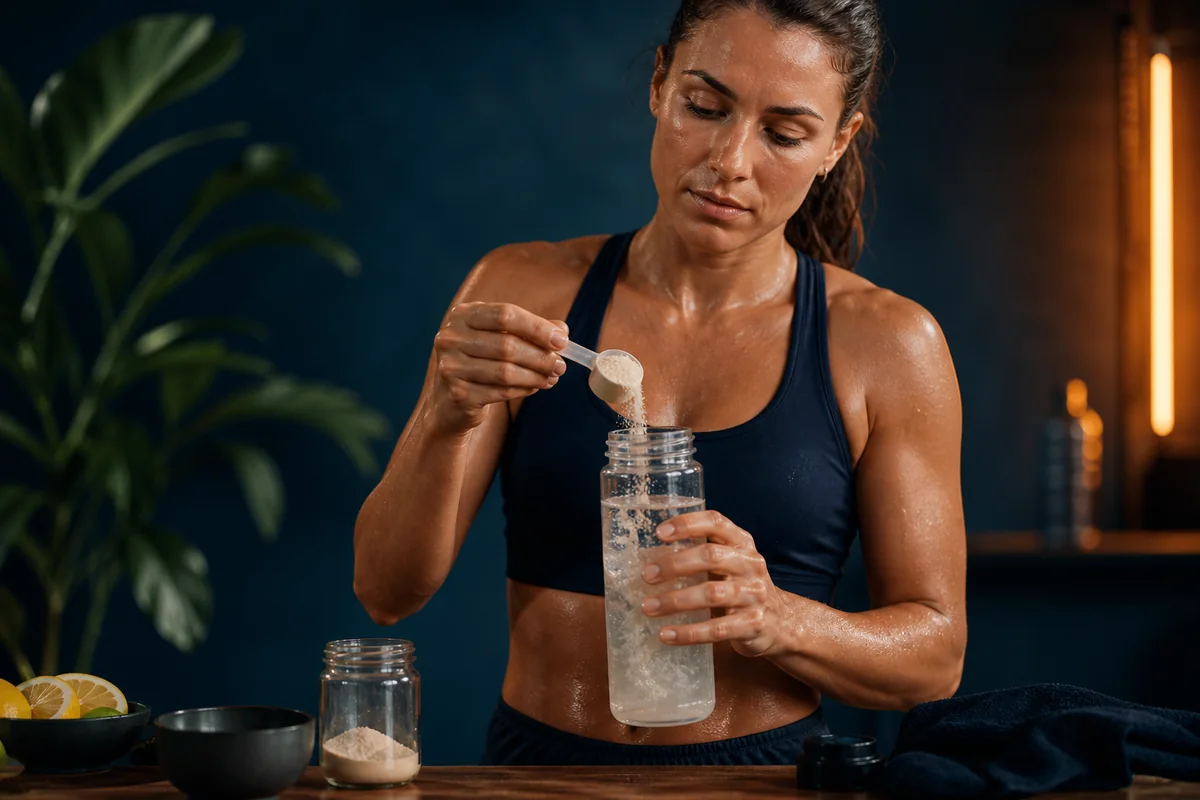
One-minute protocol
The simple evidence-based protocol
For ordinary short exercise, drink to thirst and eat normal meals. For long, hot or very sweaty sessions, estimate sweat loss from body mass and use a drink with sodium rather than forcing plain water. Avoid gaining weight during exercise. Never copy a high-sodium protocol if you have kidney, heart or blood-pressure problems.See reference 1,See reference 2,See reference 3
The 10 rules to remember
- Start normally hydratedSee reference 1
- Use thirst for ordinary short sessionsSee reference 2
- Weigh before and after representative long sessionsSee reference 3
- Account for fluid consumedSee reference 4
- Avoid body-mass gain during exerciseSee reference 5
- Add sodium for prolonged or high-sweat conditionsSee reference 6
- Use familiar products in trainingSee reference 7
- Replace remaining losses graduallySee reference 8
- Adapt for medical conditionsSee reference 1
- Review body-mass change and thirst during exercise after 3–5 representative sessions; stop if the result does not justify the burden.See reference 2
First principles: what this can actually change
Sweat removes water and sodium in amounts that vary widely between people, conditions and exercise intensity.See reference 1,See reference 2
Sodium supports fluid retention and replaces part of sweat loss, but it cannot compensate for drinking far beyond losses.See reference 2,See reference 3
Exercise-associated hyponatremia is commonly driven by excessive hypotonic fluid intake, making more fluid a potentially dangerous response.See reference 3,See reference 4
A practical protocol
- Stage
- Start
- What to do
- Start normally hydrated
- Why it matters
- Define the goal and baselineSee reference 1,See reference 2
- Stage
- Set up
- What to do
- Use thirst for ordinary short sessions
- Why it matters
- Reduce avoidable errorSee reference 2,See reference 3
- Stage
- Apply
- What to do
- Weigh before and after representative long sessions
- Why it matters
- Use a repeatable doseSee reference 3,See reference 4
- Stage
- Review
- What to do
- Account for fluid consumed
- Why it matters
- Keep only what helpsSee reference 4,See reference 5
Timing and frequency
- Decision
- Starting dose
- Practical answer
- Use water and normal meals routinely; add planned electrolytes mainly for prolonged, hot, high-sweat sessions or a clinician-directed indication.See reference 2,See reference 3
- Decision
- First review
- Practical answer
- 3–5 representative sessionsSee reference 3,See reference 4
- Decision
- Best timing
- Practical answer
- Begin exercise hydrated, drink during prolonged work according to thirst and known losses, and replace deficits gradually afterward with food and fluids.See reference 4,See reference 5
- Decision
- Stop rule
- Practical answer
- Stop exercise and seek urgent help for confusion, seizure, collapse, severe headache, repeated vomiting or worsening swelling; these can signal serious heat or sodium disorders.See reference 5,See reference 6
What to measure
- Signal
- Body-mass change and thirst during exercise
- How to use it
- Record before starting and at the review point
- Caveat
- Use the same methodSee reference 3,See reference 4
- Signal
- Performance, gastrointestinal comfort and urine recovery
- How to use it
- Track weekly rather than reacting daily
- Caveat
- Expect normal variationSee reference 4,See reference 5
- Signal
- Adherence
- How to use it
- Record sessions or days used
- Caveat
- No exposure means no fair testSee reference 5,See reference 6
- Signal
- Adverse effects
- How to use it
- Record symptoms and severity
- Caveat
- Urine colour is a rough context signal, not a precise hydration or electrolyte test.See reference 6,See reference 7
What the evidence actually shows
Sports-medicine consensus supports individualized hydration that limits excessive dehydration while preventing overdrinking. Sodium is useful in prolonged high-sweat contexts but needs vary substantially.See reference 1,See reference 2,See reference 3
Electrolyte powders do not detox the body, cure fatigue or improve performance when fluid and sodium are already adequate. More sodium is not universally healthier.See reference 4,See reference 5,See reference 6
Most studies measure short-term symptoms, physiology or performance rather than clinical events or lifespan. Results therefore support a bounded use case, not broad longevity marketing.See reference 6,See reference 7,See reference 8
Evidence strength by claim
- Claim
- Body-mass change and thirst during exercise
- Evidence
- Strong for individualized endurance hydration
- Verdict
- Sports-medicine consensus supports individualized hydration that limits excessive dehydration while preventing overdrinking. Sodium is useful in prolonged high-sweat contexts but needs vary substantially.See reference 1,See reference 2
- Claim
- Performance, gastrointestinal comfort and urine recovery
- Evidence
- Mixed or context-dependent
- Verdict
- Electrolyte powders do not detox the body, cure fatigue or improve performance when fluid and sodium are already adequate. More sodium is not universally healthier.See reference 3,See reference 4
- Claim
- Safety
- Evidence
- Depends on screening and dose
- Verdict
- People with kidney, heart or liver disease, hypertension, fluid restrictions or medicines affecting sodium and potassium need individualized medical advice.See reference 5,See reference 6
- Claim
- Longer life
- Evidence
- Not directly tested
- Verdict
- Do not convert an intermediate outcome into a lifespan promiseSee reference 7,See reference 8
Limits and common overclaims
Sweat sodium varies and field measurement is imperfect.See reference 2,See reference 3
Sports drinks differ in sodium, carbohydrate and serving size.See reference 3,See reference 4
Lab protocols may not reflect access to fluids in real events.See reference 4,See reference 5
A four-step implementation plan
- Define the exact reason you are trying electrolyte drinks.See reference 1
- Record a baseline for body-mass change and thirst during exercise.See reference 2
- Use the same protocol for 3–5 representative sessions.See reference 3
- Continue only if benefit outweighs cost, time, discomfort and risk.See reference 4
Troubleshooting
- Problem
- No benefit
- What to do
- Check adherence, dose and whether body-mass change and thirst during exercise is the right outcomeSee reference 2
- Problem
- Discomfort
- What to do
- Reduce the dose; stop for warning symptomsSee reference 3
- Problem
- Confusing data
- What to do
- Use a longer trend and the same measurement conditionsSee reference 4
- Problem
- Too much burden
- What to do
- Choose the simpler intervention that solves the same problemSee reference 5
Safety and who should be cautious
People with kidney, heart or liver disease, hypertension, fluid restrictions or medicines affecting sodium and potassium need individualized medical advice. Stop exercise and seek urgent help for confusion, seizure, collapse, severe headache, repeated vomiting or worsening swelling; these can signal serious heat or sodium disorders.See reference 5,See reference 6,See reference 7
Who is most likely to benefit
It is most valuable for endurance athletes, heavy sweaters and people exercising for long periods in heat—not for everyone sitting at a desk.See reference 2,See reference 3
It is less useful when adopted only because a score, trend or influencer made it seem mandatory.See reference 4,See reference 5
People with symptoms, diagnosed disease, pregnancy, recent surgery or complex medicines should adapt the protocol with an appropriate clinician.See reference 6,See reference 7
Track five things
- Body-mass change and thirst during exerciseSee reference 1
- Performance, gastrointestinal comfort and urine recoverySee reference 2
- The exact dose and timingSee reference 3
- Symptoms and adverse effectsSee reference 4
- Whether the result changes a real decisionSee reference 5
Frequently asked questions
What is Electrolyte hydration?
Electrolytes are charged minerals involved in fluid balance and nerve and muscle function. Most ordinary meals replace them; special drinks become more relevant during prolonged, hot or high-sweat exercise, or when a clinician identifies a need.See reference 1,See reference 2
How often should I use electrolyte drinks?
Use water and normal meals routinely; add planned electrolytes mainly for prolonged, hot, high-sweat sessions or a clinician-directed indication.See reference 2,See reference 3
How long before electrolyte drinks works?
Use 3–5 representative sessions as the first meaningful review point. Immediate comfort or device readings are not the same as a durable health effect.See reference 3,See reference 4
What should I track?
Track body-mass change and thirst during exercise, performance, gastrointestinal comfort and urine recovery, adherence and adverse effects under similar conditions.See reference 4,See reference 5
Is electrolyte drinks safe?
People with kidney, heart or liver disease, hypertension, fluid restrictions or medicines affecting sodium and potassium need individualized medical advice.See reference 5,See reference 6
When should I stop?
Stop exercise and seek urgent help for confusion, seizure, collapse, severe headache, repeated vomiting or worsening swelling; these can signal serious heat or sodium disorders.See reference 6,See reference 7
Does electrolyte drinks increase lifespan?
No trial proves that this tool extends an individual's lifespan. Its value depends on whether it improves a relevant symptom, behavior, function or established risk factor.See reference 7,See reference 8
Can it replace sleep, exercise, nutrition or medical care?
No. It is an optional layer around the fundamentals and should not delay evaluation of persistent or serious symptoms.See reference 8,See reference 1
Connect the protocol to your wider health picture
LongevityMate helps organize habits, symptoms, measurements and trends so one intervention stays in context instead of becoming the whole plan.
See how LongevityMate worksReferences
- 1. Rehydration during Endurance Exercise: Challenges, Research, Options, Methods.
NutrientsEvidence review
- 2. Exercise under heat stress: thermoregulation, hydration, performance implications, and mitigation strategies.
Physiological reviewsEvidence review
- 3. Exercise-Associated Hyponatremia.
Frontiers of hormone researchEvidence review
- 4. Exercise-associated hyponatremia.
Clinical journal of the American Society of Nephrology : CJASNEvidence review
- 5. Reviewing the current methods of assessing hydration in athletes.
Journal of the International Society of Sports NutritionEvidence review
- 6. The Hydrating Effects of Hypertonic, Isotonic and Hypotonic Sports Drinks and Waters on Central Hydration During Continuous Exercise: A Systematic Meta-Analysis and Perspective.
Sports medicine (Auckland, N.Z.)Meta-analysis
- 7. Water and healthier drinks
Centers for Disease Control and PreventionOfficial guidance
- 8. Dietary Guidelines for Americans
U.S. Department of AgricultureGuideline
Editorial transparency
- Published by
- LongevityMate Editorial Team
- Published
- Updated
Medical disclaimer
This guide provides general health education. It does not diagnose a condition, prescribe treatment, replace individualized medical care, or guarantee a health or longevity outcome.