
One-minute decision guide
The simple evidence-based answer
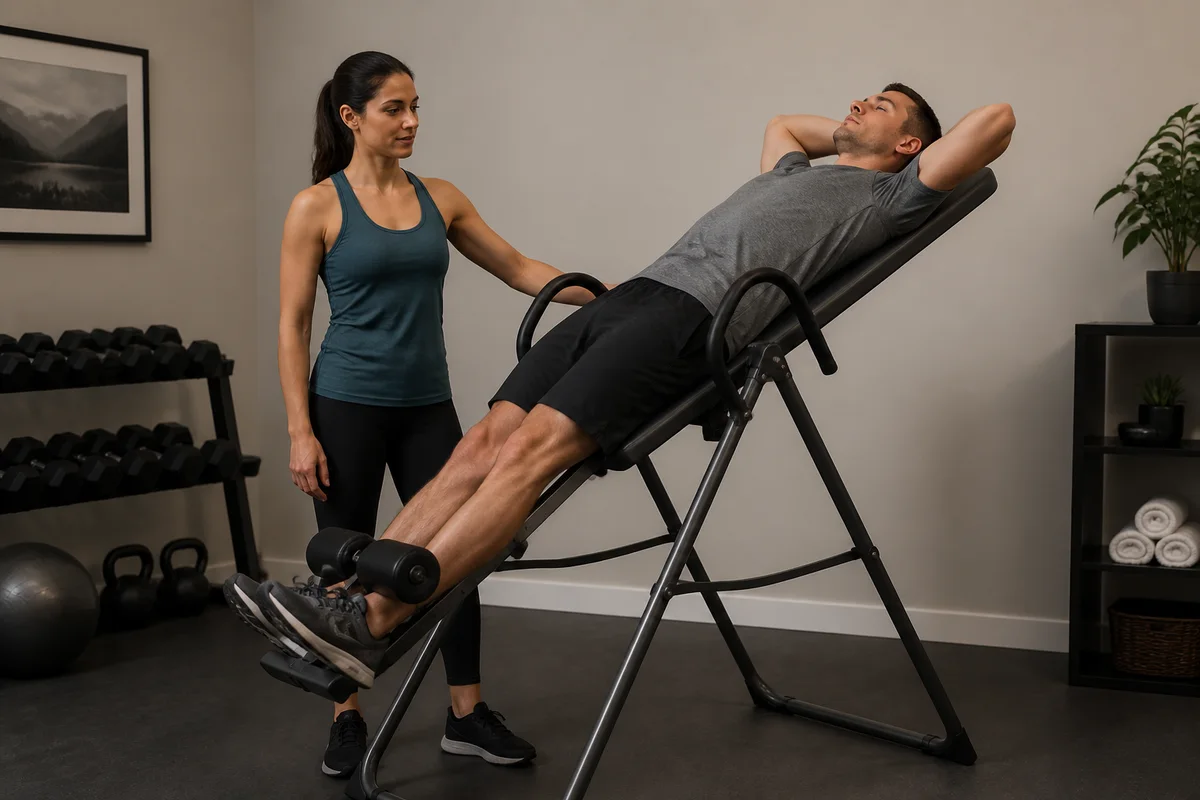
If cleared, use a stable table at a shallow angle for a brief symptom trial. Temporary spinal unloading does not correct anatomy or provide proven long-term prevention. Inversion raises pressure in the eyes and head and changes blood pressure. Avoid with glaucoma, retinal disease, uncontrolled hypertension, heart disease, pregnancy, reflux or high fall risk unless medically cleared.See reference 1,See reference 2,See reference 9
The 10 rules to remember
- Screen eye, heart, blood-pressure and fall risksSee reference 1
- Use a spotter and shallow angleSee reference 2
- Limit the first trial to one or two minutesSee reference 3
- Stop for pressure, dizziness, pain or neurologic symptomsSee reference 4
- Keep the evidence rating (limited) separate from popularitySee reference 5
- Do not use inversion therapy as a substitute for proven careSee reference 6
- Change one variable at a timeSee reference 7
- Predefine the outcome and stop ruleSee reference 8
- Record adverse effects as well as benefitsSee reference 9
- Stop when burden or risk exceeds measurable benefitSee reference 10
First principles: mechanism is not an outcome
Inversion Therapy uses gravity-assisted traction by tilting the body head-down.See reference 1,See reference 2
That mechanism matters only if controlled human research shows a useful outcome. Current evidence is rated limited, so certainty must match the data.See reference 3,See reference 4
temporary spinal unloading does not correct anatomy or provide proven long-term prevention. A biomarker, sensation or short-term change is not automatically better health or longer life.See reference 5,See reference 6
A practical use protocol
- Stage
- 1. Define
- What to do
- Screen eye, heart, blood-pressure and fall risks
- Why it matters
- Prevents aimless experimentationSee reference 1,See reference 2
- Stage
- 2. Screen
- What to do
- Use a spotter and shallow angle
- Why it matters
- Finds avoidable riskSee reference 2,See reference 3
- Stage
- 3. Use
- What to do
- Limit the first trial to one or two minutes
- Why it matters
- Controls dose and contextSee reference 3,See reference 4
- Stage
- 4. Review
- What to do
- Stop for pressure, dizziness, pain or neurologic symptoms
- Why it matters
- Stops sunk-cost useSee reference 4,See reference 5
Timing, frequency and stopping
- Decision
- Before starting
- Practical answer
- Record the goal, baseline, contraindications and a stop rule.See reference 3,See reference 4
- Decision
- First exposure
- Practical answer
- Use the lowest practical dose or duration in a controlled setting.See reference 4,See reference 5
- Decision
- During a trial
- Practical answer
- Keep other major habits stable and log benefits, adverse effects and context.See reference 5,See reference 6
- Decision
- Continue or stop
- Practical answer
- Continue only when the predefined benefit exceeds cost, burden and risk.See reference 6,See reference 7
What to measure
- Signal
- Target outcome
- How
- Use one validated or observable measure
- Interpretation
- The outcome should match the original goalSee reference 4,See reference 5
- Signal
- Exposure
- How
- Record device, dose, duration and frequency
- Interpretation
- Without dose, results cannot be interpretedSee reference 5,See reference 6
- Signal
- Adverse effects
- How
- Log symptoms and timing
- Interpretation
- Absence of immediate harm does not prove long-term safetySee reference 6,See reference 7
- Signal
- Opportunity cost
- How
- Track money, time and displaced proven habits
- Interpretation
- A small effect can still be poor valueSee reference 7,See reference 8
What the evidence actually shows
Research indexed for inversion therapy includes heterogeneous populations, doses and outcomes. The current Arsenal rating is limited.See reference 1,See reference 3
If cleared, use a stable table at a shallow angle for a brief symptom trial. This conclusion is deliberately narrower than common marketing claims.See reference 4,See reference 6
No cited study establishes that inversion therapy extends human lifespan.See reference 7,See reference 8
Evidence strength by claim
- Claim
- The intervention has a plausible or measurable mechanism
- Confidence
- Low
- Important boundary
- uses gravity-assisted traction by tilting the body head-downSee reference 1,See reference 2
- Claim
- It improves the specific outcomes studied
- Confidence
- Low
- Important boundary
- temporary spinal unloading does not correct anatomy or provide proven long-term preventionSee reference 3,See reference 4
- Claim
- It improves lifespan or healthspan
- Confidence
- Low
- Important boundary
- No direct human longevity outcome evidenceSee reference 5,See reference 6
- Claim
- More exposure produces more benefit
- Confidence
- Low
- Important boundary
- Dose-response and long-term safety are not establishedSee reference 7,See reference 8,See reference 9
Limits and common overclaims
Studies may be small, short, unblinded or focused on a condition rather than healthy users.See reference 3,See reference 7
temporary spinal unloading does not correct anatomy or provide proven long-term prevention. Device and protocol differences further limit transfer to consumer use.See reference 5,See reference 8
Testimonials cannot separate treatment effect from expectation, regression to the mean, co-interventions or natural recovery.See reference 9,See reference 10
A four-step implementation plan
- 1. Screen eye, heart, blood-pressure and fall risksSee reference 1
- 2. Use a spotter and shallow angleSee reference 2
- 3. Limit the first trial to one or two minutesSee reference 3
- 4. Stop for pressure, dizziness, pain or neurologic symptomsSee reference 4
Troubleshooting
- Problem
- No measurable benefit
- Likely issue
- The intervention may not work for this goal
- Better next step
- Stop rather than increasing dose indefinitelySee reference 2,See reference 3
- Problem
- Results vary day to day
- Likely issue
- Context, measurement noise or expectation
- Better next step
- Standardize timing and compare an averageSee reference 4,See reference 5
- Problem
- Adverse effects appear
- Likely issue
- Dose, contraindication or direct harm
- Better next step
- Stop and obtain appropriate medical adviceSee reference 6,See reference 7
- Problem
- Marketing exceeds the research
- Likely issue
- A mechanism or pilot study is being overextended
- Better next step
- Return to condition-specific human outcomesSee reference 8,See reference 9
Safety and when to get medical help
Inversion raises pressure in the eyes and head and changes blood pressure. Avoid with glaucoma, retinal disease, uncontrolled hypertension, heart disease, pregnancy, reflux or high fall risk unless medically cleared.See reference 1,See reference 5,See reference 9
Who is most likely to benefit
People with the specific condition or goal actually studied, when inversion therapy has a credible role.See reference 2,See reference 4
People who can use a standardized protocol and measure a meaningful outcome rather than rely on a feeling alone.See reference 5,See reference 7
People who have already protected higher-value foundations such as sleep, exercise, nutrition and appropriate medical care.See reference 8,See reference 10
Track five things
- Exact goal and baselineSee reference 1
- Dose, duration and frequencySee reference 2
- Target outcomeSee reference 3
- Adverse effects and warning signsSee reference 4
- Cost, burden and final continue-or-stop decisionSee reference 5
Frequently asked questions
Does it work?
Evidence is limited. Temporary spinal unloading does not correct anatomy or provide proven long-term prevention.See reference 1
Is it proven for longevity?
No direct human lifespan benefit has been established.See reference 2
What is the safest protocol?
Screen eye, heart, blood-pressure and fall risks; Use a spotter and shallow angle; Limit the first trial to one or two minutes; Stop for pressure, dizziness, pain or neurologic symptoms.See reference 3
How often should I use it?
There is no universal longevity dose. Frequency must match the studied purpose, safety limits and measurable response.See reference 4
Can I combine it with other biohacks?
Change one variable at a time; stacking makes benefit and harm harder to identify.See reference 5
Who should avoid it?
Inversion raises pressure in the eyes and head and changes blood pressure. Avoid with glaucoma, retinal disease, uncontrolled hypertension, heart disease, pregnancy, reflux or high fall risk unless medically cleared.See reference 6
What should I track?
Track the target outcome, exact exposure, adverse effects, cost and opportunity cost.See reference 7
When should I stop?
Stop for warning symptoms, no meaningful benefit after a predefined trial, or when risk and burden exceed the result.See reference 8
Connect this decision to your wider health picture
LongevityMate helps organize measurements, symptoms, habits and trends so an intervention stays in context instead of becoming the whole plan.
See how LongevityMate worksReferences
- 1. Traction for low-back pain with or without sciatica.
The Cochrane database of systematic reviewsMeta-analysis
- 2. Traction for low-back pain with or without sciatica.
The Cochrane database of systematic reviewsMeta-analysis
- 3. Traction for low-back pain with or without sciatica.
The Cochrane database of systematic reviewsMeta-analysis
- 4. Intermittent traction therapy in the treatment of chronic low back pain.
Medicinski glasnik : official publication of the Medical Association of Zenica-Doboj Canton, Bosnia and HerzegovinaObservational study
- 5. Low back pain treatment: is a 'Yank' in King Arthur's Court or elsewhere as effective as traction, epidural injections or what else?
British journal of rheumatologyObservational study
- 6. Low back pain.
Lancet (London, England)Evidence review
- 7. Health Information
National Center for Complementary and Integrative HealthOfficial guidance
- 8. MedWatch Safety Information
U.S. Food and Drug AdministrationOfficial guidance
- 9. Inversion Therapy studies registry
ClinicalTrials.govOfficial guidance
- 10. Inversion Therapy evidence search
PubMedEvidence review
Editorial transparency
- Published by
- LongevityMate Editorial Team
- Published
- Updated
Medical disclaimer
This guide provides general health education. It does not diagnose a condition, prescribe treatment, replace individualized medical care, or guarantee a health or longevity outcome.