
One-minute decision guide
The simple evidence-based answer
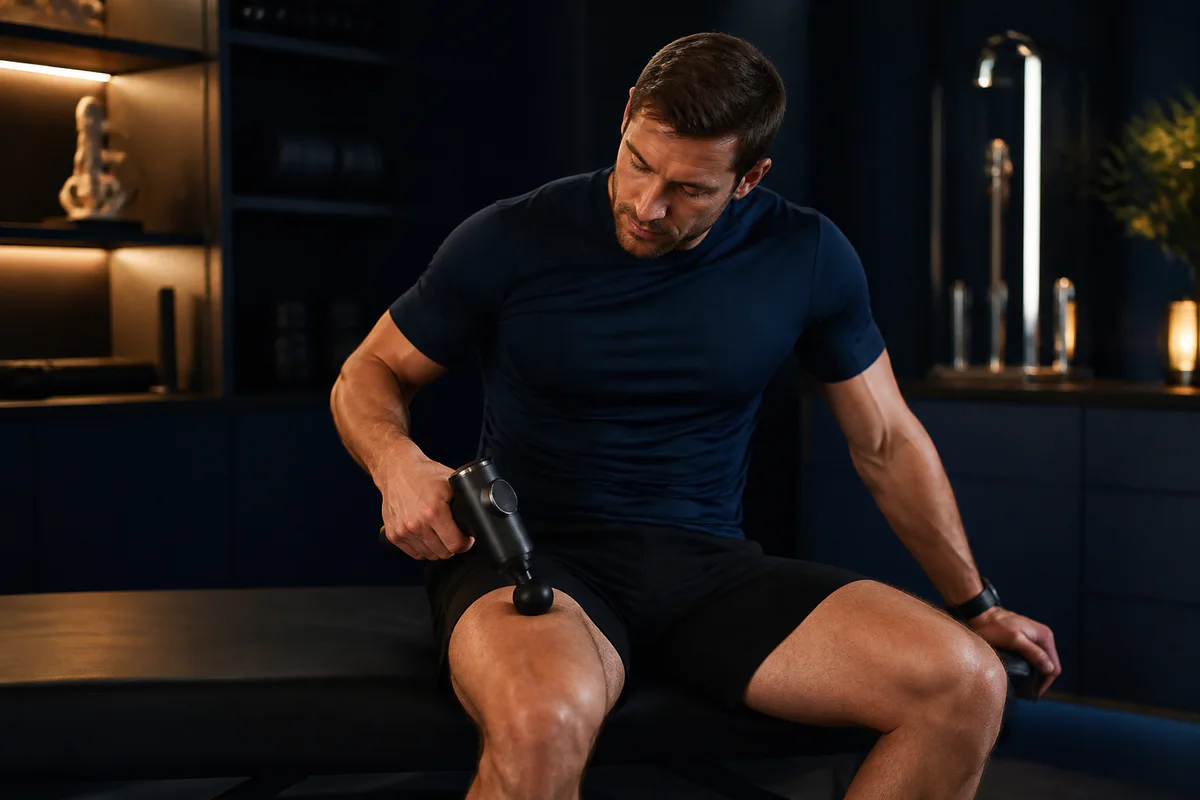
Start on the lowest setting and apply to a large muscle for 30–60 seconds while keeping the head moving. Before training, use briefly if it improves motion without reducing force; after training, use only for comfort. Avoid the front and side of the neck, head, spine, bones, joints, abdomen, kidneys, open wounds, bruises, varicose veins and areas with reduced sensation. Do not use over a blood clot, acute injury or unexplained swelling. More pressure and longer sessions are not better.See reference 1,See reference 2,See reference 3
The 10 rules to remember
- Use a massage gun only for a clearly defined problemSee reference 1
- Start with the lowest-burden evidence-based optionSee reference 2
- Record a baseline before changing anythingSee reference 3
- Do not confuse a biological mechanism with a proven health outcomeSee reference 4
- Do not let a massage gun replace established careSee reference 5
- Use qualified clinical oversight when the intervention is medicalSee reference 6
- Stop when harms, abnormal symptoms or a worse trend appearSee reference 7
- Judge benefit with measurements that matter to the original goalSee reference 8
- Reassess cost, burden and uncertainty after the planned trialSee reference 9
- Avoid protocols based only on testimonials, influencers or clinic marketingSee reference 10
First principles: what this can actually change
Percussion provides rapid local pressure and vibration that can alter sensation and temporarily change muscle-tendon stiffness.See reference 1,See reference 2
Short-term range of motion is not the same as tissue repair, lactate clearance or accelerated adaptation.See reference 3,See reference 4
The safest useful dose changes comfort without causing guarding, numbness, bruising or performance loss.See reference 5,See reference 6
A practical decision protocol
- Stage
- 1. Screen the area
- What to do
- Choose healthy muscle away from bones, nerves and vessels
- Why it matters
- Anatomy determines riskSee reference 1,See reference 2
- Stage
- 2. Start low
- What to do
- Use the soft head and lowest speed
- Why it matters
- Response varies by tissue and deviceSee reference 3,See reference 4
- Stage
- 3. Keep moving
- What to do
- Glide for 30–60 seconds per muscle
- Why it matters
- Prevents concentrated pressureSee reference 5,See reference 6
- Stage
- 4. Re-test
- What to do
- Check pain-free motion or comfort
- Why it matters
- Continue only if the target outcome improvesSee reference 7,See reference 8
Timing, dose and frequency
- Decision
- Before training
- Practical answer
- Use briefly; stop if power, coordination or pain worsens.See reference 1,See reference 2
- Decision
- After training
- Practical answer
- Use for comfort, not as a requirement for adaptation.See reference 3,See reference 4
- Decision
- On delayed soreness
- Practical answer
- A short gentle session is reasonable if it feels better during and afterward.See reference 5,See reference 6
- Decision
- On acute injury
- Practical answer
- Do not treat swelling, severe pain or suspected tear without assessment.See reference 7,See reference 8
What to measure
- Signal
- Pain-free range of motion
- How
- Test the same movement before and after
- Interpretation
- Temporary improvement supports limited useSee reference 1,See reference 2
- Signal
- Perceived soreness
- How
- Rate 0–10 at baseline and later
- Interpretation
- Meaningful comfort matters more than device intensitySee reference 3,See reference 4
- Signal
- Performance
- How
- Check jump, force or technique when used pre-session
- Interpretation
- Stop if performance fallsSee reference 5,See reference 6
- Signal
- Tissue response
- How
- Inspect for bruising, numbness or swelling
- Interpretation
- These indicate excessive or unsafe useSee reference 7,See reference 8
What the evidence actually shows
Systematic reviews find small short-term improvements in flexibility or range of motion, with substantial study limitations.See reference 1,See reference 2
Recovery and soreness findings are mixed; a controlled study found little benefit after five minutes of calf treatment.See reference 3,See reference 4
There is no evidence that massage guns break up fascia, remove toxins or accelerate longevity-related adaptation.See reference 5,See reference 6
Evidence strength by claim
- Claim
- Temporarily improves range of motion
- Confidence
- Moderate
- Important boundary
- Effect is short term and muscle-specificSee reference 1,See reference 2
- Claim
- Reduces soreness
- Confidence
- Low
- Important boundary
- Results depend on dose and comparisonSee reference 3,See reference 4
- Claim
- Improves strength or power
- Confidence
- Low
- Important boundary
- Some studies show no gain or possible impairmentSee reference 5,See reference 6
- Claim
- Heals injury faster
- Confidence
- Very low
- Important boundary
- No robust clinical outcomes evidenceSee reference 7,See reference 8
Limits and common overclaims
Devices and treatment doses vary widely.See reference 4,See reference 7
Many studies are small and at moderate or high risk of bias.See reference 5,See reference 8
Immediate sensation can mask pain without correcting the cause.See reference 6,See reference 9
A four-step implementation plan
- 1. Choose healthy muscle away from bones, nerves and vesselsSee reference 1
- 2. Use the soft head and lowest speedSee reference 2
- 3. Glide for 30–60 seconds per muscleSee reference 3
- 4. Check pain-free motion or comfortSee reference 4
Troubleshooting
- Problem
- More sore afterward
- Likely issue
- Dose was too intense or too long
- Better next step
- Stop and allow recoverySee reference 1,See reference 2
- Problem
- Numbness or tingling
- Likely issue
- A nerve may be irritated
- Better next step
- Stop immediately and seek review if persistentSee reference 3,See reference 4
- Problem
- No mobility change
- Likely issue
- The limitation may not be muscular
- Better next step
- Use assessment and targeted mobility workSee reference 5,See reference 6
- Problem
- Bruising
- Likely issue
- Pressure or bleeding risk is excessive
- Better next step
- Stop and review medicines or conditionSee reference 7,See reference 8
Safety and when to get medical help
Avoid use over the head, throat, front or side of neck, spine, chest, abdomen, kidneys, genitals, bones, joints, wounds, infection, acute swelling, suspected clot or reduced sensation. Ask a clinician before use with anticoagulants, bleeding disorders, neuropathy, pregnancy, implanted devices or recent surgery. Persistent weakness, severe pain, swelling or neurological symptoms need assessment.See reference 1,See reference 5,See reference 9
Who is most likely to benefit
Healthy adults who value short-term comfort or range of motion before or after activity.See reference 2,See reference 6
People who can identify safe muscular anatomy and use conservative settings.See reference 3,See reference 7
Anyone with unexplained pain, swelling or neurological symptoms needs diagnosis rather than percussion.See reference 4,See reference 8
Track five things
- Pain-free range of motionSee reference 1
- Perceived sorenessSee reference 3
- PerformanceSee reference 5
- Tissue responseSee reference 7
- Decision made after reviewing the resultSee reference 9
Frequently asked questions
Before or after a workout?
Either, but use briefly before training and judge performance; after training use it only for comfort.See reference 1
How long per muscle?
Start with 30–60 seconds and stop when the intended change occurs.See reference 2
Can I use it on my neck?
Avoid the front and sides of the neck and do not use over the cervical spine.See reference 3
Does it remove lactic acid?
No persuasive evidence supports toxin or lactate-clearing claims.See reference 4
Does this extend lifespan?
No human trial has shown that a massage gun extends lifespan. Any longevity claim must be separated from evidence for a specific symptom, diagnosis or surrogate marker.See reference 5
How quickly should it work?
Use briefly; stop if power, coordination or pain worsens.See reference 6
Can it replace standard treatment?
No. A complementary tool should not displace care already shown to reduce symptoms, complications or mortality.See reference 7
How do I know whether it helped?
Use a pre-defined outcome such as pain-free range of motion and compare it with a baseline over an appropriate time window.See reference 8
Connect this decision to your wider health picture
LongevityMate helps organize measurements, symptoms, habits and trends so one test, device or treatment stays in context instead of becoming the whole plan.
See how LongevityMate worksReferences
- 1. Percussive Therapy Dosage After Muscle Damage
Chiropractic and Manual TherapiesMeta-analysis
- 2. Percussive Therapy, Performance and Pain
International Journal of Sports Physical TherapySystematic review
- 3. Percussive Massage and Recovery in Active Adults
Journal of Athletic TrainingRandomized trial
- 4. Cold-Water Immersion and Strength Recovery
Sports MedicineMeta-analysis
- 5. Whole-Body Cryotherapy as Recovery Technique
International Journal of Sports MedicineSystematic review
- 6. Hot-Water Immersion and Heat Acclimation
Journal of Science and Medicine in SportRandomized trial
- 7. PRP for Knee Osteoarthritis
American Journal of Sports MedicineMeta-analysis
- 8. Effects of Massage Guns on Performance and Recovery
Journal of Functional Morphology and KinesiologySystematic review
- 9. Passive Heating and Cardiometabolic Risk
American Journal of Preventive CardiologyMeta-analysis
- 10. Cold Facts to Help Avoid Injury
U.S. Food and Drug AdministrationOfficial guidance
Editorial transparency
- Published by
- LongevityMate Editorial Team
- Published
- Updated
Medical disclaimer
This guide provides general health education. It does not diagnose a condition, prescribe treatment, replace individualized medical care, or guarantee a health or longevity outcome.