
One-minute decision guide
The simple evidence-based answer
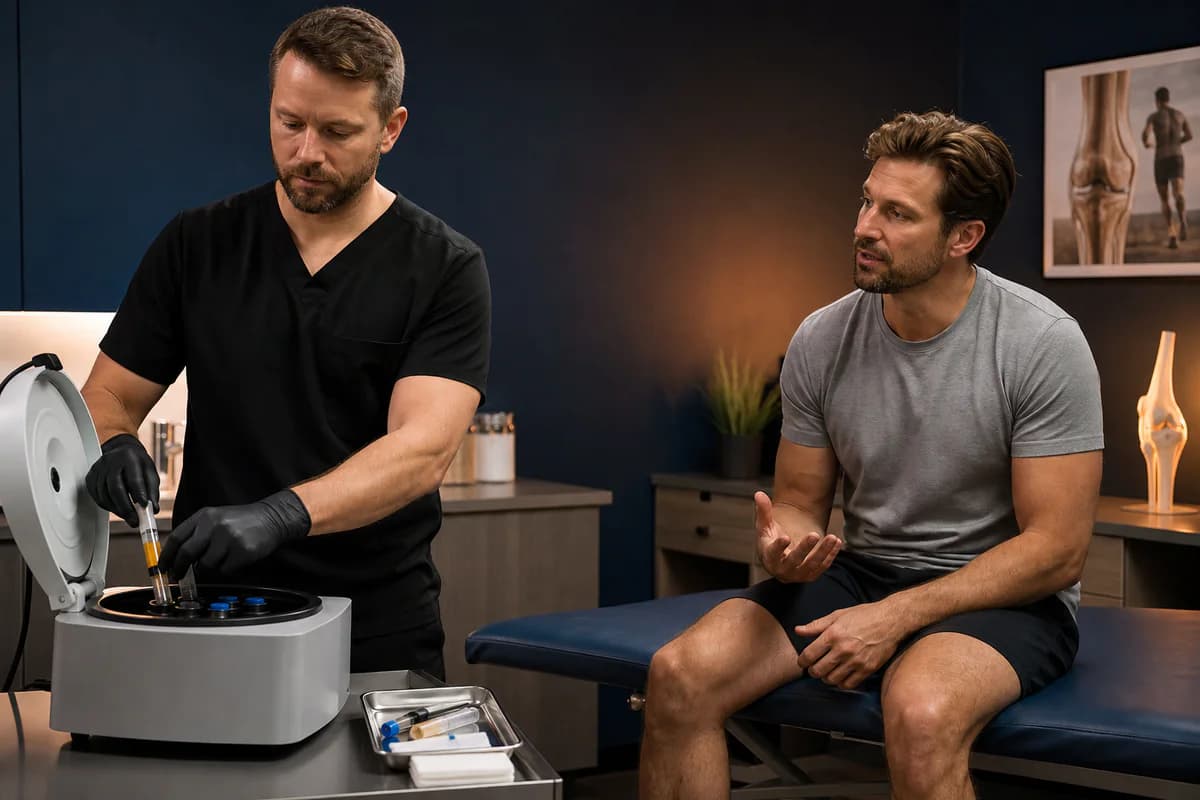
Use PRP only after a clear diagnosis, an adequate rehabilitation trial and a discussion of alternatives. Ask what preparation is used, platelet and leukocyte characteristics, number of injections, image guidance, expected absolute benefit, rehabilitation plan and total cost. Evidence is indication-specific: results for knee osteoarthritis cannot be generalized to hair loss, spine disease, sexual wellness or anti-aging. Plan the injection around a progressive loading program rather than treating the injection as the repair itself.See reference 1,See reference 2,See reference 3
The 10 rules to remember
- Use PRP therapy only for a clearly defined problemSee reference 1
- Start with the lowest-burden evidence-based optionSee reference 2
- Record a baseline before changing anythingSee reference 3
- Do not confuse a biological mechanism with a proven health outcomeSee reference 4
- Do not let PRP therapy replace established careSee reference 5
- Use qualified clinical oversight when the intervention is medicalSee reference 6
- Stop when harms, abnormal symptoms or a worse trend appearSee reference 7
- Judge benefit with measurements that matter to the original goalSee reference 8
- Reassess cost, burden and uncertainty after the planned trialSee reference 9
- Avoid protocols based only on testimonials, influencers or clinic marketingSee reference 10
First principles: what this can actually change
Platelets release signaling proteins, but the resulting biological mixture varies with blood draw, centrifugation and activation.See reference 1,See reference 2
Injected growth signals cannot restore mechanics if load, strength, sleep or diagnosis remains wrong.See reference 3,See reference 4
Autologous origin reduces some immune risks but does not establish efficacy or eliminate infection, bleeding and procedure risk.See reference 5,See reference 6
A practical decision protocol
- Stage
- 1. Diagnose
- What to do
- Confirm tissue and severity clinically and with imaging when indicated
- Why it matters
- PRP evidence is indication-specificSee reference 1,See reference 2
- Stage
- 2. Exhaust basics
- What to do
- Use appropriate exercise therapy, load management and standard care
- Why it matters
- Many conditions improve without injectionSee reference 3,See reference 4
- Stage
- 3. Specify product
- What to do
- Document preparation, guidance and injection plan
- Why it matters
- PRP is not standardizedSee reference 5,See reference 6
- Stage
- 4. Rehabilitate
- What to do
- Follow a staged loading and outcome plan
- Why it matters
- Function is rebuilt after the procedureSee reference 7,See reference 8
Timing, dose and frequency
- Decision
- Before injection
- Practical answer
- Review anticoagulants, infection, anemia, platelet disorders and planned activity.See reference 1,See reference 2
- Decision
- Immediately after
- Practical answer
- Follow procedure-specific protection; do not use pain relief to overload tissue.See reference 3,See reference 4
- Decision
- Return to training
- Practical answer
- Progress by symptoms and clinician-directed loading rather than a fixed social-media day count.See reference 5,See reference 6
- Decision
- Repeat injection
- Practical answer
- Only after judging the first treatment against a predefined meaningful outcome.See reference 7,See reference 8
What to measure
- Signal
- Pain and function
- How
- Use a validated condition-specific scale
- Interpretation
- A meaningful change exceeds day-to-day fluctuationSee reference 1,See reference 2
- Signal
- Training capacity
- How
- Track load, range and task performance
- Interpretation
- Function matters more than imaging aloneSee reference 3,See reference 4
- Signal
- PRP preparation
- How
- Record volume, platelet and leukocyte profile
- Interpretation
- Supports interpretation and future careSee reference 5,See reference 6
- Signal
- Adverse effects
- How
- Track pain flare, infection and neurovascular symptoms
- Interpretation
- Procedure harm needs prompt reviewSee reference 7,See reference 8
What the evidence actually shows
Guidelines and meta-analyses suggest PRP may improve pain and function in selected knee osteoarthritis patients, but certainty and recommendations vary.See reference 1,See reference 2
Evidence for tendinopathies is mixed and depends on site, chronicity, comparator and rehabilitation.See reference 3,See reference 4
No evidence supports PRP as a systemic longevity intervention or guaranteed tissue regeneration.See reference 5,See reference 6
Evidence strength by claim
- Claim
- Improves selected knee osteoarthritis symptoms
- Confidence
- Moderate
- Important boundary
- Preparation and comparator matterSee reference 1,See reference 2
- Claim
- Helps all tendinopathies
- Confidence
- Low
- Important boundary
- Effects are site-specific and inconsistentSee reference 3,See reference 4
- Claim
- Regrows cartilage
- Confidence
- Very low
- Important boundary
- Symptom change does not prove regenerationSee reference 5,See reference 6
- Claim
- Provides anti-aging benefit
- Confidence
- Very low
- Important boundary
- No systemic outcomes evidenceSee reference 7,See reference 8
Limits and common overclaims
PRP is a family of products, not one standardized dose.See reference 4,See reference 7
Blinding is difficult because injections and post-procedure pain differ.See reference 5,See reference 8
Commercial packages often extrapolate musculoskeletal evidence to unrelated uses.See reference 6,See reference 9
A four-step implementation plan
- 1. Confirm tissue and severity clinically and with imaging when indicatedSee reference 1
- 2. Use appropriate exercise therapy, load management and standard careSee reference 2
- 3. Document preparation, guidance and injection planSee reference 3
- 4. Follow a staged loading and outcome planSee reference 4
Troubleshooting
- Problem
- Large pain flare
- Likely issue
- Expected inflammation or complication
- Better next step
- Contact the treating clinician and screen red flagsSee reference 1,See reference 2
- Problem
- No benefit
- Likely issue
- Wrong indication, product or rehabilitation
- Better next step
- Reassess rather than buying automatic repeatsSee reference 3,See reference 4
- Problem
- Clinic cannot describe PRP
- Likely issue
- Product is not transparent
- Better next step
- Choose a service that documents preparationSee reference 5,See reference 6
- Problem
- Function improves briefly only
- Likely issue
- Load capacity was not rebuilt
- Better next step
- Return to progressive rehabilitationSee reference 7,See reference 8
Safety and when to get medical help
PRP injection can cause pain flare, bleeding, infection, nerve or vessel injury and tissue damage from inaccurate placement. Review anticoagulants and blood disorders with the clinician; do not stop prescribed medication independently. Fever, spreading redness, severe escalating pain, weakness, numbness or a cold swollen limb requires urgent assessment.See reference 1,See reference 5,See reference 9
Who is most likely to benefit
Selected patients with mild-to-moderate knee osteoarthritis after conservative care and shared decision-making.See reference 2,See reference 6
Some people with specific chronic tendinopathies under experienced diagnosis and rehabilitation.See reference 3,See reference 7
People promised whole-body regeneration, guaranteed cartilage regrowth or anti-aging should not proceed on those claims.See reference 4,See reference 8
Track five things
- Pain and functionSee reference 1
- Training capacitySee reference 3
- PRP preparationSee reference 5
- Adverse effectsSee reference 7
- Decision made after reviewing the resultSee reference 9
Frequently asked questions
How many injections?
There is no universal course; protocols vary by condition and preparation.See reference 1
How long to recover?
Early protection and staged loading depend on tissue, technique and symptoms.See reference 2
Does PRP regrow cartilage?
Symptom improvement does not establish clinically meaningful cartilage regeneration.See reference 3
Is leukocyte-rich PRP better?
The preferred formulation may differ by tissue; evidence does not support one universal product.See reference 4
Does this extend lifespan?
No human trial has shown that PRP therapy extends lifespan. Any longevity claim must be separated from evidence for a specific symptom, diagnosis or surrogate marker.See reference 5
How quickly should it work?
Review anticoagulants, infection, anemia, platelet disorders and planned activity.See reference 6
Can it replace standard treatment?
No. A complementary tool should not displace care already shown to reduce symptoms, complications or mortality.See reference 7
How do I know whether it helped?
Use a pre-defined outcome such as pain and function and compare it with a baseline over an appropriate time window.See reference 8
Connect this decision to your wider health picture
LongevityMate helps organize measurements, symptoms, habits and trends so one test, device or treatment stays in context instead of becoming the whole plan.
See how LongevityMate worksReferences
- 1. AAOS Guideline: Knee Osteoarthritis
Journal of the American Academy of Orthopaedic SurgeonsGuideline
- 2. PRP for Knee Osteoarthritis
American Journal of Sports MedicineMeta-analysis
- 3. PRP for Cartilage, Tendon and Muscle Damage
Journal of Experimental OrthopaedicsGuideline
- 4. ESSKA Consensus on PRP for Knee Osteoarthritis
Knee Surgery, Sports Traumatology, ArthroscopyGuideline
- 5. Effects of Massage Guns on Performance and Recovery
Journal of Functional Morphology and KinesiologySystematic review
- 6. Warning About Unapproved Human Cell and Tissue Products
U.S. Food and Drug AdministrationOfficial guidance
- 7. Safety and Efficacy of Extracellular Vesicle Therapy
Journal of Extracellular VesiclesMeta-analysis
- 8. Percussive Therapy, Performance and Pain
International Journal of Sports Physical TherapySystematic review
- 9. Understanding Unapproved Use of Approved Drugs
U.S. Food and Drug AdministrationOfficial guidance
- 10. Bulk Drug Substances With Significant Safety Risks
U.S. Food and Drug AdministrationOfficial guidance
Editorial transparency
- Published by
- LongevityMate Editorial Team
- Published
- Updated
Medical disclaimer
This guide provides general health education. It does not diagnose a condition, prescribe treatment, replace individualized medical care, or guarantee a health or longevity outcome.