
One-minute protocol
The simple evidence-based protocol
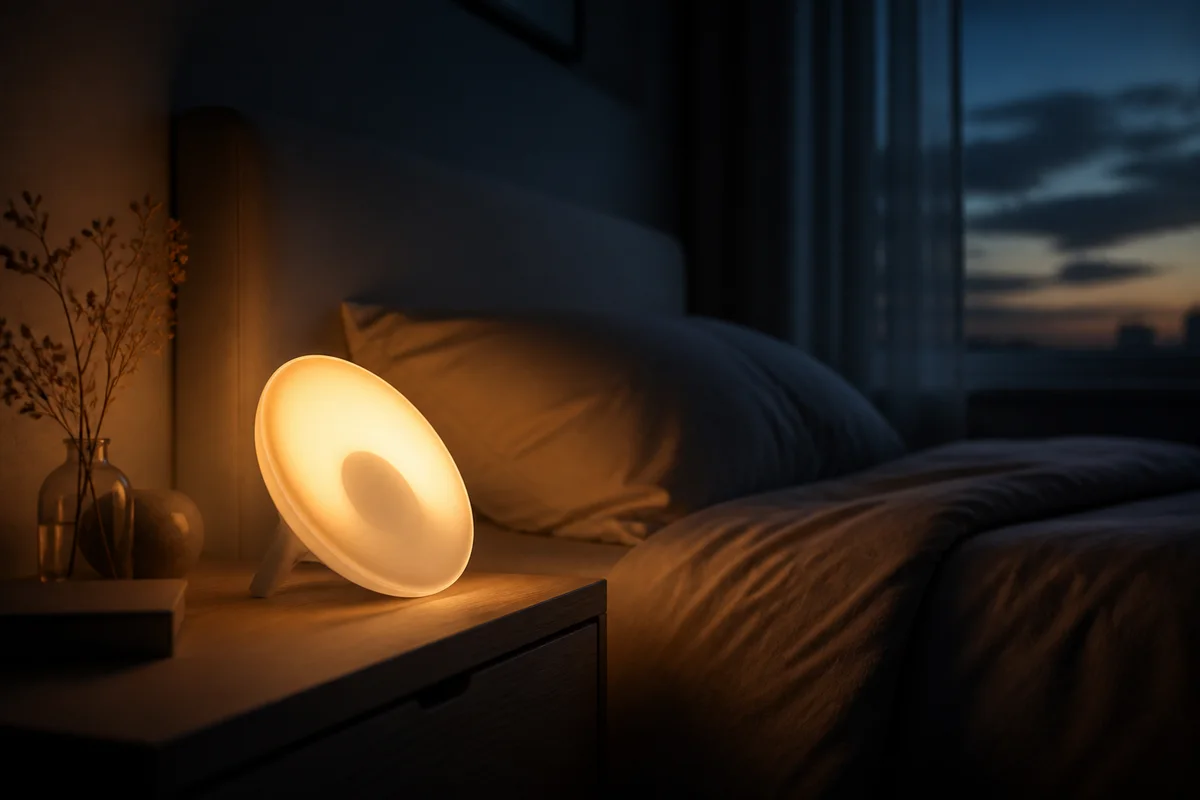
Set the light to begin 30-45 minutes before your intended wake time and rise gradually to a comfortable brightness at eye level by the alarm. Keep the schedule consistent for 1-2 weeks, get outdoor light soon after waking, and compare wake difficulty, snoozing and daytime sleepiness with baseline. Do not stare directly into a very bright source. If you have bipolar disorder, significant eye disease or take photosensitizing medicines, ask the relevant clinician before using a high-intensity light device; a sunrise alarm is not a substitute for treatment of depression or a sleep disorder.See reference 1,See reference 2,See reference 3
The 10 rules to remember
- A sunrise alarm is a gradual wake cue, not the same dose as a 10,000-lux light-therapy box.See reference 1
- The best direct trials are small and concentrated in seasonal affective disorder.See reference 2
- It may reduce morning drowsiness in people with winter-pattern hypersomnia.See reference 3
- Bright post-waking light and dawn simulation are distinct protocols and should not be conflated.See reference 4
- Naturalistic dawn simulation has performed better than dim placebo conditions in controlled trials.See reference 5
- Light timing can shift circadian rhythms, so later or mistimed exposure may have the opposite effect.See reference 6
- Bipolar disorder requires clinical oversight because bright-light interventions can affect mood state.See reference 7
- Keep outdoor morning light, sufficient sleep opportunity and a regular wake time as the foundation.See reference 8
- Evening light can delay sleep timing; a sunrise clock does not cancel late-night bright light.See reference 9
- No trial shows that a sunrise alarm extends lifespan.See reference 10
First principles: what this tool can actually change
Light reaching the retina signals the brain's circadian clock. A gradual pre-wake increase can reduce the contrast between dark sleep and abrupt waking while providing an earlier morning light signal.See reference 1,See reference 2
Illuminance falls rapidly with distance and depends on device angle, eyelids and room surfaces. A marketed brightness at the lamp is not necessarily the dose reaching the eyes in bed.See reference 3,See reference 4
A device can make waking feel easier without increasing total sleep. If bedtime stays too late, a gentler alarm may improve the transition but cannot repay chronic sleep loss.See reference 5,See reference 6
A practical protocol
- Stage
- Baseline
- What to do
- Track wake difficulty and snoozing for 3-7 days
- Why it matters
- Shows whether the device changes the targetSee reference 1
- Stage
- Program
- What to do
- Start 30-45 minutes before wake and brighten gradually
- Why it matters
- Matches practical dawn-simulation protocolsSee reference 2
- Stage
- Position
- What to do
- Place at eye level and within the specified distance without glare
- Why it matters
- Controls the light actually reaching the eyesSee reference 3
- Stage
- Anchor
- What to do
- Get outdoor light and move after waking
- Why it matters
- Reinforces a stronger daytime circadian signalSee reference 4
Timing and frequency
- When
- Before wake time
- Action
- Use a 30-45 minute gradual ramp as a starting pointSee reference 5
- When
- At wake time
- Action
- Reach comfortable peak light and use sound backup if neededSee reference 6
- When
- Within 1 hour after waking
- Action
- Seek outdoor light, especially on dim morningsSee reference 7
- When
- After 1-2 weeks
- Action
- Continue only if waking or daytime function improvesSee reference 8
What to measure
- Signal
- Wake difficulty
- How
- 0-10 rating immediately after waking
- Interpretation
- Primary direct targetSee reference 7
- Signal
- Snoozing
- How
- Number of snoozes or minutes out of bed late
- Interpretation
- Behavioral measure less affected by recallSee reference 8
- Signal
- Daytime sleepiness
- How
- Same validated or simple daily scale
- Interpretation
- Persistent elevation needs assessmentSee reference 9
- Signal
- Mood and activation
- How
- Daily mood plus agitation or reduced sleep need
- Interpretation
- Important for seasonal symptoms and bipolar riskSee reference 10
What the evidence supports
Controlled trials in seasonal affective disorder found that dawn simulation can improve depressive symptoms compared with dim placebo, although samples and protocols were limited.See reference 1,See reference 3
A trial in winter depression with hypersomnia found reduced morning drowsiness and difficulty awakening after dawn simulation.See reference 2,See reference 4
The strongest conclusion for general users is narrower: a gradual light cue may make waking easier. Evidence does not prove better sleep architecture, performance or longevity.See reference 5,See reference 6
Evidence strength by claim
- Claim
- Reduces difficulty waking in seasonal-pattern hypersomnia
- Confidence
- Low to moderate
- Important boundary
- Based on small clinical samplesSee reference 1,See reference 2
- Claim
- Improves seasonal affective symptoms
- Confidence
- Moderate for selected patients
- Important boundary
- Not a universal depression treatmentSee reference 3,See reference 4
- Claim
- Improves sleep quality in healthy adults
- Confidence
- Limited
- Important boundary
- Direct independent trials are sparseSee reference 5,See reference 6
- Claim
- Improves metabolism or extends lifespan
- Confidence
- Not established
- Important boundary
- No direct outcome evidenceSee reference 7,See reference 8,See reference 9,See reference 10
Limitations and common overclaims
Commercial devices differ in spectrum, ramp shape, peak illuminance and placement; a trial result cannot be assigned to every product labeled 'sunrise.'See reference 3,See reference 7
Many studies involve seasonal depression rather than ordinary alarm use, and placebo design is challenging when participants can see the light.See reference 5,See reference 8
Self-reported easier waking can be useful, but it does not diagnose circadian delay, sleep apnea, hypersomnia, insomnia or insufficient sleep.See reference 9,See reference 10
How to make it stick
Keep the wake time fixed first, then add the light. Changing several parts of the schedule at once makes the effect impossible to judge.See reference 1,See reference 2
Use a backup sound alarm during the first week and move the device only after checking its stated eye-level distance and brightness.See reference 3,See reference 4
If mornings improve, move bedtime early enough to preserve sleep duration. A successful wake cue should not become permission for less sleep.See reference 5,See reference 6
Troubleshooting
- Problem
- Light does not wake you
- Likely issue
- Dose at the eyes is too low or sleep debt is high
- Better next step
- Adjust approved distance/ramp and protect sleep opportunitySee reference 2,See reference 3
- Problem
- You wake too early
- Likely issue
- Ramp begins too soon or light leaks into the room
- Better next step
- Shift the start later and control unwanted lightSee reference 4,See reference 5
- Problem
- Headache or eye discomfort
- Likely issue
- Brightness, glare or sensitivity
- Better next step
- Reduce exposure and seek advice if persistentSee reference 6,See reference 7
- Problem
- Agitation or less need for sleep
- Likely issue
- Possible mood activation
- Better next step
- Stop and contact a clinician promptlySee reference 8,See reference 9,See reference 10
Safety and when to stop
Avoid staring directly into a bright lamp and follow device distance instructions. Seek eye-care advice for significant retinal disease, recent eye surgery or medicines that increase light sensitivity. People with bipolar disorder or a history of mania should use therapeutic-intensity light only with clinical oversight. Stop and obtain help for marked agitation, racing thoughts, sharply reduced need for sleep, worsening depression or suicidal thoughts. Persistent excessive sleepiness, loud snoring or witnessed breathing pauses needs medical assessment, not a brighter alarm.See reference 1,See reference 5,See reference 9
Who is most likely to benefit
A sunrise alarm is most plausible for people who wake before natural daylight, dislike abrupt alarms or have clinician-recognized seasonal morning symptoms.See reference 2,See reference 4
It is less likely to solve waking problems caused by too little sleep, sedating medicines, shift work, untreated sleep apnea or another medical condition.See reference 5,See reference 7
People with seasonal depression may use dawn simulation as part of a treatment plan, but device choice and monitoring should match symptom severity and mood history.See reference 8,See reference 10
Track five things
- Ramp start, peak time and device position.See reference 1
- Wake difficulty score.See reference 2
- Snooze count and out-of-bed time.See reference 3
- Total sleep opportunity.See reference 4
- Mood, headache and eye symptoms.See reference 5
Frequently asked questions
How long before waking should the light start?
Thirty to 45 minutes is a practical starting range; some clinical dawn protocols use longer ramps.See reference 1
How bright should a sunrise alarm be?
Use the manufacturer's eye-level setup and a comfortable peak. Bedroom dawn devices are not automatically equivalent to 10,000-lux therapy boxes.See reference 2
Does it improve sleep quality?
It may improve the waking experience, but direct evidence for better sleep architecture or total sleep in healthy users is limited.See reference 3
Is a sunrise alarm as good as morning sunlight?
No. Outdoor light is usually much brighter and remains the stronger daytime circadian cue.See reference 4
Can it treat seasonal depression?
Dawn simulation has supportive clinical trials, but depression warrants proper assessment and a complete treatment plan.See reference 5
Can I use it with blackout curtains?
Yes; controlling unwanted early light can make the programmed dawn more consistent.See reference 6
Why do I still feel exhausted?
The device cannot correct insufficient sleep or diagnose sleep apnea, circadian disorders, anemia, depression or medication effects.See reference 7
Does a sunrise alarm improve longevity?
No direct evidence shows a lifespan benefit.See reference 8
Connect the protocol to your wider health picture
LongevityMate helps organize measurements, habits, symptoms and trends so one tool stays in context instead of becoming the whole plan.
See how LongevityMate worksReferences
- 1. Dawn simulation and bright light in the treatment of seasonal affective disorder
Biological PsychiatryRandomized trial
- 2. Dawn simulation vs bright light in seasonal affective disorder
Journal of Affective DisordersRandomized trial
- 3. Dawn simulation and difficulty awakening in seasonal affective disorder
Journal of Affective DisordersRandomized trial
- 4. Naturalistic dawn simulation for seasonal affective disorder
American Journal of PsychiatryRandomized trial
- 5. Dawn simulation in subsyndromal winter depression
Journal of Affective DisordersRandomized trial
- 6. Treatment of intrinsic circadian rhythm sleep-wake disorders
American Academy of Sleep MedicineGuideline
- 7. Bright light therapy in bipolar depression
American Journal of PsychiatryRandomized trial
- 8. Bright light treatment: recommendations for clinicians
Dialogues in Clinical NeuroscienceEvidence review
- 9. Evening light and circadian-related outcomes
Sleep Medicine ReviewsSystematic review
- 10. Seasonal affective disorder
National Institute of Mental HealthOfficial guidance
Editorial transparency
- Published by
- LongevityMate Editorial Team
- Published
- Updated
Medical disclaimer
This guide provides general health education. It does not diagnose a condition, prescribe treatment, replace individualized medical care, or guarantee a health or longevity outcome.