
The short answer
Promising signals are narrower than marketing claims
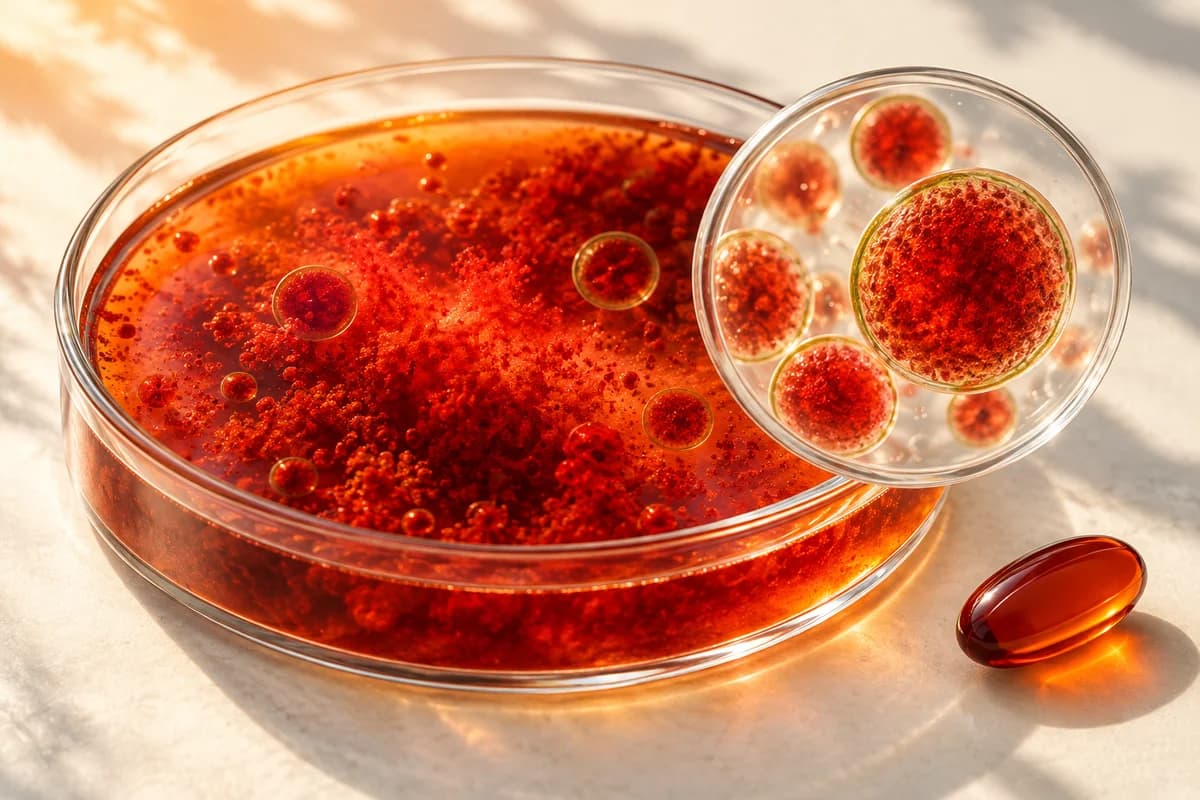
Astaxanthin is a red carotenoid often sourced for supplements from the microalga Haematococcus pluvialis. Small human trials have reported some skin measurements improving, but study size and funding limit confidence. Pooled exercise studies have not shown a consistent performance gain. A red pigment or antioxidant activity in a laboratory does not prove better health or longer life.See reference 1,See reference 2,See reference 3
Know what the product actually contains
Astaxanthin occurs in microalgae and in seafood that obtains the pigment through the food chain. A supplement may use algae-derived astaxanthin in an oil or softgel. The amount of algae extract and the amount of astaxanthin are not necessarily the same number.See reference 3
Read the label for the source, astaxanthin amount per serving, other ingredients and the intended age group. Food exposure, a cosmetic formula and a concentrated oral supplement have different evidence bases; do not transfer an outcome from one to another.See reference 3
Human evidence by question
- Question
- Skin appearance and moisture
- What studies report
- A review found 11 clinical studies, including six double-blind randomized trials; some reported improvements.
- What remains uncertain
- Many studies were small, often involved healthy Japanese women, and some had commercial funding.See reference 1
- Question
- Exercise recovery markers
- What studies report
- A 2026 review found lower creatine kinase on average; another marker was less consistent.
- What remains uncertain
- A laboratory recovery marker does not establish faster functional recovery for every athlete.See reference 2
- Question
- Aerobic or time-trial performance
- What studies report
- The same pooled review did not find consistent improvement in VO₂max, time trials or maximal workload.
- What remains uncertain
- Different study designs and small outcome groups limit certainty; no universal performance claim follows.See reference 2
- Question
- Disease prevention or longevity
- What studies report
- These skin and exercise studies were not designed to test those outcomes.
- What remains uncertain
- No disease-prevention or lifespan conclusion should be drawn from them.See reference 1,See reference 2
Read skin trials without promising a cosmetic result
The skin review reported findings on texture, wrinkles, moisture and ultraviolet-related measures in some trials. It also highlighted small samples, limited population diversity and potential funding conflicts. A finding in a short trial may not predict what an individual will see, or how long an effect lasts.See reference 1
Astaxanthin is not a substitute for established sun protection. A reported change in a skin measurement should not be described as prevention of skin cancer or repair of all UV damage.See reference 1
Do not turn a biomarker into an athletic promise
A 2026 meta-analysis of randomized trials found a signal in some recovery-related blood markers, but no significant pooled effect on the major direct performance outcomes it examined. The authors described substantial differences between studies and asked for better-powered trials.See reference 2
A lower creatine kinase value after exercise is a measurement, not a guarantee of feeling recovered, training better or running faster. The supplement should not replace training, sleep, nutrition or medical assessment of persistent symptoms.See reference 2
What the safety evidence can and cannot cover
The skin review reported no serious adverse events in its included studies, but small, short trials cannot establish long-term safety or detect rare harms. EFSA assessed a specific algae-derived novel-food context in Europe and considered total exposure from food and supplements; its conclusion for adults is not a blanket approval of every product, age group or dose.See reference 1,See reference 3
Children, pregnancy, breastfeeding, chronic illness and medicine use need a separate discussion with a qualified professional. Avoid borrowing an adult regulatory assessment to recommend a dose for another population. Report any suspected adverse effect with the product label available.See reference 3
Four checks before believing a claim
- Confirm the stated astaxanthin amount and source, not only the total algae-extract weight.See reference 3
- Ask which human outcome was measured: skin appearance, a blood marker or actual exercise performance.See reference 1,See reference 2
- Look at trial size, population, duration and funding before generalising a result.See reference 1,See reference 2
- Discuss personal suitability and medicines with a qualified professional; no universal dose follows from this guide.See reference 3
Common questions
Is astaxanthin a proven anti-ageing supplement?
No. The cited human evidence concerns selected skin and exercise measures. It does not demonstrate longer life or prevention of age-related disease.See reference 1,See reference 2
Does it make athletes faster?
Pooled trials have not shown a consistent improvement in VO₂max, time-trial performance or maximal workload. Some recovery markers changed, which is a different outcome.See reference 2
Are algae and seafood forms identical?
They can contain the same pigment, but a supplement is a formulated exposure with its own amount and ingredients. Food and capsule findings should not be treated as interchangeable.See reference 3
Did trials prove long-term safety?
No. The small skin studies reported no serious adverse events, but that does not rule out rare or long-term problems, particularly in populations not studied.See reference 1,See reference 3
References
- 1. Effects of Astaxanthin Supplementation on Skin Health: A Systematic Review of Clinical Studies
Journal of Dietary Supplements, indexed by PubMedSystematic review
- 2. The Effects of Astaxanthin Supplementation on Exercise Recovery Biomarkers and Exercise Performance: A Systematic Review and Meta-Analysis
Nutrients, full text in PubMed CentralMeta-analysis
- 3. Safety of astaxanthin for its use as a novel food in food supplements
EFSA Journal, full text in PubMed CentralOfficial guidance
Editorial transparency
- Published by
- LongevityMate Editorial
- Published
- Updated
Medical disclaimer
General education only. This guide does not diagnose a condition, interpret your personal result, choose a treatment or recommend a supplement dose. Discuss testing, symptoms, medicines and supplements with a qualified health professional.