
What this result means
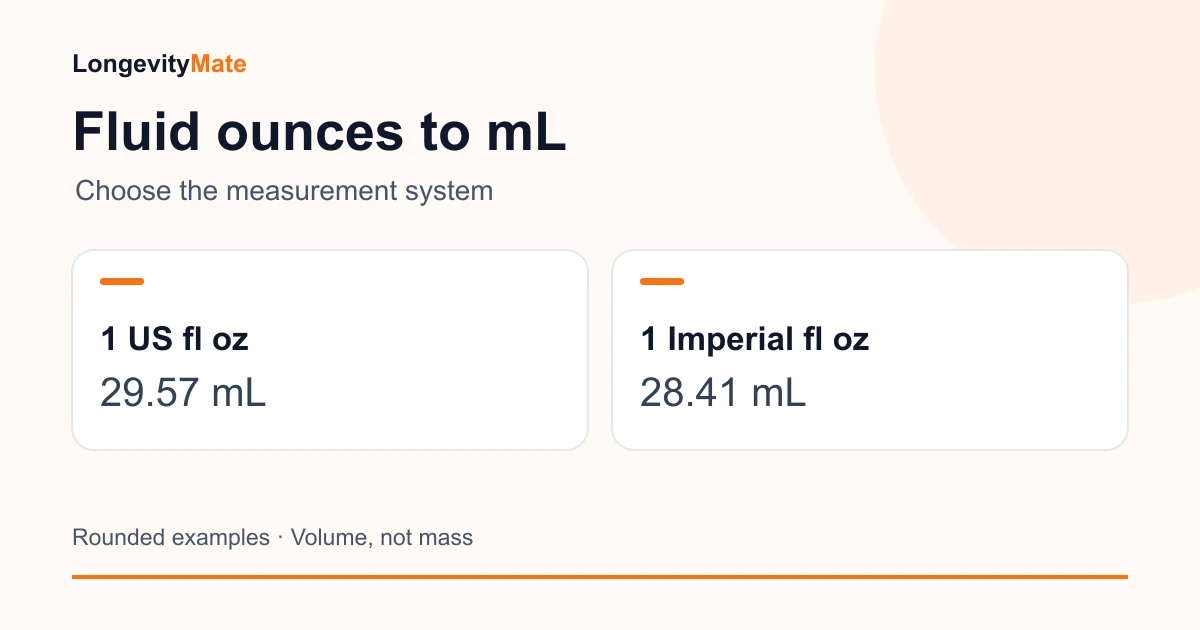
One US customary fluid ounce is 29.5735295625 mL; one Imperial fluid ounce is 28.4130625 mL. Choose the system and direction before entering a number. The result is rounded to two decimals. Fluid ounces measure volume, not weight. [1][2][3]
First identify which fluid ounce you have
US customary and Imperial fluid ounces represent different volumes. Measurement Canada lists the Imperial gallon as 4.54609 L and 160 fluid ounces, while the US gallon contains 128 US fluid ounces. Do not choose a system simply because a package was purchased in a particular country. [2]
If a recipe or label says only oz, first determine whether it means mass or fluid volume and which system applies. When a product already prints mL, retain that original figure rather than replacing it with a conversion from a rounded ounce number.
The same ounce count can describe different volumes
Eight US fluid ounces are 236.5882365 mL, displayed as 236.59 mL. Eight Imperial fluid ounces are 227.3045 mL, displayed as 227.30 mL. These are different volumes, even though both starting numbers are eight. [1][2][3]
For the reverse direction, 250 mL is approximately 8.45 US fluid ounces or 8.80 Imperial fluid ounces. Select the system you want to express; the starting 250 mL does not change.
Where the factors come from
The US factor follows from a gallon of 231 cubic inches, 128 fluid ounces per gallon and an inch of exactly 2.54 centimetres: 231 × 2.54³ ÷ 128 = 29.5735295625 cubic centimetres, or mL. [1][3]
The Imperial factor is 4.54609 × 1,000 ÷ 160 = 28.4130625 mL per fluid ounce. The converter uses these exact ratios and their reciprocals before rounding the displayed answer. [2]
Why a U.S. nutrition label may use 30 mL
For U.S. nutrition-labelling purposes, 21 CFR 101.9(b)(5)(viii) defines one fluid ounce as 30 mL. That is a separate label convention from the US customary factor above. It is not evidence that the customary factor is wrong, and it does not apply automatically to every volume statement. [4]
Use the original metric serving amount when reading the product’s nutrient information. This calculator is for unit arithmetic, not for constructing or certifying a regulatory label.
Fluid ounces cannot be converted to grams without more information
A fluid ounce measures volume; an ounce of weight measures mass. Converting liquid volume to mass requires the substance’s density. Equal volumes of different materials need not have equal masses. This tool does not guess a density. [1]
It also does not turn a drink volume into calories, caffeine, nutrients or a recommended daily amount. Those questions require product-specific information or a separate assessment.
Keep sensible measurement precision
Two displayed decimals make comparisons easy; they do not claim that a kitchen measure is accurate to 0.01 mL. Enter decimals with a full stop, without unit text or thousands separators. Enter 0.5 rather than the fraction 1/2.
Reset clears the entry. Calculations run in your browser, and a shared page address does not include your entry or result.
Formula and assumptions
- Formula
- US fl oz × 29.5735295625 = mL. Imperial fl oz × 28.4130625 = mL. Divide mL by the matching factor to reverse. [1][2][3]
- Version
- Conversion system and direction, fluid-ounces-millilitres-v1
- Rounding
- Exact decimal and rational arithmetic, rounded once to two places. Halfway cases round up in magnitude. Positive values below 0.005 display as <0.01 in the selected output unit.
Who this is for — and when not to use it
Intended use
Neutral conversion of a known US customary or Imperial fluid-volume value for food and drink measurements.
Not intended for
No medicine dosing, infant-formula preparation, clinical fluid plans, hydration targets, manufacturing certification, mass conversion or calculation of calories from volume.
Exclusions
- An ounce of weight, without a fluid-volume unit
- An unspecified ounce system or an unmarked household cup
- Medicine, infant-formula or clinical fluid instructions
- Nutrient concentration, calories or density inferred from volume
- Regulatory label creation or certification
Evidence sources
- 1. Guide to the SI: conversion factors by quantity — National Institute of Standards and Technology. Accessed Sep 11, 2026.
- 2. GEN-50: Units of measurement, gallon, pint and fluid ounce — Measurement Canada. Accessed Sep 11, 2026.
- 3. The International System of Units (SI): Conversion Factors for General Use, SP 1038 — National Institute of Standards and Technology. Accessed Sep 11, 2026.
- 4. 21 CFR 101.9: Nutrition labeling of food, paragraph (b)(5)(viii) — Electronic Code of Federal Regulations. Accessed Sep 11, 2026.