
What this result means
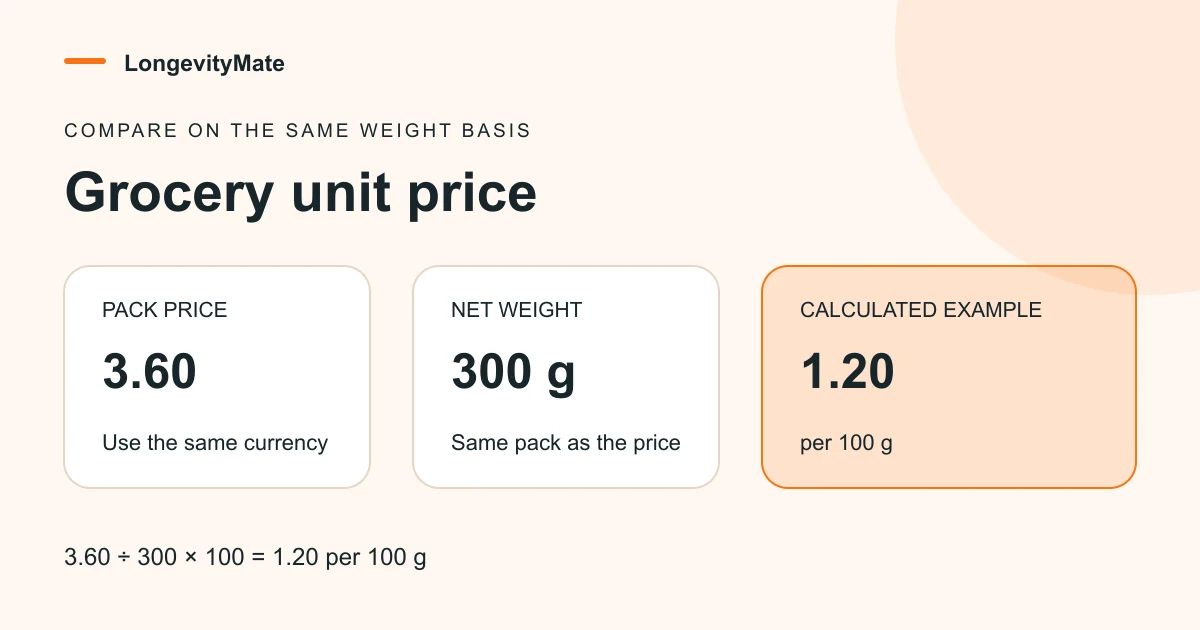
Divide the pack price by its net weight in grams, then multiply by 100. For example, a 300 g pack costing 3.60 has a unit price of 1.20 per 100 g. Compare similar products in the same currency and on the same weight basis. [1][2]
Use the price and weight of the same pack
Enter the current pack price and its net weight in grams. Net weight means the contents, excluding the packaging. If the pack is marked in kilograms, multiply by 1,000 first. A 0.75 kg pack contains 750 g. [1][3]
For a multi-pack, use the price and combined net weight of the same group. For example, four 125 g pots have a combined net weight of 500 g. Do not pair the four-pack price with the weight of one pot.
A simple comparison
Pack A costs 3.60 for 300 g: 3.60 ÷ 300 × 100 = 1.20 per 100 g. Pack B costs 5.50 for 500 g: 5.50 ÷ 500 × 100 = 1.10 per 100 g. Pack B has the lower unit price but costs more at checkout. These are invented examples, using the same currency.
A larger pack is not always cheaper by weight, and a promotion is not always the lowest unit price. Check current labels instead of assuming that the biggest pack or sale sticker wins. [2]
Match units and the product you are comparing
Compare similar products on the same basis. A price per kilogram is ten times the corresponding price per 100 g. Do not compare the raw numbers until their units match. This calculator does not convert a litre or an item into a gram weight. [1][3]
Use consistent weights for comparable contents. A dry mix and a prepared product, or a drained product and a product including liquid, may not be a fair comparison even when the arithmetic is correct.
Check the offer before entering the price
Use a discounted price only when you qualify for it and are buying the quantity it requires. The calculation cannot check membership rules, minimum quantities or whether an offer is still current. [2]
A lower unit price is one piece of information. Your total budget, storage space and the amount you will use can change which pack makes sense for you. The tool does not choose a product or give it a health score. [2]
Rounding and privacy
The result is rounded to two decimal places; it is not a live quote. For example, 2.01 for 200 g gives an exact 1.005 per 100 g and displays 1.01. A tiny amount can round to 0.00. Close displayed results can therefore be tied by rounding.
Calculations run in your browser. Entered prices, weights and results are not included in the shared page address or analytics details. Reset clears the calculation.
Formula and assumptions
- Version
- Grocery price per 100 g, grocery-unit-price-per-100g-v1
- Rounding
- Use exact fractions from the decimal inputs and integer factor 100. Round the nonnegative result once to two decimal places, with exact halfway values rounded up.
- Worked example
- A 300 g pack costing 3.60: 3.60 ÷ 300 × 100 = 1.20 per 100 g, in the same currency.
Who this is for — and when not to use it
Intended use
Neutral arithmetic for comparing the price of similar grocery products sold by weight, using a pack price and matching net weight in grams.
Not intended for
This calculator does not rank nutritional quality, recommend purchases, fetch live prices, convert currencies, add tax or delivery fees, judge affordability or compare products sold by volume or item count.
Exclusions
- Nutrition or health scores and dietary prescriptions
- Currency conversion and prices from different currencies
- Converting millilitres, litres or item counts into grams without measured mass
- Automatic application of loyalty, multi-buy, tax or delivery conditions
- Treating the lowest unit price as proof of the best purchase
Evidence sources
- 1. Unit prices for groceries — Australian Competition and Consumer Commission. Accessed Sep 8, 2026.
- 2. A short guide to unit pricing — UK Competition and Markets Authority. Accessed Sep 8, 2026.
- 3. Uniform Unit Pricing: Tools for Consumers to Fight Shrinkflation — U.S. National Institute of Standards and Technology. Accessed Sep 8, 2026.