
What this result means
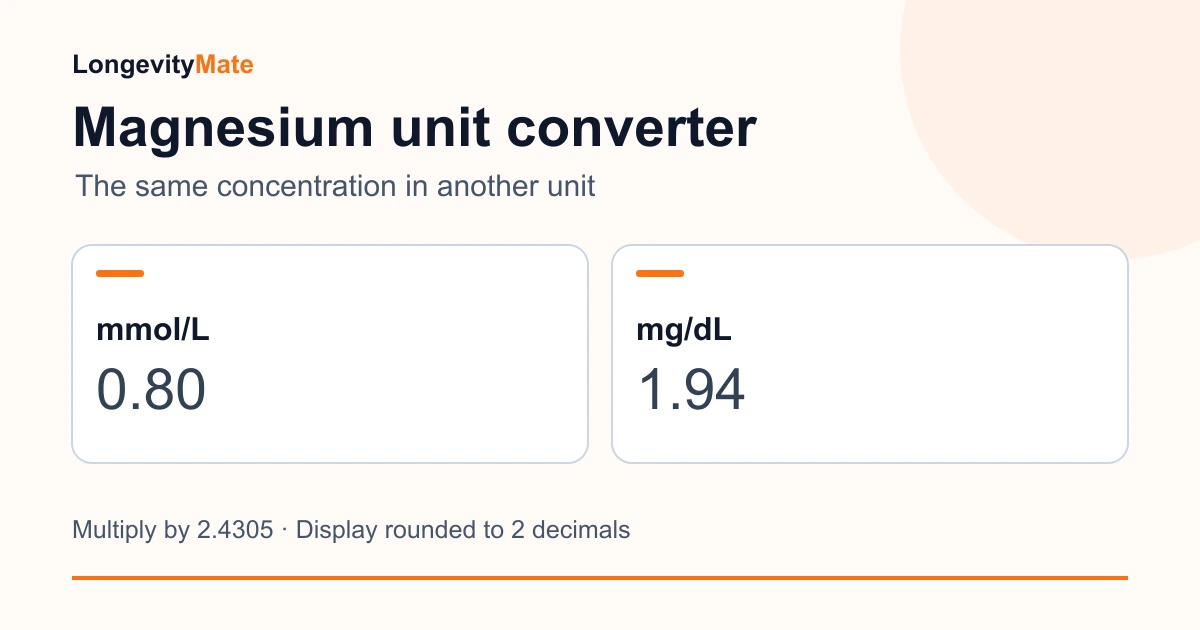
For magnesium, multiply mmol/L by 2.4305 to get mg/dL. Divide mg/dL by 2.4305 to get mmol/L. This uses a conventional magnesium molar mass of 24.305 g/mol and rounds the displayed answer once, to two decimal places. [1][2][4]
Choose the unit on your report
Why the factor is 2.4305
NIST’s handbook lists a magnesium atomic weight of 24.3050. Using the corresponding conventional molar mass of 24.305 g/mol, one millimole has a mass of 24.305 milligrams. One litre contains ten decilitres, so 24.305 mg/L equals 2.4305 mg/dL. [1][2]
NIST also gives a standard atomic-weight interval of 24.304 to 24.307 for magnesium. The selected 24.305 value is a conventional reference within that interval, not an exact physical constant or a claim that every sample has precisely the same atomic weight. [4]
Keep the specimen and measurement type
A magnesium blood test measures magnesium in a blood sample. Changing its concentration units does not measure magnesium elsewhere in the body. Keep the original specimen and laboratory description beside the answer. [3]
For example, a serum magnesium result remains a serum result after conversion. The calculator cannot turn it into a red blood cell measurement, a total daily urine amount or an ionised magnesium result. Those require information that a unit conversion does not supply.
Rounding without false precision
The reverse calculation divides by the same 2.4305 factor before rounding. It does not first shorten the reciprocal multiplier. Answers have two decimal places; halfway values round upward. A positive answer too small to display at this precision uses a less-than sign, while a true zero displays 0.00.
Keep the original unrounded number for records and further calculations. Converting a rounded answer back can lose digits. Extra digits in a conversion factor do not increase the accuracy of the laboratory measurement. [1][2][4]
Enter a number, not a unit or a limit
Use a decimal point, for example 0.80. Blank entries, negative values, commas, fractions, scientific notation and unit text are rejected. The upper input limit is a software boundary and has no medical meaning.
If the report says less than a value, do not enter that limit as an exact measurement. Keep the inequality and ask the issuing laboratory how it should be represented in the other unit.
This does not convert magnesium doses
Use the laboratory’s own context
Discuss the original report, its reference interval, symptoms and relevant medical history with the clinician who ordered the test. This calculator adds no range, colour classification or treatment recommendation. A converted number alone cannot establish a diagnosis. [3]
Your entered number stays out of the shared link
No account is needed. The Share action uses the clean calculator address without your entered magnesium value. Calculation values are not added to the page URL. Reset or reload clears the entry.
Formula and assumptions
- Version
- Magnesium amount and mass concentration conversion, magnesium-mmol-mgdl-24-305-v1
- Rounding
- Use 4861/2000 or its exact reciprocal 2000/4861; round once to two decimals, with halfway ties upward. Tiny positive answers use a less-than sign. Exact arithmetic does not make the reference mass or original measurement physically exact.
Who this is for — and when not to use it
Intended use
Neutral unit conversion for an existing magnesium concentration in mmol/L or mg/dL. Compare only the same original measurement after changing its units.
Not intended for
No reference ranges, low or high classifications, diagnosis, treatment decisions, supplement doses, magnesium-salt conversion, serum-to-red-blood-cell conversion or total-to-ionised calculation.
Exclusions
- Changing serum or plasma magnesium into a red blood cell or urine measurement
- Inferring ionised magnesium from total magnesium or the reverse
- Magnesium citrate, oxide or other salt masses, elemental supplement amounts and medicine doses
- Daily intake recommendations, deficiency diagnosis, urgent-care or treatment decisions
- Converting mmol/L into mmol per day, or changing the original laboratory method or measurement accuracy
Evidence sources
- 1. Magnesium: Atomic Data — National Institute of Standards and Technology. Accessed Sep 13, 2026.
- 2. Guide for the Use of the International System of Units: SI Prefixes — National Institute of Standards and Technology. Accessed Sep 13, 2026.
- 3. Magnesium Blood Test — MedlinePlus. Accessed Sep 13, 2026.
- 4. Atomic Weights and Isotopic Compositions for Magnesium — National Institute of Standards and Technology. Accessed Sep 13, 2026.