
What this result means
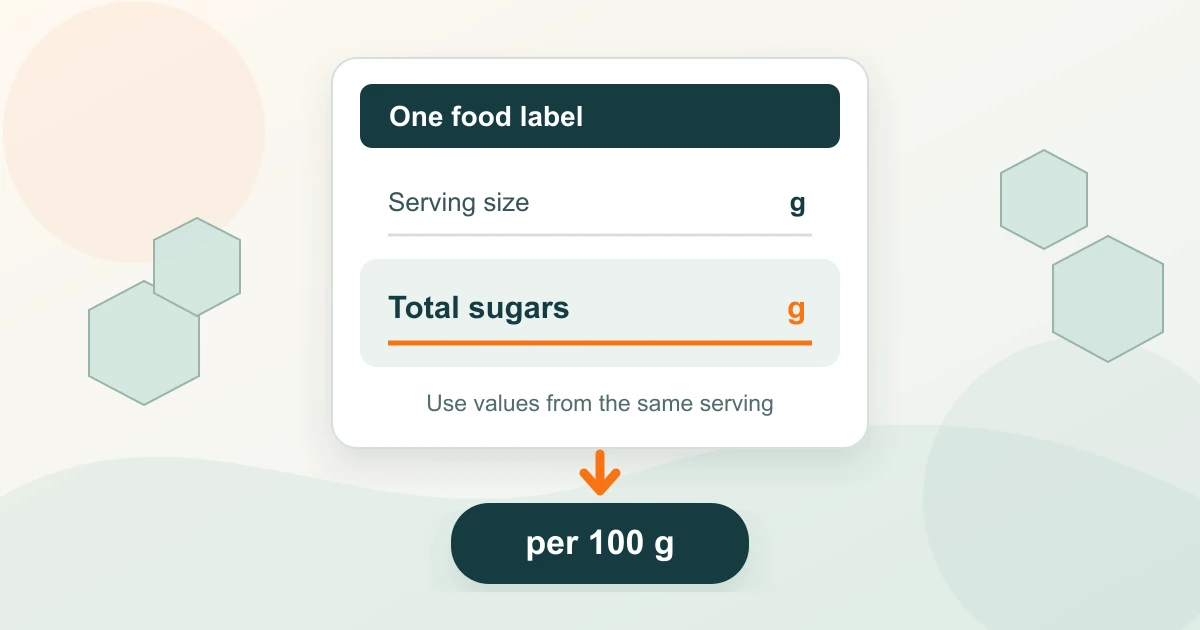
Divide grams of total sugars in one serving by the matching serving mass in grams, then multiply by 100. An invented label with 6 g total sugars in a 30 g serving gives 20.00 g per 100 g. Use the same food and preparation state for both entries; the result is label arithmetic, not a health verdict. [1][2]
Copy a matching pair from one food label
Find the Total Sugars amount in grams and the serving mass in grams for the same serving. A whole-container sugar value divided by one serving’s weight gives the wrong comparison. [1][2]
This tool uses food mass. A drink panel expressed per 100 mL is a volume basis; it cannot be treated as per 100 g without reliable density information. Compare products in the same prepared state. [1][3]
Serving size can change the apparent order
Invented Food A lists 6 g total sugars in a 30 g serving: 6 ÷ 30 × 100 = 20.00 g per 100 g. Invented Food B lists 8 g in a 50 g serving: 8 ÷ 50 × 100 = 16.00 g per 100 g. B has more sugar in its listed serving, but less per 100 g. Neither number alone describes your whole diet.
The per-100-g basis supports comparison of like foods; the amount you actually eat also matters. If a reliable per-100-g value is printed, use it directly. [1][3]
Total sugars and added sugars answer different questions
Total Sugars includes sugars naturally present in the food as well as sugars added during processing. Added Sugars is a separate U.S. label line and is included within Total Sugars, not added on top. Enter the Total Sugars value for this calculator. [2]
A food can have the same total-sugars value as another but a different added-sugars value. This calculation cannot reconstruct added sugars from a total; read the separate line when that distinction matters. [2]
Why a printed per-100-g value may differ
Panels round nutrient values, and serving mass may be rounded too. A manufacturer’s per-100-g column may therefore differ slightly from the result calculated from the two displayed per-serving numbers. Prefer the printed per-100-g column when it is available. [1][3]
Doubling both matching entries leaves the ratio unchanged: 6 g in 30 g and 12 g in 60 g both equal 20.00 g per 100 g. This check fails if the values come from different serving bases.
Check unusual results and keep the right context
The calculation uses exact decimal arithmetic and rounds once to two places. As a synthetic rounding boundary, 2.01 g in a 200 g serving gives 1.005 g per 100 g, displayed as 1.01. Two decimal places do not make a rounded label more precise.
Zero serving mass cannot produce a ratio. A result above 100 g total sugars per 100 g food is physically inconsistent and means the entries or units do not describe one matching serving. Recheck the panel before using any unusual output.
The calculation runs in your browser. Entries and results are not placed in the shared page address or analytics details. Reset clears your entries.
Formula and assumptions
- Formula
- Total sugars per 100 g (g) = total sugars per serving (g) ÷ food mass per serving (g) × 100 [1][2][3]
- Version
- Total sugars per 100 grams of food, total-sugars-per-100g-v1
- Rounding
- Calculate using exact decimal fractions from the entered values, then round a nonnegative result once to two decimal places; exact halfway values round up.
- Worked example
- Invented label: 6 g Total Sugars ÷ 30 g serving mass × 100 = 20.00 g total sugars per 100 g.
Who this is for — and when not to use it
Intended use
Neutral food-label arithmetic for comparing total sugars in like foods on a common 100 g mass basis.
Not intended for
No diabetes advice, personal sugar allowance, clinical diet plan, food safety judgement, product endorsement, added-sugars estimate, or comparison of mismatched mass and volume bases.
Exclusions
- Using added sugars as though they were total sugars
- Using millilitres as grams without reliable density information
- Mixing per-serving and per-container entries
- Comparing prepared and unprepared forms as though they were the same food
- Entering zero or missing serving mass
- Interpreting a result as a personal dietary target
Evidence sources
- 1. How to Understand and Use the Nutrition Facts Label — U.S. Food and Drug Administration. Accessed Sep 26, 2026.
- 2. Added Sugars on the Nutrition Facts Label — U.S. Food and Drug Administration. Accessed Sep 26, 2026.
- 3. Nutrition information panels — Food Standards Australia New Zealand. Accessed Sep 26, 2026.