
What this result means
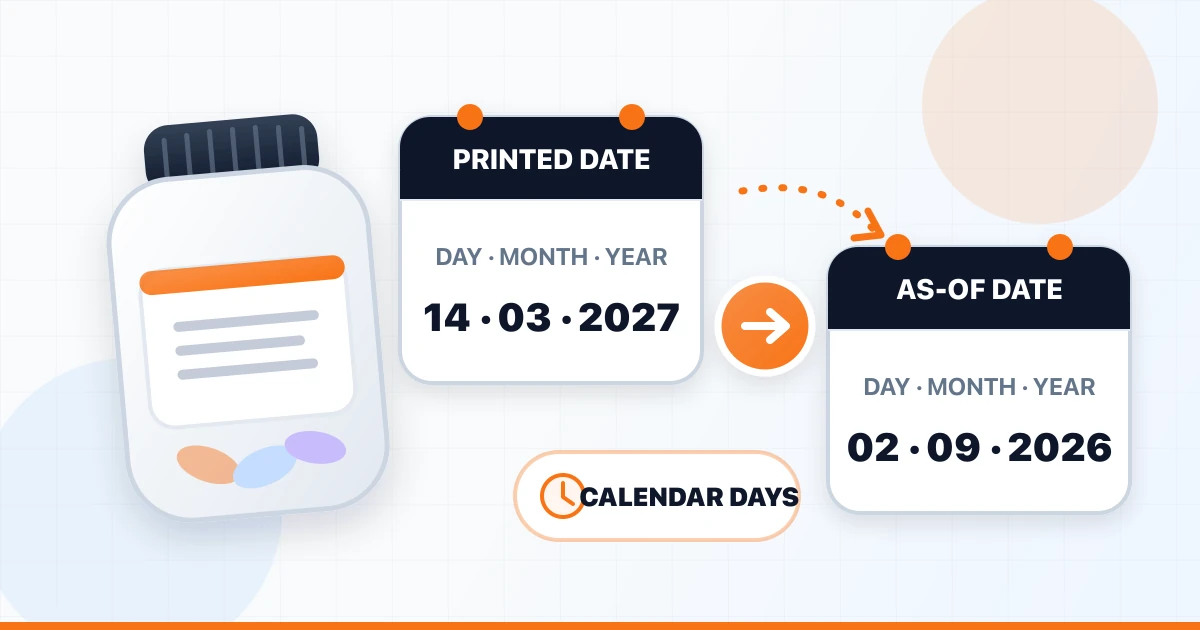
Enter the complete date printed on the label and an explicit as-of date. The calculator shows the exact day difference. It does not tell you whether a product is safe, potent or suitable to use. [1][2][3][4][5]
How the printed-date calculation works
The calculator converts each complete date to an exact Gregorian calendar-day number and subtracts the as-of date from the printed date. One day before is 1 day until, the same date is 0, and one day after is 1 day past.
Because the inputs are dates without clock times, timezone and daylight-saving changes cannot add or remove a day.
Why a complete printed date is required
A month and year do not identify one exact day. The calculator rejects month-only wording instead of guessing the first or last day of the month. [1][2][3][4]
Enter only the complete date shown on the label. Do not decode a batch number, infer a date from manufacturing information or substitute an opening date.
A day count is not a product-safety result
Date-mark requirements and meanings vary. A printed date can relate to different regulatory or manufacturer contexts, and this calculator does not decide which one applies. [1][2][3][4]
The result cannot show whether a product is safe, potent, stable, stored correctly or suitable to use. Follow the product label and obtain qualified advice for medicines or health decisions. [1][2][3][4]
Privacy and limitations
The calculation runs locally in your browser. Dates and results are not placed in the URL or sent as analytics details. Sharing sends only the public tool link.
The tool does not save products, scan labels, create reminders, decode date marks or maintain an inventory.
Formula and assumptions
- Formula
- Signed days = printed calendar date − as-of calendar date. Positive values are days until; zero is the same date; negative values are displayed by absolute magnitude as days past. [5]
- Version
- Signed proleptic Gregorian calendar-day difference, supplement-printed-date-days-v1
- Rounding
- Validate complete YYYY-MM-DD civil dates, convert each to an exact Gregorian epoch-day integer, and subtract. No clock time, timezone, daylight-saving offset or rounding is used.
- Worked example
- Example: if the complete printed date is 1 March 2027 and the as-of date is 26 February 2027, the result is 3 days until the printed date. This is only a date difference and does not judge the product.
Who this is for — and when not to use it
Intended use
Private date-only arithmetic for a complete calendar date printed on a supplement label and an explicit as-of date entered by the user.
Not intended for
This tool does not determine expiry status, safety, potency, stability, storage compliance, contamination, quality or whether to use, discard, replace, finish, consume or take a product.
Exclusions
- Month-only labels, batch codes, manufacture dates and inferred end-of-month dates
- Safety, potency, stability, shelf-life, storage, contamination and quality assessment
- Advice to use, discard, replace, finish, consume or take a product
- Interpreting best-before, use-by, expiry, EXP, BBE or other label wording
- Medicines, prescriptions, vaccines, peptides, injectables, compounded products and reconstitution
- Doses, adherence, reminders, inventory, ordering, tracking and health advice
Evidence sources
- 1. Dietary Supplement Labeling Guide: Chapter I — General Dietary Supplement Labeling — U.S. Food and Drug Administration. Accessed Aug 21, 2026.
- 2. Food supplements — UK Government. Accessed Aug 21, 2026.
- 3. Food labelling: giving food information to consumers — UK Government. Accessed Aug 21, 2026.
- 4. Use-by and best-before dates — Food Standards Australia New Zealand. Accessed Aug 21, 2026.
- 5. ISO 8601-1:2019 — Date and time representations for information interchange — International Organization for Standardization. Accessed Aug 21, 2026.