
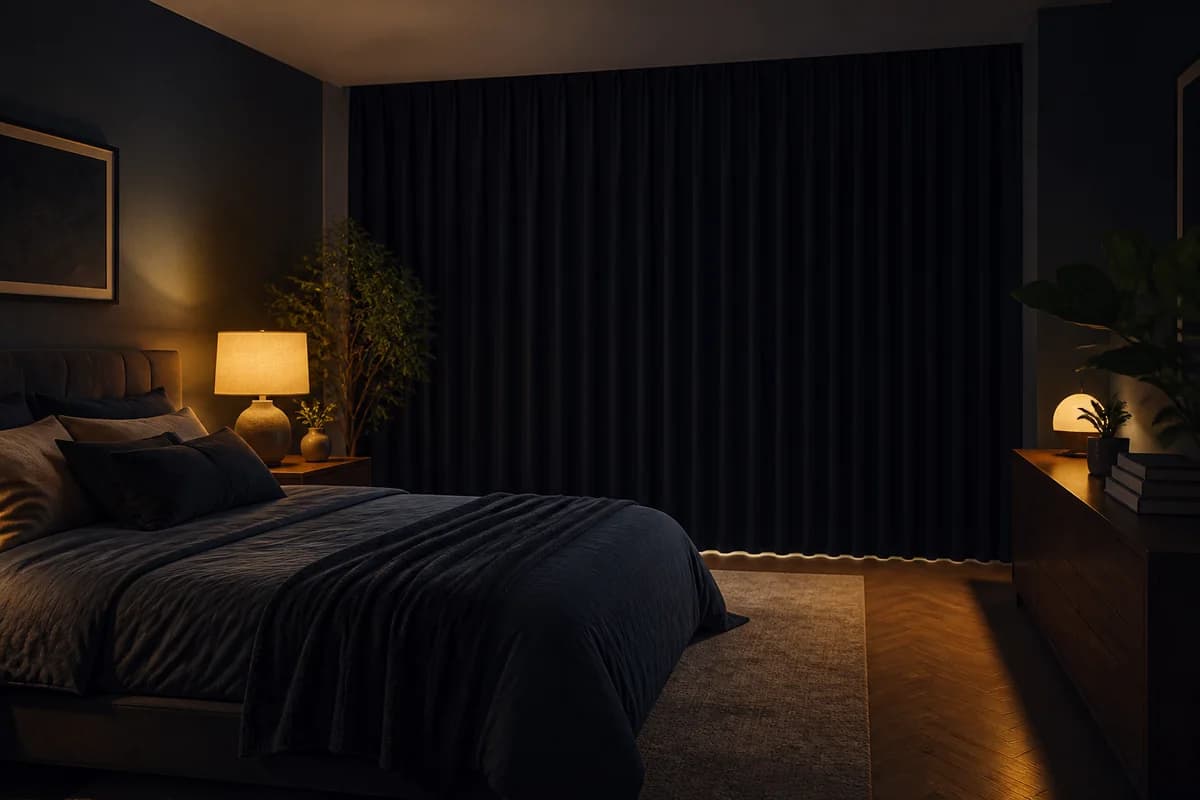
One-minute protocol
The simple evidence-based protocol
Make the bedroom dark enough that outdoor lights and electronics do not repeatedly reach the eyes. Start with the cheapest fix: cover standby LEDs, close gaps, move glowing devices and try a comfortable eye mask. If outside light remains substantial, install well-fitted blackout curtains or blinds with side channels. Keep exits clear and use a very dim warm or red nightlight for fall safety if needed. Get bright outdoor light soon after waking.See reference 1,See reference 2,See reference 3
The 10 rules to remember
- Target darkness, not a premium curtain label.See reference 1
- Measure the room after your eyes adapt for several minutes.See reference 2
- Cover or remove unnecessary LEDs first.See reference 3
- Block window gaps at the top, sides and bottom.See reference 4
- Use an eye mask when renovation is impractical.See reference 5
- Keep cords, exits and walking paths safe.See reference 6
- Use the dimmest practical nightlight for bathroom trips.See reference 7
- Open curtains or seek outdoor light after waking.See reference 8
- Judge success by sleep and daytime function.See reference 9
- Blackout curtains can reduce light exposure; direct evidence that the product itself cures insomnia or extends life is not established.See reference 10,See reference 9
First principles: what this tool can actually change
Light reaching the retina at night can shift circadian timing, suppress melatonin and increase alerting signals depending on intensity, spectrum, timing and prior light exposure.See reference 1,See reference 2
Observational studies associate more light at night with sleep problems, but people, neighborhoods and health behaviors differ in ways that can confound results.See reference 2,See reference 3
Curtains are one engineering control; an eye mask, removing LEDs and changing room layout can reach the same biological target.See reference 3,See reference 4
A practical protocol
- Stage
- Audit
- What to do
- Check outdoor light, LEDs and door gaps
- Why it matters
- Finds the dominant sourceSee reference 2
- Stage
- Block
- What to do
- Use covers, blinds, curtains or eye mask
- Why it matters
- Reduces retinal light exposureSee reference 3
- Stage
- Protect
- What to do
- Keep exits and cords safe
- Why it matters
- Prevents falls and entanglementSee reference 4
- Stage
- Anchor morning
- What to do
- Open the room and get outdoor light
- Why it matters
- Supports circadian contrastSee reference 5
Timing and frequency
- When
- 30–60 minutes before bed
- Action
- Dim unnecessary room lightingSee reference 3
- When
- During sleep
- Action
- Maintain darkness consistent with safetySee reference 4
- When
- Night waking
- Action
- Use the dimmest practical warm lightSee reference 5
- When
- After waking
- Action
- Seek bright light and normal daytime activitySee reference 6
What to measure
- Signal
- Illuminance
- How
- Lux meter at pillow level
- Interpretation
- Approximate light reaching the sleep areaSee reference 4
- Signal
- Source
- How
- Window, door, LED or phone
- Interpretation
- Determines the cheapest fixSee reference 5
- Signal
- Sleep continuity
- How
- Awakenings and time awake
- Interpretation
- Whether darkness helpsSee reference 6
- Signal
- Morning function
- How
- Alertness and wake time
- Interpretation
- Checks for circadian trade-offsSee reference 7
What the evidence supports
Experimental and observational evidence supports minimizing light during the intended sleep period.See reference 2,See reference 4
Direct trials of blackout curtains in ordinary homes are limited, so the product-specific evidence is weaker than the physiology of light exposure.See reference 3,See reference 5
A dark night works best with bright days and consistent sleep timing rather than as a standalone insomnia treatment.See reference 4,See reference 6
Evidence strength by claim
- Claim
- Blackout curtains lower bedroom illuminance
- Confidence
- Moderate to strong
- Important boundary
- Fit and edge leakage determine performanceSee reference 1,See reference 2
- Claim
- A darker room may improve sleep continuity
- Confidence
- Variable
- Important boundary
- Direct curtain trials are limited and insomnia has many causesSee reference 3,See reference 4
- Claim
- Blackout curtains prevent metabolic disease, cancer or dementia
- Confidence
- Limited or indirect
- Important boundary
- Risk-factor change is not proof of disease preventionSee reference 5,See reference 6
- Claim
- It extends human lifespan
- Confidence
- Not established
- Important boundary
- Association is not proof of causationSee reference 7,See reference 8,See reference 9,See reference 10
Limitations and common overclaims
Phone lux sensors are not laboratory instruments and can miss very low light or spectral differences.See reference 5,See reference 7
Complete darkness can increase fall risk for people who walk at night.See reference 6,See reference 8
Room-darkening curtains may trap heat or delay morning light, which can counter the intended sleep benefit.See reference 7,See reference 9
How to make it stick
Choose the smallest version you can repeat under normal conditions. Consistency creates a useful signal; a heroic one-off session does not.See reference 1,See reference 2
Change one variable at a time and write down the protocol. Otherwise an apparent improvement may reflect different timing, equipment or conditions.See reference 3,See reference 4
Review the result after a pre-defined period. Continue only when the benefit is meaningful, the burden is acceptable and no safety signal has appeared.See reference 5,See reference 6
Troubleshooting
- Problem
- Room is still bright
- Likely issue
- Light leaks around edges
- Better next step
- Add side channels or combine layersSee reference 5
- Problem
- Bedroom overheats
- Likely issue
- Curtains reduce ventilation or retain heat
- Better next step
- Manage temperature separatelySee reference 6
- Problem
- Hard to wake
- Likely issue
- Morning light stays blocked
- Better next step
- Automate opening or seek outdoor light promptlySee reference 7
- Problem
- Night trips feel unsafe
- Likely issue
- No visual path
- Better next step
- Add a very dim low-level warm lightSee reference 8
Safety and when to stop
Keep curtain cords inaccessible to children and pets, keep fabric away from heaters and candles, and preserve a clear emergency exit. Total darkness can increase fall risk; use the dimmest safe low-level nightlight if you get up frequently. People with persistent insomnia should use evidence-based assessment such as CBT-I rather than relying only on bedroom products.See reference 1,See reference 5,See reference 9
Who is most likely to benefit
Shift workers, people near streetlights and early sunrise, and light-sensitive sleepers are the clearest candidates.See reference 2,See reference 6
People with insomnia should treat darkness as one environmental input alongside CBT-I and regular timing.See reference 3,See reference 7
Older adults or anyone at fall risk need a safety-adjusted version rather than absolute darkness.See reference 4,See reference 8
Track five things
- Main light source and approximate lux.See reference 1
- Bedtime and wake time.See reference 2
- Awakenings and time awake.See reference 3
- Morning alertness and outdoor light.See reference 4
- Temperature, safety and practical burden.See reference 5
Frequently asked questions
Do blackout curtains improve sleep?
They reliably darken a room; direct sleep-outcome trials are limited, but nighttime darkness is biologically plausible and supported by broader light evidence.See reference 1
How dark should a bedroom be?
As dark as practical without creating a safety problem; no universal home lux cutoff guarantees better sleep.See reference 2
Is an eye mask as good?
A well-fitting comfortable mask can target retinal light and is a useful low-cost alternative.See reference 3
Should I cover every LED?
Cover unnecessary lights that reach the eyes, but never cover safety indicators that must remain visible.See reference 4
Can darkness make waking harder?
Yes, if morning light remains blocked; open curtains or get outdoor light after waking.See reference 5
Will blackout curtains cure insomnia?
No. Persistent insomnia is better treated with CBT-I and assessment of contributing causes.See reference 6
Connect the protocol to your wider health picture
LongevityMate helps organize measurements, habits, symptoms and trends so one tool stays in context instead of becoming the whole plan.
See how LongevityMate worksReferences
- 1. Association between light at night and sleep problems: systematic review
Science of the Total EnvironmentMeta-analysis
- 2. Effects of room light before bedtime on melatonin and sleep
Journal of Clinical Endocrinology & MetabolismRandomized trial
- 3. Light exposure during sleep impairs cardiometabolic function
PNASRandomized trial
- 4. Nighttime bedroom light exposure and incident diabetes
SleepObservational study
- 5. Light and the human circadian clock
Sleep Medicine ReviewsEvidence review
- 6. Evening use of light-emitting eReaders affects sleep and circadian timing
PNASRandomized trial
- 7. Clinical Practice Guideline for the Treatment of Chronic Insomnia
American Academy of Sleep MedicineGuideline
- 8. Insomnia
National Heart, Lung, and Blood InstituteOfficial guidance
- 9. Preventing falls in older adults
Centers for Disease Control and PreventionOfficial guidance
- 10. Morning light treatment for sleep and circadian rhythm
Sleep Medicine ReviewsSystematic review
Editorial transparency
- Published by
- LongevityMate Editorial Team
- Published
- Updated
Medical disclaimer
This guide provides general health education. It does not diagnose a condition, prescribe treatment, replace individualized professional care, or guarantee a health or longevity outcome.