
One-minute protocol
The simple evidence-based protocol
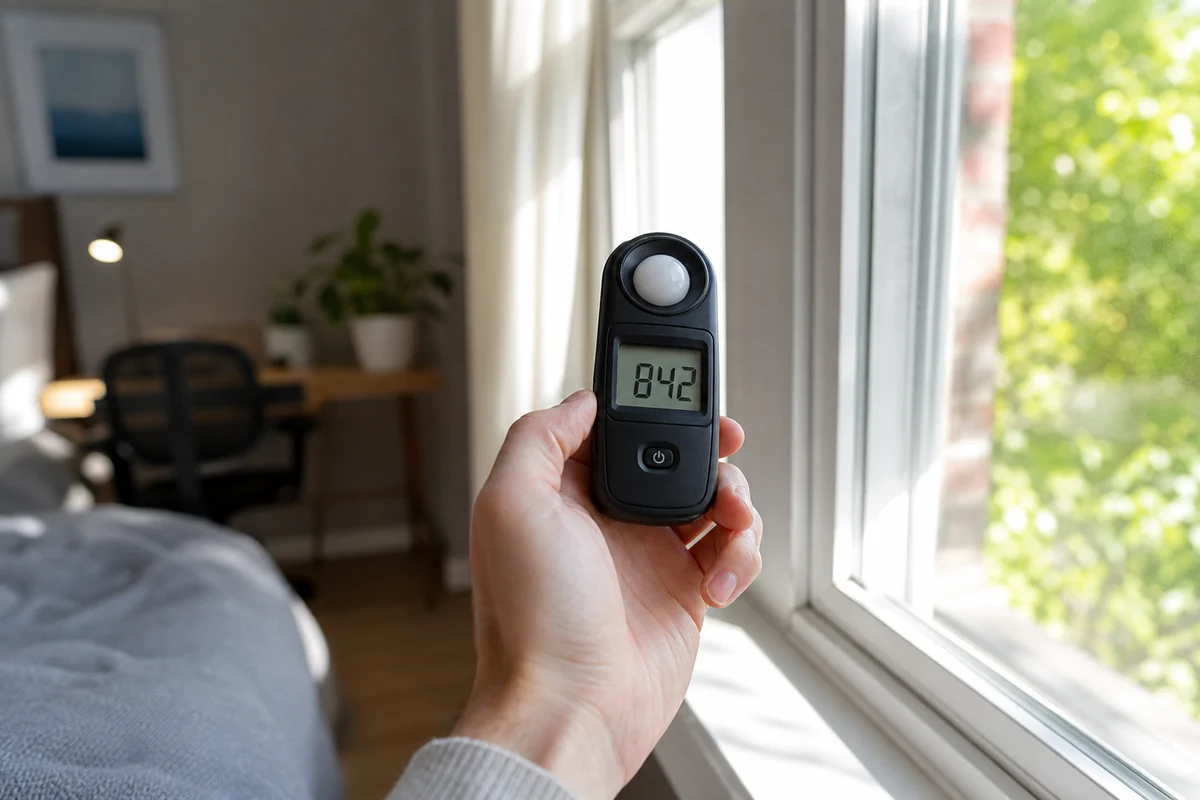
Measure where your eyes are, facing the direction you normally look. Compare outdoor morning light, your main daytime room, evening seating and the pillow area. Use the pattern—not one magic number—to create brighter days and dimmer evenings. Repeat in different seasons and track sleep timing for two to four weeks.See reference 1,See reference 2,See reference 7
The rules to remember
- Choose a calibrated meter when decisions matterSee reference 1,See reference 2
- Measure at eye position and viewing angleSee reference 2,See reference 3
- Record outdoor light after wakingSee reference 3,See reference 4
- Measure the main daytime workspaceSee reference 4,See reference 5
- Measure the evening room at eye levelSee reference 5,See reference 6
- Check the pillow area after lights are offSee reference 6,See reference 7
- Repeat across weather and seasonsSee reference 7,See reference 8
- Change one light source at a timeSee reference 8,See reference 9
- Use sleep timing rather than lux alone as the outcomeSee reference 9,See reference 10
- Check the official guidance and evidence boundaries before escalating the protocol.See reference 10,See reference 1
First principles: what this can actually change
Illuminance quantifies visible light arriving at a surface using photopic weighting.See reference 1,See reference 2
Circadian responses depend on spectrum, timing, duration, prior exposure and the light reaching the eye.See reference 2,See reference 3
Repeated measurements expose large differences between outdoor light and ordinary indoor environments.See reference 3,See reference 4
A practical protocol
- Stage
- Define
- What to do
- Choose a calibrated meter when decisions matter
- Why it matters
- Reduce avoidable errorSee reference 1,See reference 2
- Stage
- Screen
- What to do
- Measure at eye position and viewing angle
- Why it matters
- Reduce avoidable errorSee reference 2,See reference 3
- Stage
- Apply
- What to do
- Record outdoor light after waking
- Why it matters
- Keep the dose repeatableSee reference 3,See reference 4
- Stage
- Apply
- What to do
- Measure the main daytime workspace
- Why it matters
- Keep the dose repeatableSee reference 4,See reference 5
- Stage
- Review
- What to do
- Measure the evening room at eye level
- Why it matters
- Keep the dose repeatableSee reference 5,See reference 6
- Stage
- Review
- What to do
- Check the pillow area after lights are off
- Why it matters
- Keep only what helpsSee reference 6,See reference 7
Timing and frequency
- Decision
- Starting frequency
- Practical answer
- Audit several representative days at baseline, after a lighting change and when seasons shift.See reference 2,See reference 3
- Decision
- First review
- Practical answer
- 2–4 weeksSee reference 3,See reference 4
- Decision
- Best timing
- Practical answer
- Measure morning, midday, evening and the actual sleep period rather than taking one isolated reading.See reference 4,See reference 5
- Decision
- Stop rule
- Practical answer
- Stop measuring if it drives anxiety or unsafe lighting; simplify to bright days, dim evenings and dark sleep.See reference 5,See reference 6,See reference 7
What to measure
- Signal
- Daily light-dark contrast
- How to use it
- Record a baseline and compare at the review point
- Caveat
- Use the same method and conditionsSee reference 3,See reference 4
- Signal
- Sleep and wake timing
- How to use it
- Track a weekly trend
- Caveat
- Expect normal variationSee reference 4,See reference 5
- Signal
- Adherence
- How to use it
- Record the exact dose and timing
- Caveat
- No exposure means no fair testSee reference 5,See reference 6
- Signal
- Interpretation
- How to use it
- Ask whether the result changes a real decision
- Caveat
- Consumer lux meters and phone sensors may be inaccurate at low levels and do not fully represent melanopic light.See reference 6,See reference 7
What the evidence actually shows
Consensus recommendations and human studies support bright daytime exposure, dimmer evenings and darkness during sleep.See reference 1,See reference 2,See reference 3
Lux is a visual metric, not a direct dose of circadian stimulation, and no single reading diagnoses a circadian disorder.See reference 4,See reference 5,See reference 6
Most studies measure short-term symptoms, physiology or biomarkers rather than clinical events or lifespan. The evidence supports a bounded experiment, not a longevity guarantee.See reference 6,See reference 7,See reference 8
Evidence strength by claim
- Claim
- Daily light-dark contrast
- Evidence
- Strong measurement rationale; limited outcome trials of consumer meters
- Verdict
- Consensus recommendations and human studies support bright daytime exposure, dimmer evenings and darkness during sleep.See reference 1,See reference 2
- Claim
- Sleep and wake timing
- Evidence
- Mixed or context-dependent
- Verdict
- Lux is a visual metric, not a direct dose of circadian stimulation, and no single reading diagnoses a circadian disorder.See reference 3,See reference 4
- Claim
- Safety
- Evidence
- Depends on screening and dose
- Verdict
- Do not stare at the sun or very bright sources to obtain a reading. Preserve safe visibility and seek clinical advice before intense light therapy with bipolar disorder, eye disease or photosensitizing medication.See reference 5,See reference 7
- Claim
- Longer life
- Evidence
- Not directly tested
- Verdict
- Do not turn an intermediate outcome into a lifespan promise.See reference 6,See reference 8
Limits and common overclaims
Phone sensors differ by device and camera geometry.See reference 2,See reference 3
A lux value without direction and timing loses important context.See reference 3,See reference 4
Measurement can become compulsive without improving the actual light pattern.See reference 4,See reference 5
A four-step implementation plan
- Define the exact reason you are trying a lux meter.See reference 1
- Record a baseline for daily light-dark contrast.See reference 2
- Use the same protocol until the 2–4 weeks review point.See reference 3
- Continue only if benefit outweighs cost, time, discomfort and risk.See reference 4
Troubleshooting
- Problem
- No benefit
- What to do
- Check adherence, dose and whether daily light-dark contrast is the right outcomeSee reference 2
- Problem
- Discomfort
- What to do
- Reduce the dose and stop for warning symptomsSee reference 3
- Problem
- Confusing data
- What to do
- Use the same measurement conditions and a longer trendSee reference 4
- Problem
- Too much burden
- What to do
- Choose the simpler intervention that solves the same problemSee reference 5
Safety and who should be cautious
Do not stare at the sun or very bright sources to obtain a reading. Preserve safe visibility and seek clinical advice before intense light therapy with bipolar disorder, eye disease or photosensitizing medication. Stop measuring if it drives anxiety or unsafe lighting; simplify to bright days, dim evenings and dark sleep.See reference 5,See reference 6,See reference 7
Who is most likely to benefit
It is useful for shift workers, people in dark buildings, delayed sleepers and anyone troubleshooting a weak light-dark pattern.See reference 2,See reference 3
It is less useful when adopted only because a score, trend or influencer made a lux meter seem mandatory.See reference 4,See reference 5
People with symptoms, diagnosed disease, pregnancy, recent surgery or complex medicines should adapt the protocol with an appropriate clinician.See reference 6,See reference 7
Track five things
- Daily light-dark contrastSee reference 1
- Sleep and wake timingSee reference 2
- The exact dose and timingSee reference 3
- Symptoms and adverse effectsSee reference 4
- Whether the result changes a real decisionSee reference 5
Frequently asked questions
What is Lux meters for circadian light?
A lux meter measures illuminance as weighted for human visual sensitivity. It is useful for revealing that indoor days are often dim and evenings surprisingly bright, but lux is not a complete measure of circadian-effective light and should guide behavior rather than become a perfection score.See reference 1,See reference 2
How often should I use a lux meter?
Audit several representative days at baseline, after a lighting change and when seasons shift.See reference 2,See reference 3
How long before a lux meter works?
Use 2–4 weeks as the first meaningful review point. Immediate sensations or device scores are not durable health outcomes.See reference 3,See reference 4
What should I track?
Track daily light-dark contrast, sleep and wake timing, adherence and adverse effects under similar conditions.See reference 4,See reference 5
Is a lux meter safe?
Do not stare at the sun or very bright sources to obtain a reading. Preserve safe visibility and seek clinical advice before intense light therapy with bipolar disorder, eye disease or photosensitizing medication.See reference 5,See reference 6
When should I stop?
Stop measuring if it drives anxiety or unsafe lighting; simplify to bright days, dim evenings and dark sleep.See reference 6,See reference 7
Does a lux meter increase lifespan?
No human trial proves that this tool extends an individual's lifespan. Its value depends on whether it improves a relevant symptom, behavior, function or established risk factor.See reference 7,See reference 8
Can it replace sleep, exercise, nutrition or medical care?
No. It is an optional layer around the fundamentals and should not delay evaluation of persistent or serious symptoms.See reference 8,See reference 9
Connect the protocol to your wider health picture
LongevityMate helps organize habits, symptoms, measurements and trends so one intervention stays in context instead of becoming the whole plan.
See how LongevityMate worksReferences
- 1. Recommendations for daytime, evening, and nighttime indoor light exposure to best support physiology, sleep, and wakefulness in healthy adults.
PLoS biologyEvidence review
- 2. Systematic review of light exposure impact on human circadian rhythm.
Chronobiology internationalSystematic review
- 3. Exposure to room light before bedtime suppresses melatonin onset and shortens melatonin duration in humans.
The Journal of clinical endocrinology and metabolismEvidence review
- 4. Light exposure behaviors predict mood, memory and sleep quality.
Scientific reportsEvidence review
- 5. Assessment of Circadian Rhythms.
Neurologic clinicsEvidence review
- 6. Sleep Hygiene and Light Exposure Can Improve Performance Following Long-Haul Air Travel.
International journal of sports physiology and performanceRandomized trial
- 7. Circadian rhythm disorders
National Heart, Lung, and Blood InstituteOfficial guidance
- 8. Light therapy
Mayo ClinicOfficial guidance
- 9. Healthy sleep habits
National Heart, Lung, and Blood InstituteOfficial guidance
- 10. Radiation: ultraviolet radiation
World Health OrganizationOfficial guidance
Editorial transparency
- Published by
- LongevityMate Editorial Team
- Published
- Updated
Medical disclaimer
This guide provides general health education. It does not diagnose a condition, prescribe treatment, replace individualized medical care, or guarantee a health or longevity outcome.