
One-minute protocol
The simple evidence-based protocol
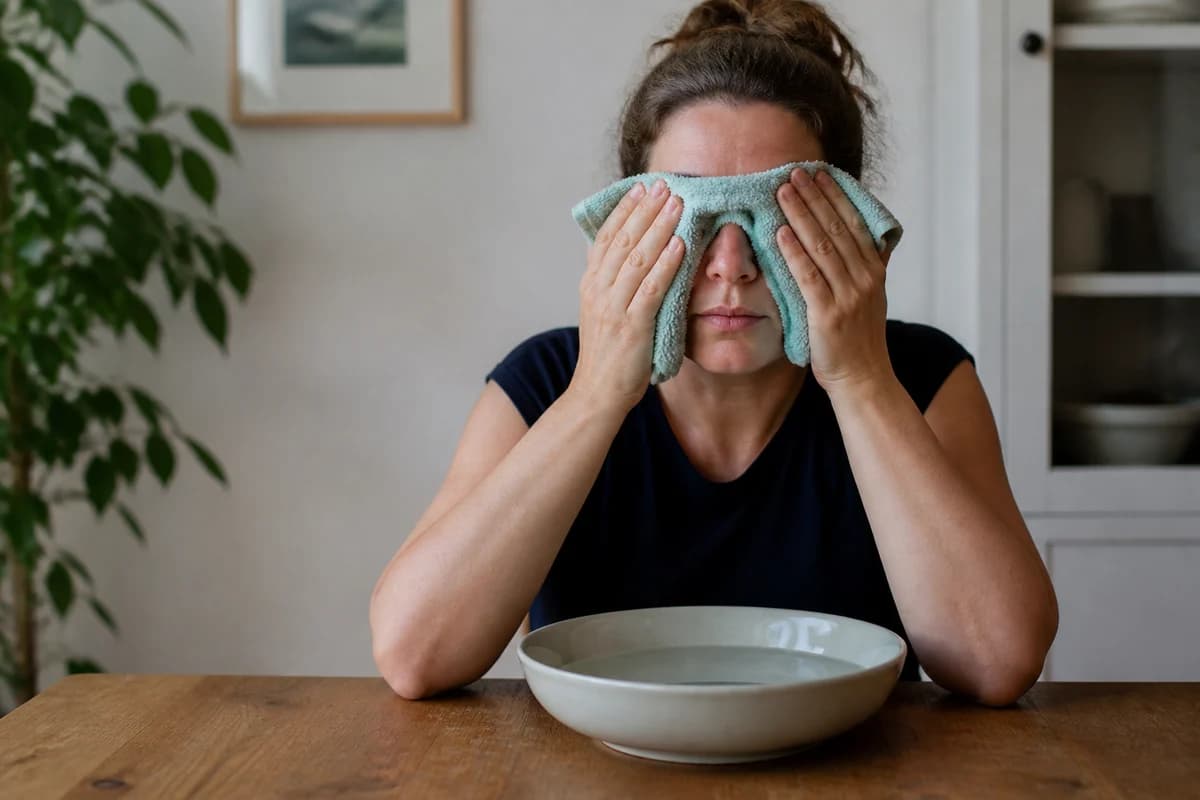
Sit or lie somewhere safe. Use a cool wet towel on the cheeks and forehead for 10–20 seconds while breathing normally; this is safer than submerging the face or holding the breath. Repeat only if comfortable. Stop for dizziness, chest symptoms, severe headache or panic, and avoid self-experimentation with heart rhythm disease or fainting history.See reference 1,See reference 2,See reference 7
The rules to remember
- Choose a seated or lying positionSee reference 1,See reference 2
- Prefer a cool towel before immersionSee reference 2,See reference 3
- Keep the airway unobstructedSee reference 3,See reference 4
- Breathe normally on the first trialsSee reference 4,See reference 5
- Apply for 10–20 secondsSee reference 5,See reference 6
- Warm gradually between attemptsSee reference 6,See reference 7
- Limit to one to three gentle roundsSee reference 7,See reference 8
- Track symptoms rather than lowest heart rateSee reference 8,See reference 9
- Use clinical care for persistent anxietySee reference 9,See reference 10
- Check the official guidance and evidence boundaries before escalating the protocol.See reference 10,See reference 1
First principles: what this can actually change
Facial cold receptors and breath holding can evoke coordinated autonomic cardiovascular changes.See reference 1,See reference 2
The response often includes bradycardia and peripheral vasoconstriction, with substantial person-to-person variation.See reference 2,See reference 3
A slower pulse is not the same as resolving the cause of anxiety and may be undesirable with conduction or rhythm problems.See reference 3,See reference 4
A practical protocol
- Stage
- Define
- What to do
- Choose a seated or lying position
- Why it matters
- Reduce avoidable errorSee reference 1,See reference 2
- Stage
- Screen
- What to do
- Prefer a cool towel before immersion
- Why it matters
- Reduce avoidable errorSee reference 2,See reference 3
- Stage
- Apply
- What to do
- Keep the airway unobstructed
- Why it matters
- Keep the dose repeatableSee reference 3,See reference 4
- Stage
- Apply
- What to do
- Breathe normally on the first trials
- Why it matters
- Keep the dose repeatableSee reference 4,See reference 5
- Stage
- Review
- What to do
- Apply for 10–20 seconds
- Why it matters
- Keep the dose repeatableSee reference 5,See reference 6
- Stage
- Review
- What to do
- Warm gradually between attempts
- Why it matters
- Keep only what helpsSee reference 6,See reference 7
Timing and frequency
- Decision
- Starting frequency
- Practical answer
- Use occasionally as an acute calming experiment, not as repeated heart-rate training.See reference 2,See reference 3
- Decision
- First review
- Practical answer
- 3–5 carefully observed usesSee reference 3,See reference 4
- Decision
- Best timing
- Practical answer
- Only while seated or lying safely, never in a bath, pool, while driving or during breath-hold competition.See reference 4,See reference 5
- Decision
- Stop rule
- Practical answer
- Stop immediately for chest pain, faintness, palpitations, severe headache, confusion, numbness or escalating panic.See reference 5,See reference 6,See reference 7
What to measure
- Signal
- Subjective acute stress
- How to use it
- Record a baseline and compare at the review point
- Caveat
- Use the same method and conditionsSee reference 3,See reference 4
- Signal
- Symptoms and heart-rate response
- How to use it
- Track a weekly trend
- Caveat
- Expect normal variationSee reference 4,See reference 5
- Signal
- Adherence
- How to use it
- Record the exact dose and timing
- Caveat
- No exposure means no fair testSee reference 5,See reference 6
- Signal
- Interpretation
- How to use it
- Ask whether the result changes a real decision
- Caveat
- Wearables can lag during rapid autonomic changes and do not screen for arrhythmias.See reference 6,See reference 7
What the evidence actually shows
A systematic review supports increased cardiac vagal activity during the human diving response.See reference 1,See reference 2,See reference 3
Direct randomized evidence for cold-face immersion as an anxiety treatment is sparse, and heart-rate slowing is a physiological proxy rather than a mental-health outcome.See reference 4,See reference 5,See reference 6
Most studies measure short-term symptoms, physiology or biomarkers rather than clinical events or lifespan. The evidence supports a bounded experiment, not a longevity guarantee.See reference 6,See reference 7,See reference 8
Evidence strength by claim
- Claim
- Subjective acute stress
- Evidence
- Moderate for autonomic physiology; limited for anxiety relief
- Verdict
- A systematic review supports increased cardiac vagal activity during the human diving response.See reference 1,See reference 2
- Claim
- Symptoms and heart-rate response
- Evidence
- Mixed or context-dependent
- Verdict
- Direct randomized evidence for cold-face immersion as an anxiety treatment is sparse, and heart-rate slowing is a physiological proxy rather than a mental-health outcome.See reference 3,See reference 4
- Claim
- Safety
- Evidence
- Depends on screening and dose
- Verdict
- Cold-face stimulation can slow heart rate and provoke dizziness or rhythm symptoms. Avoid without clinical guidance with arrhythmia, bradycardia, syncope, significant heart disease, cold urticaria, Raynaud symptoms or neurologic warning signs.See reference 5,See reference 7
- Claim
- Longer life
- Evidence
- Not directly tested
- Verdict
- Do not turn an intermediate outcome into a lifespan promise.See reference 6,See reference 8
Limits and common overclaims
Protocols combine cold intensity, facial area and breath holding differently.See reference 2,See reference 3
Small physiology studies may not represent cardiac patients.See reference 3,See reference 4
Placebo, distraction and expectation can contribute to subjective calming.See reference 4,See reference 5
A four-step implementation plan
- Define the exact reason you are trying cold-face immersion.See reference 1
- Record a baseline for subjective acute stress.See reference 2
- Use the same protocol until the 3–5 carefully observed uses review point.See reference 3
- Continue only if benefit outweighs cost, time, discomfort and risk.See reference 4
Troubleshooting
- Problem
- No benefit
- What to do
- Check adherence, dose and whether subjective acute stress is the right outcomeSee reference 2
- Problem
- Discomfort
- What to do
- Reduce the dose and stop for warning symptomsSee reference 3
- Problem
- Confusing data
- What to do
- Use the same measurement conditions and a longer trendSee reference 4
- Problem
- Too much burden
- What to do
- Choose the simpler intervention that solves the same problemSee reference 5
Safety and who should be cautious
Cold-face stimulation can slow heart rate and provoke dizziness or rhythm symptoms. Avoid without clinical guidance with arrhythmia, bradycardia, syncope, significant heart disease, cold urticaria, Raynaud symptoms or neurologic warning signs. Stop immediately for chest pain, faintness, palpitations, severe headache, confusion, numbness or escalating panic.See reference 5,See reference 6,See reference 7
Who is most likely to benefit
Healthy adults seeking a brief low-cost sensory reset may try the cool-towel version after slower breathing is understood.See reference 2,See reference 3
It is less useful when adopted only because a score, trend or influencer made cold-face immersion seem mandatory.See reference 4,See reference 5
People with symptoms, diagnosed disease, pregnancy, recent surgery or complex medicines should adapt the protocol with an appropriate clinician.See reference 6,See reference 7
Track five things
- Subjective acute stressSee reference 1
- Symptoms and heart-rate responseSee reference 2
- The exact dose and timingSee reference 3
- Symptoms and adverse effectsSee reference 4
- Whether the result changes a real decisionSee reference 5
Frequently asked questions
What is Cold-face immersion?
Cooling the forehead and face while briefly pausing breathing can trigger elements of the mammalian diving response, including increased cardiac vagal activity and a slower heart rate. That physiological response is real, but evidence for treating anxiety is indirect and the technique can be unsafe for people prone to arrhythmia or fainting.See reference 1,See reference 2
How often should I use cold-face immersion?
Use occasionally as an acute calming experiment, not as repeated heart-rate training.See reference 2,See reference 3
How long before cold-face immersion works?
Use 3–5 carefully observed uses as the first meaningful review point. Immediate sensations or device scores are not durable health outcomes.See reference 3,See reference 4
What should I track?
Track subjective acute stress, symptoms and heart-rate response, adherence and adverse effects under similar conditions.See reference 4,See reference 5
Is cold-face immersion safe?
Cold-face stimulation can slow heart rate and provoke dizziness or rhythm symptoms. Avoid without clinical guidance with arrhythmia, bradycardia, syncope, significant heart disease, cold urticaria, Raynaud symptoms or neurologic warning signs.See reference 5,See reference 6
When should I stop?
Stop immediately for chest pain, faintness, palpitations, severe headache, confusion, numbness or escalating panic.See reference 6,See reference 7
Does cold-face immersion increase lifespan?
No human trial proves that this tool extends an individual's lifespan. Its value depends on whether it improves a relevant symptom, behavior, function or established risk factor.See reference 7,See reference 8
Can it replace sleep, exercise, nutrition or medical care?
No. It is an optional layer around the fundamentals and should not delay evaluation of persistent or serious symptoms.See reference 8,See reference 9
Connect the protocol to your wider health picture
LongevityMate helps organize habits, symptoms, measurements and trends so one intervention stays in context instead of becoming the whole plan.
See how LongevityMate worksReferences
- 1. The diving response and cardiac vagal activity: A systematic review and meta-analysis.
PsychophysiologyMeta-analysis
- 2. Trigeminal Cardiac Reflex and Cerebral Blood Flow Regulation.
Frontiers in neuroscienceEvidence review
- 3. Applied physiology of diving.
Sports medicine (Auckland, N.Z.)Evidence review
- 4. Drowning and the diving reflex in man.
The Medical journal of AustraliaEvidence review
- 5. Diving reflex after physical training.
Journal of applied physiologyEvidence review
- 6. Physiology Of Drowning: A Review.
Physiology (Bethesda, Md.)Evidence review
- 7. Cold-water shock
Royal National Lifeboat InstitutionOfficial guidance
- 8. Arrhythmia
National Heart, Lung, and Blood InstituteOfficial guidance
- 9. Anxiety disorders
National Institute of Mental HealthOfficial guidance
- 10. Fainting
National Health ServiceOfficial guidance
Editorial transparency
- Published by
- LongevityMate Editorial Team
- Published
- Updated
Medical disclaimer
This guide provides general health education. It does not diagnose a condition, prescribe treatment, replace individualized medical care, or guarantee a health or longevity outcome.