
One-minute protocol
The simple evidence-based protocol
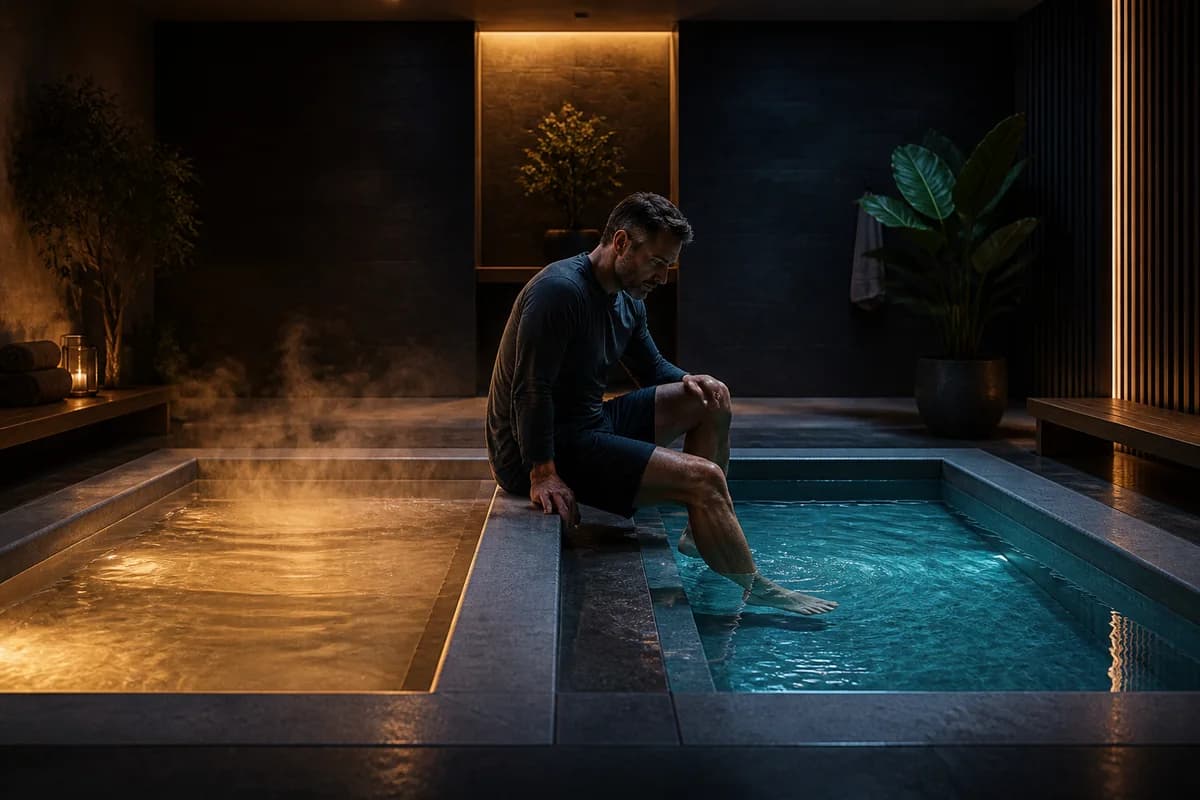
If you are healthy and already tolerate both temperatures, use comfortably warm water for 2–3 minutes and cool—not painfully icy—water for 30–60 seconds, repeated 3–4 times. Keep the face out, never do it alone in deep water and avoid extreme heat or cold. Use it for preference and short-term soreness, not as a medical treatment.See reference 1,See reference 2,See reference 3
The 10 rules to remember
- Screen cardiovascular and cold risksSee reference 1
- Use shallow controlled waterSee reference 2
- Begin comfortably warmSee reference 3
- Use cool rather than extreme coldSee reference 4
- Alternate 2–3 minutes warm with 30–60 seconds coolSee reference 5
- Repeat 3–4 roundsSee reference 6
- Keep the face outSee reference 7
- Exit slowly and rewarmSee reference 8
- Track next-day functionSee reference 1
- Review post-exercise soreness after 2–4 weeks; stop if the result does not justify the burden.See reference 2
First principles: what this can actually change
Warm and cool exposure produce opposing changes in skin temperature, blood-vessel tone and perceived discomfort.See reference 1,See reference 2
Alternation may change swelling and soreness perception, but blood flow in deeper exercising muscle is not a simple pump that removes toxins.See reference 2,See reference 3
Both heat and cold increase cardiovascular demand, and rapid transitions can provoke dizziness or cold-shock responses.See reference 3,See reference 4
A practical protocol
- Stage
- Start
- What to do
- Screen cardiovascular and cold risks
- Why it matters
- Define the goal and baselineSee reference 1,See reference 2
- Stage
- Set up
- What to do
- Use shallow controlled water
- Why it matters
- Reduce avoidable errorSee reference 2,See reference 3
- Stage
- Apply
- What to do
- Begin comfortably warm
- Why it matters
- Use a repeatable doseSee reference 3,See reference 4
- Stage
- Review
- What to do
- Use cool rather than extreme cold
- Why it matters
- Keep only what helpsSee reference 4,See reference 5
Timing and frequency
- Decision
- Starting dose
- Practical answer
- Optional after demanding exercise, one to three times weekly; use less if it adds stress without meaningful benefit.See reference 2,See reference 3
- Decision
- First review
- Practical answer
- 2–4 weeksSee reference 3,See reference 4
- Decision
- Best timing
- Practical answer
- Use after training when short-term recovery is the goal; avoid immediately before skill, strength or endurance performance.See reference 4,See reference 5
- Decision
- Stop rule
- Practical answer
- Stop for chest pain, severe breathlessness, dizziness, confusion, loss of coordination, numbness, skin pain or persistent shivering.See reference 5,See reference 6
What to measure
- Signal
- Post-exercise soreness
- How to use it
- Record before starting and at the review point
- Caveat
- Use the same methodSee reference 3,See reference 4
- Signal
- Next-day strength, power and comfort
- How to use it
- Track weekly rather than reacting daily
- Caveat
- Expect normal variationSee reference 4,See reference 5
- Signal
- Adherence
- How to use it
- Record sessions or days used
- Caveat
- No exposure means no fair testSee reference 5,See reference 6
- Signal
- Adverse effects
- How to use it
- Record symptoms and severity
- Caveat
- Feeling invigorated immediately is not evidence of faster tissue repair.See reference 6,See reference 7
What the evidence actually shows
Reviews suggest contrast water therapy may modestly improve perceived recovery and soreness compared with passive rest, but comparisons with other active recovery methods are inconsistent.See reference 1,See reference 2,See reference 3
Protocols vary widely and trials are small. Evidence does not establish toxin removal, immunity enhancement, superior long-term adaptation or disease treatment.See reference 4,See reference 5,See reference 6
Most studies measure short-term symptoms, physiology or performance rather than clinical events or lifespan. Results therefore support a bounded use case, not broad longevity marketing.See reference 6,See reference 7,See reference 8
Evidence strength by claim
- Claim
- Post-exercise soreness
- Evidence
- Low-to-moderate for short-term soreness
- Verdict
- Reviews suggest contrast water therapy may modestly improve perceived recovery and soreness compared with passive rest, but comparisons with other active recovery methods are inconsistent.See reference 1,See reference 2
- Claim
- Next-day strength, power and comfort
- Evidence
- Mixed or context-dependent
- Verdict
- Protocols vary widely and trials are small. Evidence does not establish toxin removal, immunity enhancement, superior long-term adaptation or disease treatment.See reference 3,See reference 4
- Claim
- Safety
- Evidence
- Depends on screening and dose
- Verdict
- Avoid unsupervised contrast exposure with cardiovascular disease, fainting history, uncontrolled blood pressure, neuropathy, Raynaud phenomenon, pregnancy complications or impaired temperature sensation.See reference 5,See reference 6
- Claim
- Longer life
- Evidence
- Not directly tested
- Verdict
- Do not convert an intermediate outcome into a lifespan promiseSee reference 7,See reference 8
Limits and common overclaims
Temperature, immersion depth and work-to-rest ratios differ across studies.See reference 2,See reference 3
Participants can identify the treatment, increasing expectancy effects.See reference 3,See reference 4
Long-term adaptation and clinical outcomes are rarely measured.See reference 4,See reference 5
A four-step implementation plan
- Define the exact reason you are trying contrast therapy.See reference 1
- Record a baseline for post-exercise soreness.See reference 2
- Use the same protocol for 2–4 weeks.See reference 3
- Continue only if benefit outweighs cost, time, discomfort and risk.See reference 4
Troubleshooting
- Problem
- No benefit
- What to do
- Check adherence, dose and whether post-exercise soreness is the right outcomeSee reference 2
- Problem
- Discomfort
- What to do
- Reduce the dose; stop for warning symptomsSee reference 3
- Problem
- Confusing data
- What to do
- Use a longer trend and the same measurement conditionsSee reference 4
- Problem
- Too much burden
- What to do
- Choose the simpler intervention that solves the same problemSee reference 5
Safety and who should be cautious
Avoid unsupervised contrast exposure with cardiovascular disease, fainting history, uncontrolled blood pressure, neuropathy, Raynaud phenomenon, pregnancy complications or impaired temperature sensation. Stop for chest pain, severe breathlessness, dizziness, confusion, loss of coordination, numbness, skin pain or persistent shivering.See reference 5,See reference 6,See reference 7
Who is most likely to benefit
It may suit trained people who enjoy both heat and cold and experience a repeatable short-term recovery benefit.See reference 2,See reference 3
It is less useful when adopted only because a score, trend or influencer made it seem mandatory.See reference 4,See reference 5
People with symptoms, diagnosed disease, pregnancy, recent surgery or complex medicines should adapt the protocol with an appropriate clinician.See reference 6,See reference 7
Track five things
- Post-exercise sorenessSee reference 1
- Next-day strength, power and comfortSee reference 2
- The exact dose and timingSee reference 3
- Symptoms and adverse effectsSee reference 4
- Whether the result changes a real decisionSee reference 5
Frequently asked questions
What is Contrast water therapy?
Contrast water therapy alternates warm and cool immersion or showers. Temperature changes alter skin blood flow and sensation, but the popular explanation that it mechanically flushes toxins is not established.See reference 1,See reference 2
How often should I use contrast therapy?
Optional after demanding exercise, one to three times weekly; use less if it adds stress without meaningful benefit.See reference 2,See reference 3
How long before contrast therapy works?
Use 2–4 weeks as the first meaningful review point. Immediate comfort or device readings are not the same as a durable health effect.See reference 3,See reference 4
What should I track?
Track post-exercise soreness, next-day strength, power and comfort, adherence and adverse effects under similar conditions.See reference 4,See reference 5
Is contrast therapy safe?
Avoid unsupervised contrast exposure with cardiovascular disease, fainting history, uncontrolled blood pressure, neuropathy, Raynaud phenomenon, pregnancy complications or impaired temperature sensation.See reference 5,See reference 6
When should I stop?
Stop for chest pain, severe breathlessness, dizziness, confusion, loss of coordination, numbness, skin pain or persistent shivering.See reference 6,See reference 7
Does contrast therapy increase lifespan?
No trial proves that this tool extends an individual's lifespan. Its value depends on whether it improves a relevant symptom, behavior, function or established risk factor.See reference 7,See reference 8
Can it replace sleep, exercise, nutrition or medical care?
No. It is an optional layer around the fundamentals and should not delay evaluation of persistent or serious symptoms.See reference 8,See reference 1
Connect the protocol to your wider health picture
LongevityMate helps organize habits, symptoms, measurements and trends so one intervention stays in context instead of becoming the whole plan.
See how LongevityMate worksReferences
- 1. Effects of Cold Water Immersion and Contrast Water Therapy for Recovery From Team Sport: A Systematic Review and Meta-analysis.
Journal of strength and conditioning researchMeta-analysis
- 2. Contrast water therapy and exercise induced muscle damage: a systematic review and meta-analysis.
PloS oneMeta-analysis
- 3. An Evidence-Based Approach for Choosing Post-exercise Recovery Techniques to Reduce Markers of Muscle Damage, Soreness, Fatigue, and Inflammation: A Systematic Review With Meta-Analysis.
Frontiers in physiologyEvidence review
- 4. Effects of Cold-Water Immersion Compared with Other Recovery Modalities on Athletic Performance Following Acute Strenuous Exercise in Physically Active Participants: A Systematic Review, Meta-Analysis, and Meta-Regression.
Sports medicine (Auckland, N.Z.)Meta-analysis
- 5. The effects of hydrotherapy and cryotherapy on recovery from acute post-exercise induced muscle damage-a network meta-analysis.
BMC musculoskeletal disordersMeta-analysis
- 6. Whole-body cryotherapy (extreme cold air exposure) for preventing and treating muscle soreness after exercise in adults.
The Cochrane database of systematic reviewsMeta-analysis
- 7. Cold water hazards and safety
National Weather ServiceOfficial guidance
- 8. Heat and athletes
Centers for Disease Control and PreventionOfficial guidance
Editorial transparency
- Published by
- LongevityMate Editorial Team
- Published
- Updated
Medical disclaimer
This guide provides general health education. It does not diagnose a condition, prescribe treatment, replace individualized medical care, or guarantee a health or longevity outcome.