
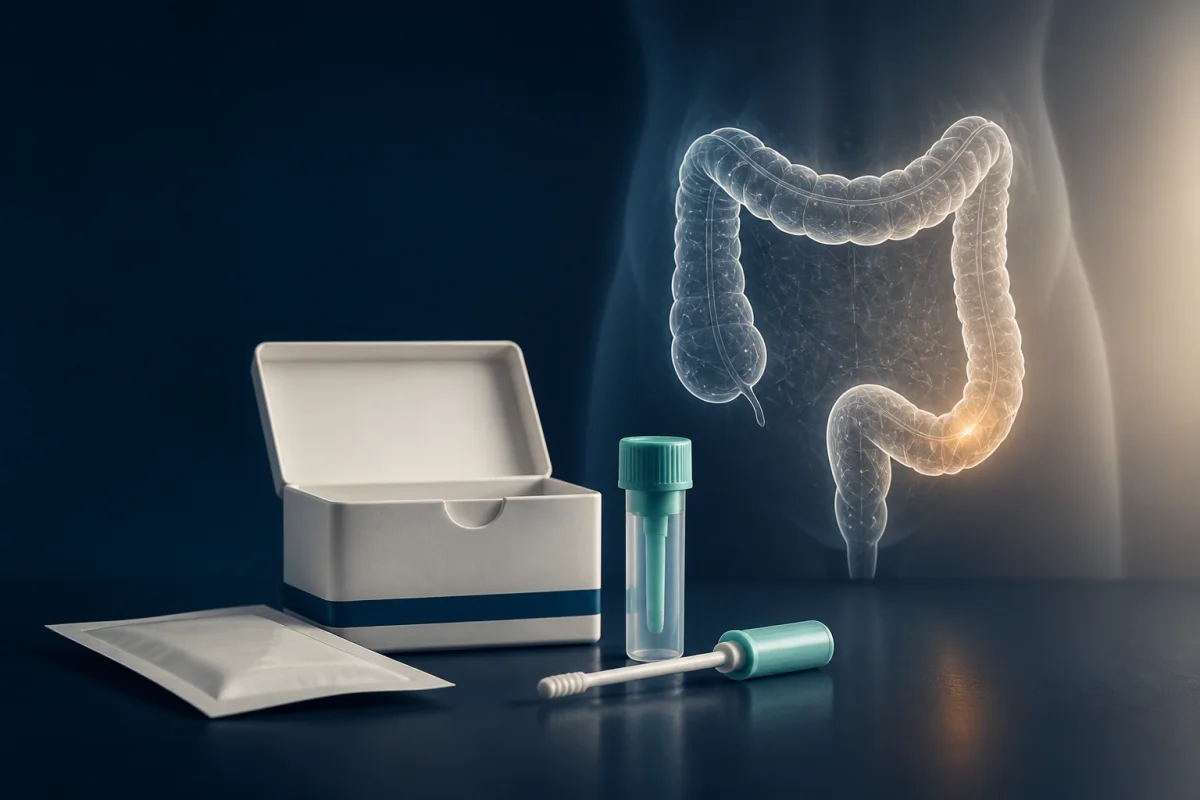
One-minute decision guide
The simple evidence-based protocol
Average-risk adults should follow local screening guidance, commonly beginning at age 45 and continuing regularly through 75. Strong options include annual FIT, stool DNA-FIT every 1–3 years, CT colonography every 5 years or colonoscopy every 10 years, with exact programs varying by country. Any abnormal stool or imaging screen needs timely diagnostic colonoscopy. Symptoms, prior polyps, inflammatory bowel disease, strong family history or hereditary syndromes require a different, often earlier pathway.See reference 1,See reference 2,See reference 3
The 10 rules to remember
- Start average-risk screening on timeSee reference 1
- Choose a validated test you will completeSee reference 2
- Repeat stool testing at the required intervalSee reference 3
- Use one properly collected sample according to kit instructionsSee reference 4
- Never ignore a positive FIT or stool DNA resultSee reference 5
- Complete colonoscopy after an abnormal non-colonoscopy testSee reference 6
- Do not use screening to explain away symptomsSee reference 7
- Tell the clinician about family history and prior polypsSee reference 8
- Use high-risk pathways when appropriateSee reference 9
- Continue prevention habits without substituting them for screeningSee reference 10
First principles: what this can actually change
Most colorectal cancers develop over years through identifiable precursor lesions, creating an opportunity to prevent disease by removal.See reference 1,See reference 2
Stool tests look for blood or altered DNA and must be repeated often; structural tests visualize the bowel and use longer intervals but involve preparation and procedural burdens.See reference 3,See reference 4
A screening program is a chain: invitation, completed test, follow-up of abnormal results, treatment and future surveillance. Benefit is lost when the chain breaks.See reference 5,See reference 6
A practical decision protocol
- Stage
- 1. Risk group
- What to do
- Review age, symptoms, family history, prior polyps and bowel disease
- Why it matters
- Determines screening versus diagnostic or high-risk careSee reference 1,See reference 2
- Stage
- 2. Choose test
- What to do
- Compare home stool testing, colonoscopy and imaging
- Why it matters
- Preferences influence completionSee reference 2,See reference 3
- Stage
- 3. Complete correctly
- What to do
- Follow collection or bowel-preparation instructions
- Why it matters
- Poor preparation reduces accuracySee reference 3,See reference 4
- Stage
- 4. Close the loop
- What to do
- Document the result, next due date and colonoscopy after abnormal tests
- Why it matters
- Follow-up creates the benefitSee reference 4,See reference 5
Timing and frequency
- Decision
- FIT
- Practical answer
- Usually every year in USPSTF options; follow the local program interval.See reference 3,See reference 4
- Decision
- Stool DNA-FIT
- Practical answer
- Every 1–3 years depending on the approved test and guideline.See reference 4,See reference 5
- Decision
- CT colonography
- Practical answer
- Every 5 years when used as a screening strategy, with colonoscopy after an abnormal result.See reference 5,See reference 6
- Decision
- Colonoscopy
- Practical answer
- Often every 10 years after a normal high-quality exam in average-risk adults; surveillance intervals differ.See reference 6,See reference 7
What to measure
- Signal
- Risk category
- How
- Record family history, genetics, polyps and bowel disease
- Interpretation
- High-risk people need tailored timingSee reference 4,See reference 5
- Signal
- Test quality
- How
- Check sample validity or bowel-preparation quality
- Interpretation
- An incomplete test may need repetitionSee reference 5,See reference 6
- Signal
- Result and follow-up
- How
- Record positive/negative and diagnostic completion
- Interpretation
- A positive stool test is not a cancer diagnosisSee reference 6,See reference 7
- Signal
- Next due date
- How
- Use the program or endoscopist recommendation
- Interpretation
- Prevents silent gaps in screeningSee reference 7,See reference 8
What the evidence actually shows
USPSTF modeling and evidence show that multiple stool-based and direct-visualization strategies reduce colorectal cancer mortality and gain life-years when completed with follow-up.See reference 1,See reference 3
Colonoscopy can find and remove precancerous lesions in one procedure, while FIT offers a low-burden home option that works only with regular repetition.See reference 4,See reference 6
No single option is best for everyone. Adherence and access can matter more than theoretical differences between recommended tests.See reference 7,See reference 8
Evidence strength by claim
- Claim
- Screening ages 45–75 reduces colorectal cancer burden
- Confidence
- High
- Important boundary
- Applies to average-risk asymptomatic adultsSee reference 1,See reference 2
- Claim
- Annual FIT is an effective strategy
- Confidence
- High
- Important boundary
- Every positive test requires colonoscopySee reference 3,See reference 4
- Claim
- Colonoscopy every 10 years is effective
- Confidence
- High
- Important boundary
- Quality, preparation and procedural risk matterSee reference 5,See reference 6
- Claim
- A negative test rules out future cancer
- Confidence
- Low
- Important boundary
- Screening must continue at the recommended intervalSee reference 7,See reference 8,See reference 9
Limits and common overclaims
Stool tests can miss lesions and can be positive for reasons other than cancer.See reference 3,See reference 7
Colonoscopy can miss lesions and carries small risks of bleeding, perforation and sedation complications.See reference 5,See reference 8
USPSTF age and interval examples are U.S.-based; national programs differ, and individual history overrides average-risk schedules.See reference 9,See reference 10
A four-step implementation plan
- 1. Review age, symptoms, family history, prior polyps and bowel diseaseSee reference 1
- 2. Compare home stool testing, colonoscopy and imagingSee reference 2
- 3. Follow collection or bowel-preparation instructionsSee reference 3
- 4. Document the result, next due date and colonoscopy after abnormal testsSee reference 4
Troubleshooting
- Problem
- Positive FIT
- Likely issue
- Blood was detected but the cause is unknown
- Better next step
- Arrange diagnostic colonoscopy; do not repeat FIT to cancel itSee reference 2,See reference 3
- Problem
- Poor bowel preparation
- Likely issue
- The lining was not fully visible
- Better next step
- Follow the endoscopist's repeat recommendationSee reference 4,See reference 5
- Problem
- Family member had early cancer
- Likely issue
- Average-risk timing may be inappropriate
- Better next step
- Get individualized risk assessment and earlier testing if indicatedSee reference 6,See reference 7
- Problem
- Overdue but worried about colonoscopy
- Likely issue
- Procedural burden is blocking all screening
- Better next step
- Discuss a validated stool option while preserving follow-up commitmentSee reference 8,See reference 9
Safety and when to get medical help
Rectal bleeding, black stool, unexplained iron-deficiency anemia, persistent change in bowel habits, abdominal mass, severe pain or unintended weight loss needs medical evaluation, not routine screening. After colonoscopy, severe or worsening abdominal pain, fever, heavy bleeding, dizziness or fainting requires urgent care.See reference 1,See reference 5,See reference 9
Who is most likely to benefit
Average-risk adults in the guideline-recommended age range who are due for screening.See reference 2,See reference 4
People who choose a lower-burden home test and can reliably repeat it and complete colonoscopy if positive.See reference 5,See reference 7
Higher-risk people who enter an individualized surveillance program based on family history, genetics, bowel disease or prior polyps.See reference 8,See reference 10
Track five things
- Risk category and family-history detailsSee reference 1
- Test type, date and qualitySee reference 2
- Result and pathology when applicableSee reference 3
- Completion of follow-up colonoscopySee reference 4
- Next screening or surveillance due dateSee reference 5
Frequently asked questions
At what age should screening start?
Many current guidelines start average-risk screening at 45; follow your country's program and individual risk.See reference 1
Is FIT as good as colonoscopy?
Both are recommended strategies with different tradeoffs. FIT must be repeated regularly and every positive result needs colonoscopy.See reference 2
Can I repeat FIT after a positive result?
No. A second negative test does not cancel the need for diagnostic colonoscopy.See reference 3
Does a positive stool test mean cancer?
No. It means further evaluation is required.See reference 4
How often is colonoscopy needed?
Often every 10 years after a normal high-quality average-risk exam, but findings and risk can shorten the interval.See reference 5
What if I have symptoms?
Symptoms require diagnostic evaluation regardless of age or prior screening.See reference 6
When can screening stop?
USPSTF recommends individualized decisions from 76–85 and stopping after 85; other countries may differ.See reference 7
Can diet replace screening?
No. Healthy habits may reduce risk but do not replace recommended testing.See reference 8
Connect this decision to your wider health picture
LongevityMate helps organize measurements, symptoms, habits and trends so a test or treatment stays in context instead of becoming the whole plan.
See how LongevityMate worksReferences
- 1. Colorectal Cancer: Screening
U.S. Preventive Services Task ForceGuideline
- 2. Colorectal Cancer Screening Guideline
American College of GastroenterologyGuideline
- 3. Colorectal Cancer Screening Guideline
American Cancer SocietyGuideline
- 4. Colorectal Cancer Screening Tests
National Cancer InstituteOfficial guidance
- 5. FIT Screening and Colorectal Cancer Mortality
Annals of Internal MedicineObservational study
- 6. Flexible Sigmoidoscopy Screening Trial
New England Journal of MedicineRandomized trial
- 7. Colonoscopy Screening Trial
New England Journal of MedicineRandomized trial
- 8. Stool DNA Testing for Colorectal Cancer
New England Journal of MedicineObservational study
- 9. Harms of Colorectal Cancer Screening
USPSTF Evidence ReviewSystematic review
- 10. Follow-up After Positive FIT
GastroenterologyObservational study
Editorial transparency
- Published by
- LongevityMate Editorial Team
- Published
- Updated
Medical disclaimer
This guide provides general health education. It does not diagnose a condition, prescribe treatment, replace individualized medical care, or guarantee a health or longevity outcome.