
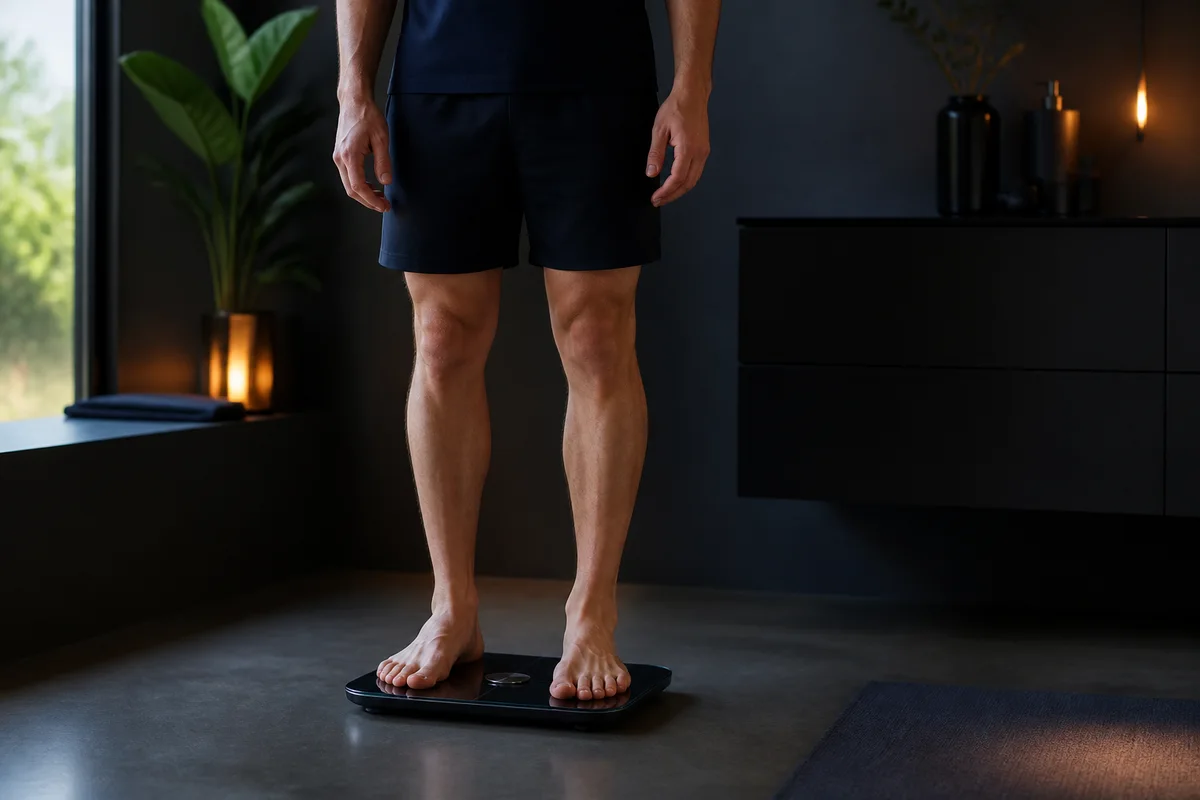
One-minute protocol
The simple evidence-based protocol
Place the same scale on a hard level floor. Measure in the morning after using the bathroom, before eating, drinking or exercising, with bare dry feet and similar hydration. Record weight and the scale's body-fat estimate, but interpret only the 4-week trend and never compare percentages across different devices. A surprising composition change over days is usually fluid or algorithm noise; clinical decisions require an appropriate validated assessment.See reference 1,See reference 2,See reference 3
The 10 rules to remember
- Treat body weight as the scale's strongest measurement and body composition as an estimate.See reference 1
- Use the same device, placement, time of day and pre-measurement routine.See reference 2
- Measure after the bathroom and before food, fluid or exercise when practical.See reference 3
- Avoid interpreting day-to-day body-fat or muscle changes; tissue does not change that quickly.See reference 4
- Review a rolling four-week trend rather than the latest app number.See reference 5
- Do not compare values from different brands or assume they use the same equations.See reference 6
- Ignore proprietary metabolic age, body type and visceral-fat scores unless independently validated for the decision.See reference 7
- Use waist, strength, training performance and clinical markers alongside scale data.See reference 8
- Stop or reduce tracking if weight and composition numbers worsen anxiety or disordered eating.See reference 9
- Do not use a consumer BIA result to diagnose obesity, sarcopenia, malnutrition or fluid overload.See reference 10
First principles: what this tool can actually change
BIA sends a small current through the body and measures opposition to that current. Because water-rich lean tissue and fat differ electrically, an equation combines impedance with height, weight, age, sex and proprietary assumptions to estimate compartments.See reference 1,See reference 2
The device does not directly see fat or muscle. Hydration, recent food, exercise, skin temperature, foot contact and population-specific equations can shift the estimate even when actual tissue is unchanged.See reference 3,See reference 4
A device can be highly repeatable yet inaccurate: it may give nearly the same biased answer each time. Consistency supports trend use under standardized conditions but does not prove equivalence to a four-compartment model, MRI or DXA.See reference 5,See reference 6
A practical protocol
- Stage
- Set up
- What to do
- Use one scale on a hard level surface and create one profile
- Why it matters
- Prevents placement and profile errorsSee reference 1
- Stage
- Standardize
- What to do
- Measure morning, post-bathroom, pre-food and pre-exercise
- Why it matters
- Reduces fluid and timing variabilitySee reference 2
- Stage
- Record
- What to do
- Save weight and body-fat estimate without reacting daily
- Why it matters
- Preserves data while limiting noise-driven decisionsSee reference 3
- Stage
- Review
- What to do
- Compare four-week averages with waist and performance
- Why it matters
- Requires converging outcomesSee reference 4
Timing and frequency
- When
- Two to seven mornings weekly
- Action
- Use enough repeat readings for a stable weight trendSee reference 5
- When
- After hard exercise or alcohol
- Action
- Wait until usual hydration and routine returnSee reference 6
- When
- During major fluid shifts
- Action
- Flag illness, menstruation, travel, edema or carbohydrate changeSee reference 7
- When
- Every four weeks
- Action
- Review the trend; avoid daily composition judgmentsSee reference 8
What to measure
- Signal
- Weight
- How
- Use the weekly mean
- Interpretation
- Generally accurate on a sound scaleSee reference 7
- Signal
- Estimated body fat
- How
- Use same-device four-week direction
- Interpretation
- Absolute percentage may be materially wrongSee reference 8
- Signal
- Waist circumference
- How
- Measure consistently at an anatomical landmark
- Interpretation
- Independent body-size trendSee reference 9
- Signal
- Performance
- How
- Track strength, pace or function
- Interpretation
- Helps distinguish useful change from weight aloneSee reference 10
What the evidence supports
Consumer smart scales can measure weight with small error under stable conditions, making frequent weight trends their most defensible use.See reference 1,See reference 3
Some BIA systems show good repeatability and can rank or track groups, but individual body-fat and lean-mass agreement with criterion methods is often too wide for diagnosis.See reference 2,See reference 4
A standardized home trend can support behavior review when it is combined with waist, health markers and performance, not used as a single definition of progress.See reference 5,See reference 6
Evidence strength by claim
- Claim
- Measures body weight for home trending
- Confidence
- High
- Important boundary
- Requires hard level placement and calibration qualitySee reference 1,See reference 2
- Claim
- Provides repeatable same-device composition trends
- Confidence
- Low to moderate
- Important boundary
- Standardized conditions are essentialSee reference 3,See reference 4
- Claim
- Accurately measures an individual's body-fat percentage
- Confidence
- Low
- Important boundary
- Wide limits of agreement are commonSee reference 5,See reference 6
- Claim
- Metabolic age or visceral-fat score predicts longevity
- Confidence
- Not established
- Important boundary
- Proprietary estimates lack direct validationSee reference 7,See reference 8,See reference 9,See reference 10
Limitations and common overclaims
A 2026 systematic review found BIA body-fat estimates were not equivalent to a four-compartment model at the individual level, with limits of agreement often spanning 15-20 percentage points.See reference 3,See reference 7
Prediction equations may not represent every age, ancestry, athletic status or disease state. Devices can hide which equation they use and update algorithms without an interpretable audit trail.See reference 5,See reference 8
DXA also has assumptions and measurement error, so it is not a perfect universal truth. Use the method appropriate to the clinical or performance question and avoid false precision.See reference 9,See reference 10
How to make it stick
Automate data capture but hide daily body-fat notifications; schedule a monthly review so measurement does not become the behavior goal.See reference 1,See reference 2
Set an interpretation rule before starting: only consider a composition trend if it persists four weeks and agrees with waist or performance.See reference 3,See reference 4
If accurate body composition matters clinically, ask which criterion method and repeatability protocol is appropriate rather than upgrading consumer features blindly.See reference 5,See reference 6
Troubleshooting
- Problem
- Body fat changes overnight
- Likely issue
- Hydration, glycogen, food or contact changed
- Better next step
- Ignore the single estimate and restore standard conditionsSee reference 2,See reference 3
- Problem
- Weight differs by floor location
- Likely issue
- Uneven or soft surface
- Better next step
- Move to one hard level location and retestSee reference 4,See reference 5
- Problem
- Two scales disagree
- Likely issue
- Different hardware and prediction equations
- Better next step
- Do not convert; choose one trend methodSee reference 6,See reference 7
- Problem
- Tracking causes anxiety
- Likely issue
- Measurement is harming behavior
- Better next step
- Reduce frequency, hide metrics or stop with professional supportSee reference 8,See reference 9,See reference 10
Safety and when to stop
Follow the device label for pregnancy, implanted pacemakers or defibrillators, edema and other medical conditions; composition estimates may be invalid even when weighing is permitted. Do not use the result to change medicines, diuretics, nutrition support or fluid treatment. Rapid unexplained weight gain with swelling or breathlessness, severe unintentional weight loss, or signs of an eating disorder require clinical assessment rather than more scale measurements.See reference 1,See reference 5,See reference 9
Who is most likely to benefit
It can help adults who want convenient weight trends and can view body-composition estimates as noisy supporting information.See reference 2,See reference 4
Athletes may use same-device trends under strict standardization, but glycogen and fluid shifts make short-term lean-mass interpretations especially unreliable.See reference 5,See reference 7
It is poorly suited to diagnosis, pregnancy composition tracking, major fluid disorders or anyone whose mental health deteriorates with weight monitoring.See reference 8,See reference 10
Track five things
- Morning weight and weekly mean.See reference 1
- Same-device four-week body-fat trend.See reference 2
- Waist circumference.See reference 3
- Hydration, cycle, illness and training context.See reference 4
- Strength, function or other real-world outcome.See reference 5
Frequently asked questions
Are body-fat scales accurate?
Often not for an individual's absolute body-fat percentage. Weight is much more accurate than the composition estimates.See reference 1
When should I measure?
Morning after the bathroom and before food, drink or exercise gives a repeatable practical routine.See reference 2
Why did muscle mass fall overnight?
True muscle tissue did not change that quickly; fluid, glycogen, contact or algorithmic variation is the likely reason.See reference 3
Can I compare BIA with DXA?
Not as interchangeable numbers. Record the method and compare repeat tests using the same protocol.See reference 4
How often should I weigh?
Two to seven mornings per week can support a weekly average; choose less if frequent weighing harms behavior.See reference 5
Does drinking water increase body fat?
It changes electrical conduction and body mass, which can shift the estimate without changing fat tissue.See reference 6
Is visceral fat on a smart scale measured?
Usually it is a proprietary estimate, not a direct image of abdominal fat.See reference 7
Should I buy an eight-electrode scale?
More contacts may improve modeling, but no configuration guarantees individual accuracy; independent validation matters more than features.See reference 8
Connect the protocol to your wider health picture
LongevityMate helps organize measurements, habits, symptoms and trends so one tool stays in context instead of becoming the whole plan.
See how LongevityMate worksReferences
- 1. BIA Versus a Four-Compartment Model
American Journal of Clinical NutritionSystematic review
- 2. Predictive Equations for BIA
Journal of Translational MedicineSystematic review
- 3. Accuracy of Smart Scales
JMIR mHealth and uHealthObservational study
- 4. Fifteen BIA Devices: Reliability and Validity
British Journal of NutritionObservational study
- 5. Reliability and Accuracy of Multi-Frequency BIA
Military MedicineObservational study
- 6. Consumer BIA Compared With MRI and DXA
Obesity FactsObservational study
- 7. Commercial Multi-Frequency BIA Reliability
International Journal of Sports MedicineObservational study
- 8. Real-World Multi-Frequency BIA Assessment
European Journal of Clinical NutritionObservational study
- 9. Methodological Standards for Body Composition
American Journal of Clinical NutritionGuideline
- 10. Bioelectrical Impedance Analysis in Body Composition
National Institutes of HealthOfficial guidance
Editorial transparency
- Published by
- LongevityMate Editorial Team
- Published
- Updated
Medical disclaimer
This guide provides general health education. It does not diagnose a condition, prescribe treatment, replace individualized medical care, or guarantee a health or longevity outcome.