
One-minute decision guide
The simple evidence-based protocol
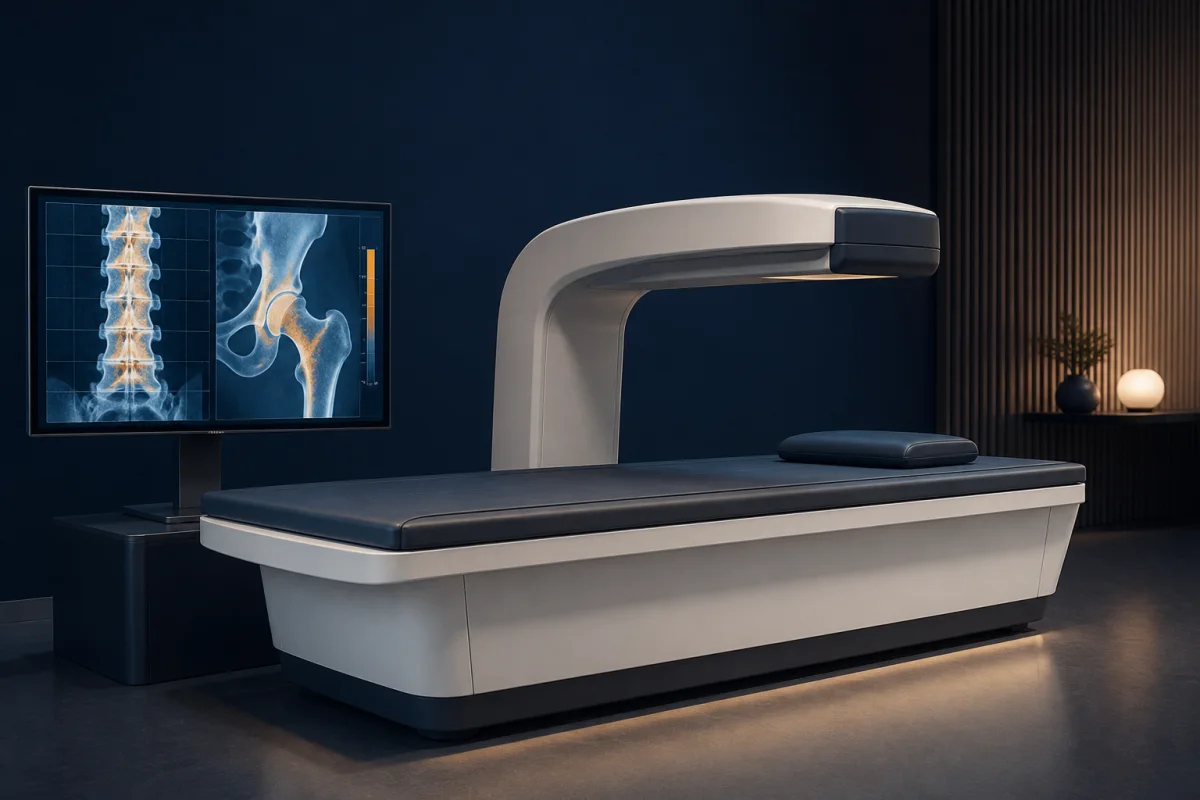
Use DXA bone-density testing when age, menopause, fracture history, medication or a medical condition makes the result clinically useful. Standard diagnostic sites are the lumbar spine and hip. T-scores compare postmenopausal women and older men with a young-adult reference; Z-scores compare with age peers and are used in younger people. For body composition, standardize hydration, food, exercise and machine. Repeat only when the result could change care and the expected change exceeds the facility's least significant change.See reference 1,See reference 2,See reference 3
The 10 rules to remember
- Know whether the goal is bone density or body compositionSee reference 1
- Use hip and spine for standard osteoporosis diagnosisSee reference 2
- Interpret T-scores and Z-scores in the correct populationSee reference 3
- Do not diagnose osteoporosis from body-fat softwareSee reference 4
- Use the same facility and machine when possibleSee reference 5
- Standardize food, hydration and recent exercise for body compositionSee reference 6
- Compare change with least significant changeSee reference 7
- Do not retest too soon without a clinical reasonSee reference 8
- Pair bone density with fracture-risk assessmentSee reference 9
- Treat unexpected results as a reason for clinical review, not self-treatmentSee reference 10
First principles: what this can actually change
DXA passes two low-dose X-ray energies through the body and estimates how much is attenuated by bone and soft tissue.See reference 1,See reference 2
Bone mineral density predicts fracture risk but does not measure bone quality completely; age, prior fracture, falls, medicines and disease also matter.See reference 3,See reference 4
Body-composition estimates depend on machine calibration, positioning, hydration and analysis software. Small changes may be noise rather than real fat or lean-mass change.See reference 5,See reference 6
A practical decision protocol
- Stage
- 1. Define the question
- What to do
- Choose bone-health assessment, body composition, or both
- Why it matters
- The preparation and interpretation differSee reference 1,See reference 2
- Stage
- 2. Use a qualified site
- What to do
- Select an accredited or quality-controlled facility with trained staff
- Why it matters
- Acquisition quality drives reliabilitySee reference 2,See reference 3
- Stage
- 3. Standardize
- What to do
- Use the same machine, positioning and pre-scan conditions for follow-up
- Why it matters
- Reduces artificial changeSee reference 3,See reference 4
- Stage
- 4. Interpret
- What to do
- Review T/Z scores, clinical risks and least significant change
- Why it matters
- A number alone is not a diagnosis or trendSee reference 4,See reference 5
Timing and frequency
- Decision
- Bone screening
- Practical answer
- Follow local guidance; many guidelines start routine assessment around age 65 for women, earlier when risk is elevated.See reference 3,See reference 4
- Decision
- After starting treatment
- Practical answer
- Repeat timing is individualized and should be long enough for a measurable change to occur.See reference 4,See reference 5
- Decision
- Body-composition tracking
- Practical answer
- Several months is usually more informative than frequent scans; standardize time of day and conditions.See reference 5,See reference 6
- Decision
- After major clinical change
- Practical answer
- Earlier testing may be reasonable after a fragility fracture, major weight change or a treatment decision.See reference 6,See reference 7
What to measure
- Signal
- T-score
- How
- Compare BMD with a young-adult reference
- Interpretation
- Used for diagnostic classification in postmenopausal women and older menSee reference 4,See reference 5
- Signal
- Z-score
- How
- Compare BMD with age-matched reference
- Interpretation
- A low value in younger people can prompt evaluation for secondary causesSee reference 5,See reference 6
- Signal
- Least significant change
- How
- Ask the facility for its precision-derived threshold
- Interpretation
- Change smaller than this may be measurement noiseSee reference 6,See reference 7
- Signal
- Regional fat and lean mass
- How
- Compare same machine and standardized conditions
- Interpretation
- Useful for trends, not exact tissue truthSee reference 7,See reference 8
What the evidence actually shows
DXA-measured hip and spine bone density predicts fracture risk and helps identify people who may benefit from prevention or treatment.See reference 1,See reference 3
Serial testing can monitor clinically meaningful change when the same quality system and least significant change are used.See reference 4,See reference 6
DXA body composition is more informative than a bathroom impedance scale, but it remains an estimate and has weaker direct evidence for improving health outcomes.See reference 7,See reference 8
Evidence strength by claim
- Claim
- DXA supports osteoporosis diagnosis and fracture-risk assessment
- Confidence
- High
- Important boundary
- Use validated skeletal sites and population-specific interpretationSee reference 1,See reference 2
- Claim
- Serial DXA can monitor treatment
- Confidence
- Moderate
- Important boundary
- Timing and least significant change matterSee reference 3,See reference 4
- Claim
- DXA accurately tracks large body-composition changes
- Confidence
- Moderate
- Important boundary
- Consistency is more important than a single decimalSee reference 5,See reference 6
- Claim
- Frequent body-fat scans improve longevity
- Confidence
- Low
- Important boundary
- No outcome evidence supports scanning for its own sakeSee reference 7,See reference 8,See reference 9
Limits and common overclaims
Arthritis, vertebral changes, implants, contrast and body size can distort measurements.See reference 3,See reference 7
A T-score is not a complete fracture forecast and a normal score does not remove fall risk.See reference 5,See reference 8
Different scanners and software can yield different body-fat and lean-mass estimates, so cross-facility comparisons can mislead.See reference 9,See reference 10
A four-step implementation plan
- 1. Choose bone-health assessment, body composition, or bothSee reference 1
- 2. Select an accredited or quality-controlled facility with trained staffSee reference 2
- 3. Use the same machine, positioning and pre-scan conditions for follow-upSee reference 3
- 4. Review T/Z scores, clinical risks and least significant changeSee reference 4
Troubleshooting
- Problem
- Spine and hip disagree
- Likely issue
- Artifact or site-specific bone loss may be present
- Better next step
- Have the report reviewed clinically rather than averaging the scoresSee reference 2,See reference 3
- Problem
- Small body-fat change
- Likely issue
- Hydration or positioning noise may explain it
- Better next step
- Repeat only under matched conditions after enough timeSee reference 4,See reference 5
- Problem
- Result changed after switching centers
- Likely issue
- Machines are not fully interchangeable
- Better next step
- Use cross-calibration or establish a new baselineSee reference 6,See reference 7
- Problem
- Low Z-score in a younger adult
- Likely issue
- A secondary cause may be present
- Better next step
- Seek evaluation of nutrition, hormones, medicines and medical conditionsSee reference 8,See reference 9
Safety and when to get medical help
DXA uses a small dose of ionizing radiation. Tell the facility if you are or may be pregnant, recently had a contrast study, or have implants. A fragility fracture, severe new back pain with height loss, or symptoms suggesting an acute fracture needs medical assessment rather than waiting for routine scanning.See reference 1,See reference 5,See reference 9
Who is most likely to benefit
Older adults and postmenopausal women covered by local screening guidance.See reference 2,See reference 4
Younger adults with fragility fracture, prolonged glucocorticoid use or conditions linked to bone loss.See reference 5,See reference 7
People tracking a substantial body-composition intervention who can standardize repeat scans and will act on the trend.See reference 8,See reference 10
Track five things
- Machine, facility and scan dateSee reference 1
- Hip and spine BMD plus T/Z scoresSee reference 2
- Facility least significant changeSee reference 3
- Fractures, falls and bone-active medicinesSee reference 4
- Standardized body-composition conditionsSee reference 5
Frequently asked questions
Is DEXA the same as DXA?
Yes. DXA is the preferred abbreviation, but DEXA is widely used in search and everyday language.See reference 1
What T-score means osteoporosis?
A T-score at or below -2.5 at an accepted site meets a densitometric criterion in the appropriate population; diagnosis and treatment still use clinical context.See reference 2
Is DEXA body fat exact?
No. It is a useful estimate with machine and hydration-related error.See reference 3
Should I fast?
Bone-density scans usually require little preparation. For body composition, follow the facility's standardized food and hydration protocol.See reference 4
How often should I repeat it?
Only when a result could change management and enough time has passed for change beyond measurement error.See reference 5
Can I compare two different machines?
Not reliably unless the facilities have cross-calibrated them.See reference 6
Is the radiation dangerous?
The dose is low but not zero, so unnecessary repeat scans should still be avoided.See reference 7
Can strength training improve the result?
Resistance and impact exercise can support bone and lean mass, but response varies and scan change takes time.See reference 8
Connect this decision to your wider health picture
LongevityMate helps organize measurements, symptoms, habits and trends so a test or treatment stays in context instead of becoming the whole plan.
See how LongevityMate worksReferences
- 1. 2023 Adult Official Positions
International Society for Clinical DensitometryGuideline
- 2. Text-Based Adult Official Positions
International Society for Clinical DensitometryGuideline
- 3. Osteoporosis to Prevent Fractures: Screening
USPSTFGuideline
- 4. Bone Health and Osteoporosis Foundation Clinician's Guide
Osteoporosis InternationalGuideline
- 5. FRAX fracture risk assessment
University of SheffieldOfficial guidance
- 6. DXA Reporting Updates: 2023 Official Positions
Journal of Clinical DensitometryGuideline
- 7. Follow-up Bone Mineral Density Testing
Journal of Clinical DensitometryGuideline
- 8. Body Composition Assessment Using DXA
European Journal of Clinical NutritionEvidence review
- 9. Precision Assessment and Least Significant Change
ISCDOfficial guidance
- 10. ACR Practice Parameter for DXA
American College of RadiologyGuideline
Editorial transparency
- Published by
- LongevityMate Editorial Team
- Published
- Updated
Medical disclaimer
This guide provides general health education. It does not diagnose a condition, prescribe treatment, replace individualized medical care, or guarantee a health or longevity outcome.