
One-minute decision guide
The simple evidence-based protocol
Use HSAT through an accredited sleep service when an adult has symptoms suggesting moderate-to-severe obstructive sleep apnea and no major condition that makes laboratory testing safer or more accurate. Apply every sensor exactly as instructed, sleep in usual positions, and record problems. A clinician should interpret the raw data. A technically inadequate or negative test does not rule out apnea when suspicion remains; the next step is usually in-laboratory polysomnography.See reference 1,See reference 2,See reference 3
The 10 rules to remember
- Use a medical HSAT, not a consumer sleep scoreSee reference 1
- Start with a comprehensive sleep evaluationSee reference 2
- Reserve HSAT for appropriate uncomplicated adultsSee reference 3
- Follow sensor placement instructions exactlySee reference 4
- Sleep in normal positions and routinesSee reference 5
- Record awakenings, alcohol and sensor problemsSee reference 6
- Have a qualified clinician interpret the studySee reference 7
- Know that REI can underestimate AHISee reference 8
- Do not accept a negative test when suspicion stays highSee reference 9
- Use laboratory polysomnography when complexity requires itSee reference 10
First principles: what this can actually change
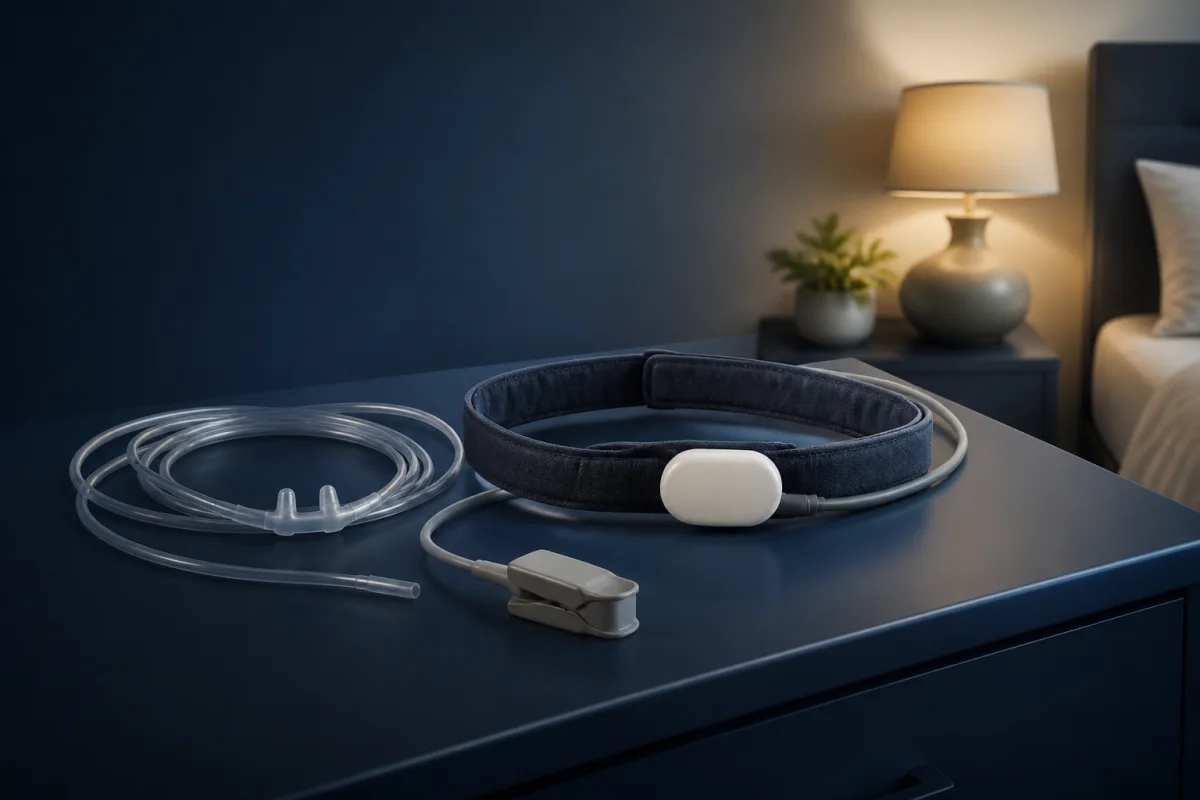
Most HSAT devices measure airflow, breathing effort, heart rate and oxygen but do not measure brain waves, so they usually cannot identify actual sleep time.See reference 1,See reference 2
Dividing events by recording time instead of sleep time can dilute the event index and understate severity, especially when a person lies awake for long periods.See reference 3,See reference 4
Diagnostic accuracy depends on pretest probability. A positive result is more useful in a carefully selected high-risk patient than in broad screening of people without symptoms.See reference 5,See reference 6
A practical decision protocol
- Stage
- 1. Clinical screen
- What to do
- Review snoring, witnessed apnea, sleepiness, hypertension and medical history
- Why it matters
- Determines whether HSAT fits the questionSee reference 1,See reference 2
- Stage
- 2. Device setup
- What to do
- Apply airflow, effort and oxygen sensors exactly as taught
- Why it matters
- Lost signals can invalidate the nightSee reference 2,See reference 3
- Stage
- 3. Normal night
- What to do
- Keep usual sleep timing and positions and note disruptions
- Why it matters
- A representative night improves relevanceSee reference 3,See reference 4
- Stage
- 4. Interpretation
- What to do
- Return data for clinician scoring and a treatment plan
- Why it matters
- Automated summaries alone are insufficientSee reference 4,See reference 5
Timing and frequency
- Decision
- Test night
- Practical answer
- Aim for the main sleep period and enough valid recording time; do not deliberately sleep only on one side unless instructed.See reference 3,See reference 4
- Decision
- After an inadequate study
- Practical answer
- Repeat or move to laboratory polysomnography promptly.See reference 4,See reference 5
- Decision
- After a negative study
- Practical answer
- If symptoms or clinical suspicion persist, arrange laboratory polysomnography rather than repeating reassurance.See reference 5,See reference 6
- Decision
- After treatment or major change
- Practical answer
- Repeat testing only when it will guide treatment after weight, symptoms, surgery or device changes.See reference 6,See reference 7
What to measure
- Signal
- REI or AHI
- How
- Events per hour using the report's denominator
- Interpretation
- Understand whether recording time or sleep time was usedSee reference 4,See reference 5
- Signal
- Oxygen desaturation
- How
- Review depth, duration and signal quality
- Interpretation
- Low readings can be real or sensor artifactSee reference 5,See reference 6
- Signal
- Event type and position
- How
- Review obstructive/central classification and supine time
- Interpretation
- Limited channels can reduce certaintySee reference 6,See reference 7
- Signal
- Technical quality
- How
- Check airflow, effort and oximetry signal loss
- Interpretation
- A number from poor data is not reliableSee reference 7,See reference 8
What the evidence actually shows
AASM guidance supports HSAT as an alternative to polysomnography for diagnosing OSA in uncomplicated adults with signs and symptoms suggesting moderate-to-severe disease.See reference 1,See reference 3
Home testing is more convenient and can reduce barriers, but its role is part of a clinical pathway rather than stand-alone self-diagnosis.See reference 4,See reference 6
Laboratory polysomnography remains preferred when there is significant cardiorespiratory disease, neuromuscular weakness, hypoventilation concern, chronic opioid use, stroke history or severe insomnia.See reference 7,See reference 8
Evidence strength by claim
- Claim
- Diagnoses OSA in carefully selected adults
- Confidence
- High
- Important boundary
- Requires a technically adequate medical device and clinical interpretationSee reference 1,See reference 2
- Claim
- Replaces laboratory testing for everyone
- Confidence
- Low
- Important boundary
- Important comorbidities and other sleep disorders require more channelsSee reference 3,See reference 4
- Claim
- A positive high-risk result can guide treatment
- Confidence
- High
- Important boundary
- Use within an accredited clinical pathwaySee reference 5,See reference 6
- Claim
- A negative HSAT rules out OSA
- Confidence
- Low
- Important boundary
- False negatives and underestimation are importantSee reference 7,See reference 8,See reference 9
Limits and common overclaims
HSAT usually cannot diagnose insomnia, narcolepsy, parasomnias, limb-movement disorders or many forms of central sleep-disordered breathing.See reference 3,See reference 7
Night-to-night variability means one night may not represent usual severity.See reference 5,See reference 8
Consumer rings, watches and oxygen apps are not interchangeable with a validated medical HSAT.See reference 9,See reference 10
A four-step implementation plan
- 1. Review snoring, witnessed apnea, sleepiness, hypertension and medical historySee reference 1
- 2. Apply airflow, effort and oxygen sensors exactly as taughtSee reference 2
- 3. Keep usual sleep timing and positions and note disruptionsSee reference 3
- 4. Return data for clinician scoring and a treatment planSee reference 4
Troubleshooting
- Problem
- Nasal sensor falls off
- Likely issue
- Airflow signal may be unusable
- Better next step
- Reapply as instructed and report the problem; do not invent dataSee reference 2,See reference 3
- Problem
- Very low oxygen with no symptoms
- Likely issue
- Motion or poor finger contact may be artifact
- Better next step
- Have raw signal quality reviewed clinicallySee reference 4,See reference 5
- Problem
- Negative test but classic symptoms
- Likely issue
- HSAT may have underestimated disease
- Better next step
- Arrange laboratory polysomnographySee reference 6,See reference 7
- Problem
- Few hours of data
- Likely issue
- Study may be technically inadequate
- Better next step
- Ask the sleep service whether repeat testing is neededSee reference 8,See reference 9
Safety and when to get medical help
Do not delay care for severe daytime sleepiness, falling asleep while driving, witnessed prolonged breathing pauses, chest pain or major nocturnal oxygen desaturation. Avoid driving when dangerously sleepy. People with significant heart, lung, neuromuscular or neurologic disease, suspected hypoventilation, chronic opioid use or severe insomnia should be assessed for laboratory testing.See reference 1,See reference 5,See reference 9
Who is most likely to benefit
Uncomplicated adults with loud snoring, witnessed apnea and excessive sleepiness suggesting moderate-to-severe OSA.See reference 2,See reference 4
People who cannot easily attend a sleep laboratory but can complete a clinician-directed home pathway.See reference 5,See reference 7
Patients needing objective reassessment after a major treatment or weight change when a sleep clinician considers HSAT suitable.See reference 8,See reference 10
Track five things
- Device type and channels recordedSee reference 1
- Valid recording duration and signal lossSee reference 2
- REI/AHI plus oxygen findingsSee reference 3
- Symptoms and Epworth Sleepiness ScaleSee reference 4
- Clinician interpretation and next actionSee reference 5
Frequently asked questions
Is a home sleep test accurate?
It can be accurate for obstructive sleep apnea in properly selected adults, but is less comprehensive than laboratory polysomnography.See reference 1
What is REI?
Respiratory event index is events divided by monitoring time; it may underestimate AHI when awake time is included.See reference 2
Can a smartwatch diagnose sleep apnea?
No consumer wearable should replace a validated diagnostic pathway.See reference 3
What if my result is negative?
Persistent clinical suspicion should lead to laboratory polysomnography.See reference 4
Can I take sleep medicine on test night?
Follow the ordering clinician's instructions; do not change prescribed medicine without guidance.See reference 5
Should I avoid alcohol?
Do not manipulate the result. Follow clinical instructions and record alcohol because it can affect severity.See reference 6
Does the test hurt?
It is noninvasive, although sensors can feel awkward.See reference 7
Can HSAT diagnose central sleep apnea?
Some devices flag central patterns, but suspected central apnea or hypoventilation generally requires more comprehensive testing.See reference 8
Connect this decision to your wider health picture
LongevityMate helps organize measurements, symptoms, habits and trends so a test or treatment stays in context instead of becoming the whole plan.
See how LongevityMate worksReferences
- 1. Diagnostic Testing for Adult OSA
American Academy of Sleep MedicineGuideline
- 2. AASM Diagnostic Testing Guideline
Journal of Clinical Sleep MedicineGuideline
- 3. Clinical Use of a Home Sleep Apnea Test
American Academy of Sleep MedicineOfficial guidance
- 4. Home Sleep Apnea Testing for OSA
ChestEvidence review
- 5. Portable Monitoring for OSA Diagnosis
Annals of Internal MedicineSystematic review
- 6. Night-to-Night Variability in OSA
ChestObservational study
- 7. Respiratory Devices
U.S. Food and Drug AdministrationOfficial guidance
- 8. Sleep Study Coverage
Centers for Medicare & Medicaid ServicesOfficial guidance
- 9. HSAT Underestimation of Sleep Apnea Severity
Journal of Clinical Sleep MedicineObservational study
- 10. Obstructive Sleep Apnea in Adults
USPSTFGuideline
Editorial transparency
- Published by
- LongevityMate Editorial Team
- Published
- Updated
Medical disclaimer
This guide provides general health education. It does not diagnose a condition, prescribe treatment, replace individualized medical care, or guarantee a health or longevity outcome.