
One-minute decision guide
The simple evidence-based answer
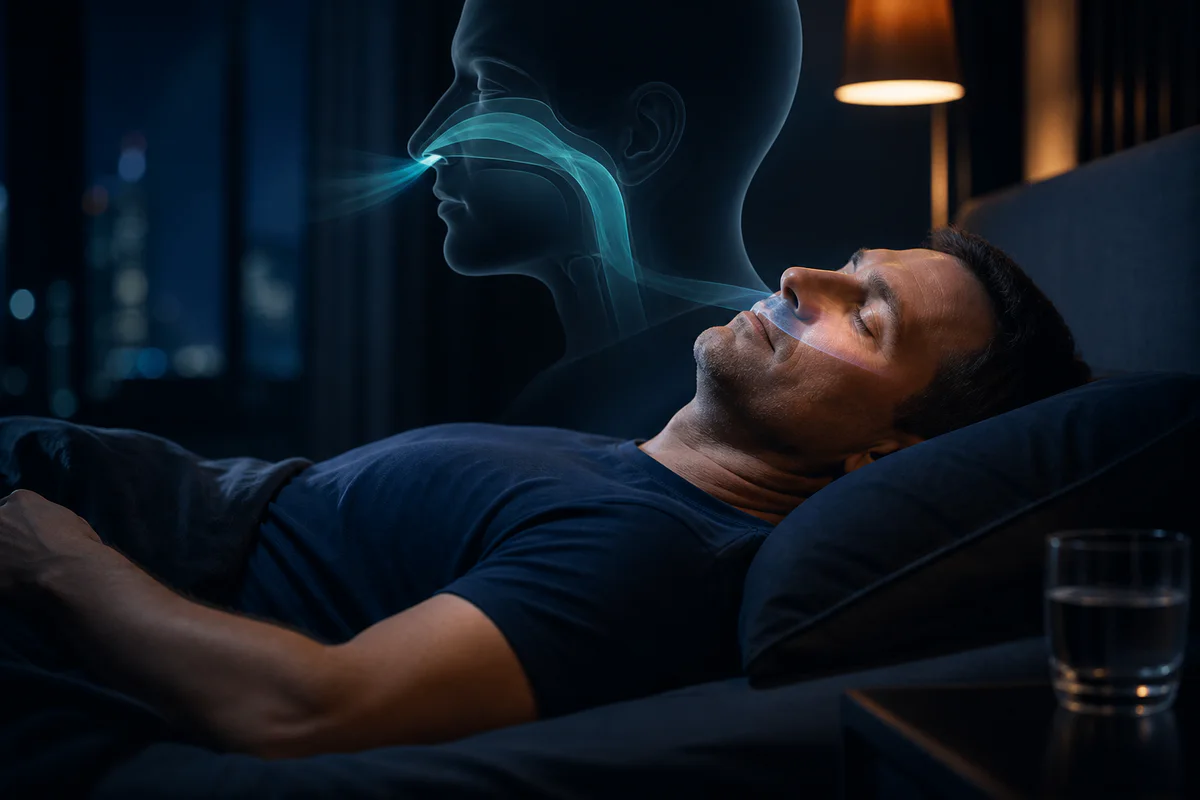
Do not tape your mouth shut simply to improve sleep. First check why you mouth-breathe: nasal congestion, anatomy, medication effects and obstructive sleep apnea are common possibilities. Avoid mouth taping with nasal blockage, vomiting risk, sedatives or alcohol, significant lung disease, untreated sleep apnea, anxiety about restricted breathing, or inability to remove the tape. A clinician-supervised trial may have a narrow role for selected CPAP users, but mouth taping alone is not an established treatment for snoring or apnea.See reference 1,See reference 2,See reference 3
The 10 rules to remember
- Use mouth taping only for a clearly defined problemSee reference 1
- Start with the lowest-burden evidence-based optionSee reference 2
- Record a baseline before changing anythingSee reference 3
- Do not confuse a biological mechanism with a proven health outcomeSee reference 4
- Do not let mouth taping replace established careSee reference 5
- Use qualified clinical oversight when the intervention is medicalSee reference 6
- Stop when harms, abnormal symptoms or a worse trend appearSee reference 7
- Judge benefit with measurements that matter to the original goalSee reference 8
- Reassess cost, burden and uncertainty after the planned trialSee reference 9
- Avoid protocols based only on testimonials, influencers or clinic marketingSee reference 10
First principles: what this can actually change
Closing the lips does not open a blocked nose or prevent the throat from collapsing. Airflow must still pass safely through the nose and upper airway.See reference 1,See reference 2
Snoring and dry mouth are symptoms, not diagnoses. A quieter night can occur while oxygen drops or respiratory events continue.See reference 3,See reference 4
The relevant outcome is safer, more stable breathing and restorative sleep—not whether the mouth remained closed.See reference 5,See reference 6
A practical decision protocol
- Stage
- 1. Identify the cause
- What to do
- Review congestion, allergies, anatomy, snoring, witnessed pauses and daytime sleepiness
- Why it matters
- Treatment depends on the source of mouth breathingSee reference 1,See reference 2
- Stage
- 2. Screen for risk
- What to do
- Do not experiment when nasal breathing is unreliable or apnea is suspected
- Why it matters
- Mechanical closure can remove a backup airwaySee reference 3,See reference 4
- Stage
- 3. Use safer options
- What to do
- Treat congestion appropriately and optimize CPAP mask, humidity or oral appliance care
- Why it matters
- These address the actual problemSee reference 5,See reference 6
- Stage
- 4. Verify
- What to do
- Use symptoms plus device or sleep-test data when treatment is medical
- Why it matters
- Feeling better alone can miss residual apneaSee reference 7,See reference 8
Timing, dose and frequency
- Decision
- Before any trial
- Practical answer
- Confirm that you can breathe comfortably through both nostrils while lying down and discuss apnea symptoms.See reference 1,See reference 2
- Decision
- During CPAP
- Practical answer
- Only consider as an adjunct after mask fit, pressure, humidification and nasal obstruction have been reviewed.See reference 3,See reference 4
- Decision
- After alcohol or sedatives
- Practical answer
- Do not use; arousal and protective responses may be impaired.See reference 5,See reference 6
- Decision
- If breathing feels restricted
- Practical answer
- Remove it immediately and do not retry until the cause is assessed.See reference 7,See reference 8
What to measure
- Signal
- Nasal airflow
- How
- Compare each nostril seated and lying down
- Interpretation
- Variable or blocked airflow argues against tapingSee reference 1,See reference 2
- Signal
- Snoring and breathing pauses
- How
- Use a bed-partner history or validated sleep assessment
- Interpretation
- Possible apnea needs testingSee reference 3,See reference 4
- Signal
- CPAP leak and residual AHI
- How
- Use clinician-reviewed device data
- Interpretation
- Lower leak matters only if events remain controlledSee reference 5,See reference 6
- Signal
- Dry mouth and sleep quality
- How
- Track a simple daily score
- Interpretation
- Symptoms are secondary outcomes, not proof of safetySee reference 7,See reference 8
What the evidence actually shows
A 2025 systematic review found only 10 small studies and 213 participants, with mixed results and important exclusions such as nasal obstruction.See reference 1,See reference 2
A 2025 crossover trial found improved CPAP adherence in selected mouth-breathing CPAP users, which does not justify mouth taping for the general population.See reference 3,See reference 4
There is no evidence that mouth taping improves longevity, prevents facial aging, changes the jawline or treats undiagnosed sleep apnea.See reference 5,See reference 6
Evidence strength by claim
- Claim
- Treats obstructive sleep apnea by itself
- Confidence
- Low
- Important boundary
- Small studies are mixed and airway obstruction may persistSee reference 1,See reference 2
- Claim
- May reduce leak in selected CPAP users
- Confidence
- Moderate
- Important boundary
- Use only with clinical selection and monitoringSee reference 3,See reference 4
- Claim
- Improves dry mouth or snoring
- Confidence
- Low
- Important boundary
- Symptom improvement does not verify oxygen or AHISee reference 5,See reference 6
- Claim
- Improves longevity or facial structure
- Confidence
- Very low
- Important boundary
- No clinical outcomes evidenceSee reference 7,See reference 8
Limits and common overclaims
Most studies were small, short and selected participants who could already breathe through the nose.See reference 4,See reference 7
Commercial tapes vary in seal, adhesive and removability, so results from a porous patch cannot be generalized to fully sealing tape.See reference 5,See reference 8
Self-recorded snoring apps cannot diagnose sleep apnea or prove safe breathing.See reference 6,See reference 9
A four-step implementation plan
- 1. Review congestion, allergies, anatomy, snoring, witnessed pauses and daytime sleepinessSee reference 1
- 2. Do not experiment when nasal breathing is unreliable or apnea is suspectedSee reference 2
- 3. Treat congestion appropriately and optimize CPAP mask, humidity or oral appliance careSee reference 3
- 4. Use symptoms plus device or sleep-test data when treatment is medicalSee reference 4
Troubleshooting
- Problem
- Dry mouth persists
- Likely issue
- Congestion, medication, CPAP leak or dehydration may remain
- Better next step
- Review causes rather than adding a tighter sealSee reference 1,See reference 2
- Problem
- Skin irritation
- Likely issue
- Adhesive reaction or repeated trauma
- Better next step
- Stop and allow skin to recoverSee reference 3,See reference 4
- Problem
- Panic or air hunger
- Likely issue
- Nasal or upper-airway limitation
- Better next step
- Remove immediately and seek assessmentSee reference 5,See reference 6
- Problem
- Snoring is quieter but fatigue remains
- Likely issue
- Sleep apnea or another sleep disorder may persist
- Better next step
- Arrange objective evaluationSee reference 7,See reference 8
Safety and when to get medical help
Never use mouth tape on a child, anyone unable to remove it independently, or anyone with vomiting risk, intoxication, heavy sedation, unreliable nasal breathing or untreated suspected sleep apnea. Remove it immediately for air hunger, panic, choking or worsening breathing. Urgent symptoms such as severe breathlessness, blue lips, chest pain or confusion need emergency care.See reference 1,See reference 5,See reference 9
Who is most likely to benefit
A small subset of established CPAP users with mouth leak after professional optimization may benefit from a supervised adjunct.See reference 2,See reference 6
People with night-time mouth breathing benefit more from identifying nasal disease, apnea, medication effects or oral dryness than from indiscriminate taping.See reference 3,See reference 7
People without a defined problem are unlikely to gain meaningful health benefit.See reference 4,See reference 8
Track five things
- Nasal airflowSee reference 1
- Snoring and breathing pausesSee reference 3
- CPAP leak and residual AHISee reference 5
- Dry mouth and sleep qualitySee reference 7
- Decision made after reviewing the resultSee reference 9
Frequently asked questions
Is mouth taping safe for everyone?
No. Nasal obstruction, apnea risk, sedatives, alcohol, vomiting risk and inability to remove the tape are important reasons not to use it.See reference 1
Does it cure snoring?
No. It may change the sound while the throat still narrows or collapses.See reference 2
Can I use it with CPAP?
Possibly as a clinician-guided adjunct for selected mouth leak, after mask and nasal issues are addressed.See reference 3
What is the safer first step?
Check nasal breathing and screen for obstructive sleep apnea when snoring, pauses or daytime sleepiness are present.See reference 4
Does this extend lifespan?
No human trial has shown that mouth taping extends lifespan. Any longevity claim must be separated from evidence for a specific symptom, diagnosis or surrogate marker.See reference 5
How quickly should it work?
Confirm that you can breathe comfortably through both nostrils while lying down and discuss apnea symptoms.See reference 6
Can it replace standard treatment?
No. A complementary tool should not displace care already shown to reduce symptoms, complications or mortality.See reference 7
How do I know whether it helped?
Use a pre-defined outcome such as nasal airflow and compare it with a baseline over an appropriate time window.See reference 8
Connect this decision to your wider health picture
LongevityMate helps organize measurements, symptoms, habits and trends so one test, device or treatment stays in context instead of becoming the whole plan.
See how LongevityMate worksReferences
- 1. Safety and Efficacy of Mouth Taping: Systematic Review
PLOS OneSystematic review
- 2. Mouth Tape for CPAP Use in Mouth Breathing and OSA
Journal of Clinical Sleep MedicineRandomized trial
- 3. Mouth Closing With Mandibular Advancement Therapy
Annals of the American Thoracic SocietyRandomized trial
- 4. Clinical Effectiveness of Nasal Dilators in Sleep-Disordered Breathing
CureusMeta-analysis
- 5. Nasal Dilators for Snoring and OSA
Pulmonary MedicineMeta-analysis
- 6. External Nasal Dilators: Definition and Current Uses
International Journal of General MedicineEvidence review
- 7. Weighted Blankets for Psychiatric Symptoms
Complementary Therapies in MedicineMeta-analysis
- 8. Diagnostic Testing for Adult Obstructive Sleep Apnea
American Academy of Sleep MedicineGuideline
- 9. PAP Treatment of Adult Obstructive Sleep Apnea
American Academy of Sleep MedicineGuideline
- 10. Oral Appliance Therapy Guideline
American Academy of Sleep MedicineGuideline
Editorial transparency
- Published by
- LongevityMate Editorial Team
- Published
- Updated
Medical disclaimer
This guide provides general health education. It does not diagnose a condition, prescribe treatment, replace individualized medical care, or guarantee a health or longevity outcome.