
One-minute protocol
The simple evidence-based protocol
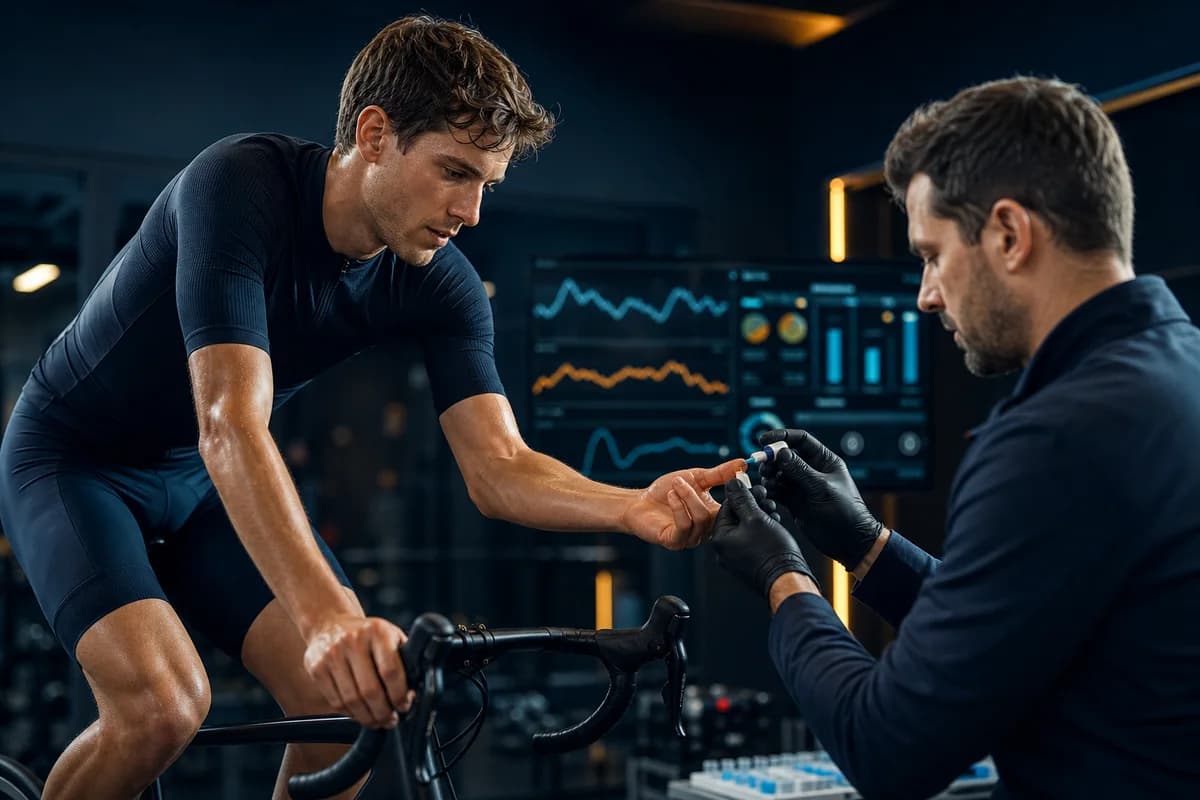
Use lactate testing only if the result will change training. Have a qualified tester run a sport-specific incremental protocol with 3-5 minute stages, small consistent workload increases and a capillary sample near the end of each stage, while recording heart rate, pace or power and perceived effort. Arrive rested and keep food, caffeine, hydration, temperature and equipment consistent. Analyze the curve with one preselected threshold method, then repeat the same protocol after roughly 8-12 weeks—not weekly. Stop the test for chest pain, faintness, severe unusual breathlessness, loss of coordination or other clinical stop signs.See reference 1,See reference 2,See reference 3
The 10 rules to remember
- Portable analyzers can be reliable, but device bias—especially at high lactate—varies.See reference 1
- There are many lactate-threshold concepts; identical labels do not guarantee identical physiology.See reference 2
- The full lactate-power or lactate-pace curve is more informative than one fixed cutoff.See reference 3
- Different handheld analyzers are not automatically interchangeable.See reference 4
- Sample technique, sweat contamination and timing can alter a tiny capillary result.See reference 5
- Repeatability depends on using the same protocol, stage length and threshold method.See reference 6
- Short stages may not reach a physiological steady state and can shift the curve.See reference 7
- A fixed 4 mmol/L threshold may correlate with performance in groups but can misclassify an individual.See reference 8
- Heart-rate-derived thresholds have wide individual limits of agreement with lactate thresholds.See reference 9
- Testing is optional; sustainable training can be prescribed without blood sampling.See reference 10
First principles: what this tool can actually change
Lactate is continuously produced and used as a fuel and signaling molecule. Blood concentration reflects the balance of appearance, transport and removal—not a switch from aerobic to anaerobic metabolism and not a waste product causing next-day soreness.See reference 1,See reference 2
As workload rises, lactate often remains near baseline, then rises more clearly as production outpaces removal. Where a tester places one or two thresholds depends on the mathematical or visual definition selected.See reference 3,See reference 4
Training value comes from matching a repeatable external workload to internal response. A threshold is an estimate with biological and analytical error, so zones should be bands tested against breathing, perceived effort and performance.See reference 5,See reference 6
A practical protocol
- Stage
- Standardize
- What to do
- Same mode, preparation, environment and analyzer
- Why it matters
- Controls major sources of variationSee reference 1
- Stage
- Stage
- What to do
- Increase pace or power every 3-5 minutes
- Why it matters
- Allows lactate response to developSee reference 2
- Stage
- Sample
- What to do
- Clean, dry site; discard contaminated drop if protocol requires
- Why it matters
- Reduces sweat and tissue-fluid errorSee reference 3
- Stage
- Model
- What to do
- Plot lactate with power/pace, HR and effort using one method
- Why it matters
- Prevents a number being detached from performanceSee reference 4
Timing and frequency
- When
- 24-48 hours before
- Action
- Avoid unusually hard or glycogen-depleting trainingSee reference 5
- When
- Test day
- Action
- Replicate food, caffeine, hydration and time of daySee reference 6
- When
- During test
- Action
- Sample at the same point in every stageSee reference 7
- When
- Retest
- Action
- Usually after an 8-12 week training block or meaningful program changeSee reference 8
What to measure
- Signal
- Lactate
- How
- mmol/L at each stage
- Interpretation
- Interpret as a curve with meter uncertaintySee reference 7
- Signal
- External workload
- How
- Power, pace or speed
- Interpretation
- The actionable training outputSee reference 8
- Signal
- Heart rate
- How
- Stable end-stage value where possible
- Interpretation
- Useful secondary anchor with day-to-day driftSee reference 9
- Signal
- Perceived exertion and breathing
- How
- Same scale and notes
- Interpretation
- Adds field context to the laboratory estimateSee reference 10
What the evidence supports
A standardized lactate curve can identify submaximal changes that a maximal VO2 test alone may miss and can anchor sport-specific endurance prescription.See reference 1,See reference 3
Recent review finds portable analyzers generally show strong reliability and moderate-to-high validity, while systematic bias at high concentrations remains common.See reference 2,See reference 4
Threshold workloads correlate with endurance performance in many sports, but predictive quality depends on the threshold definition, test design and population.See reference 5,See reference 6
Evidence strength by claim
- Claim
- Maps an individual's lactate response to workload
- Confidence
- Strong with a sound protocol
- Important boundary
- Analytical and biological variation remainSee reference 1,See reference 2
- Claim
- Helps prescribe endurance intensity
- Confidence
- Moderate
- Important boundary
- No single threshold method is universally bestSee reference 3,See reference 4
- Claim
- A fixed 4 mmol/L value is every person's threshold
- Confidence
- Not supported
- Important boundary
- Individual curves varySee reference 5,See reference 6
- Claim
- Frequent lactate testing improves longevity
- Confidence
- Not established
- Important boundary
- Testing itself is not trainingSee reference 7,See reference 8,See reference 9,See reference 10
Limitations and common overclaims
Threshold terminology is inconsistent and more than two dozen concepts exist. Reports must name the method rather than presenting 'LT2' as self-explanatory.See reference 3,See reference 7
Glycogen, prior exercise, temperature, altitude, stage duration, sampling site and meter bias can shift the curve without a true fitness change.See reference 5,See reference 8
A precise threshold can create false confidence. Real training responses span zones, and heart rate or pace may drift with heat, fatigue and terrain.See reference 9,See reference 10
How to make it stick
Decide before testing which threshold method and training decision will be used. Do not select the method afterward because it gives preferred zones.See reference 1,See reference 2
Create a protocol sheet with every workload, stage length, sample time, device and preparation variable so the retest is genuinely comparable.See reference 3,See reference 4
Use the result for broad intensity ranges, then verify them in normal training with talk test, perceived effort, recovery and performance.See reference 5,See reference 6
Troubleshooting
- Problem
- Curve is erratic
- Likely issue
- Sampling contamination, short stages or device error
- Better next step
- Repeat suspect samples and audit the protocolSee reference 2,See reference 3
- Problem
- Zones feel impossible
- Likely issue
- Threshold method or preparation may not fit
- Better next step
- Review the curve and verify in the fieldSee reference 4,See reference 5
- Problem
- Retest is worse
- Likely issue
- Fatigue, glycogen, heat or illness may differ
- Better next step
- Compare conditions before changing the programSee reference 6,See reference 7
- Problem
- Meter disagrees with lab
- Likely issue
- Systematic device bias
- Better next step
- Do not mix devices; use method-specific interpretationSee reference 8,See reference 9,See reference 10
Safety and when to stop
Finger-prick testing requires gloves for anyone handling another person's blood, a new sterile single-use lancet, an approved sharps container and proper disinfection; never share lancing devices. Maximal or near-maximal incremental testing should be appropriately screened and supervised. Do not undertake an unsupervised hard field test with exertional chest pain, unexplained fainting, unstable heart or lung disease or acute illness. Stop for chest pressure, faintness, severe unusual breathlessness, loss of coordination, cyanosis or sustained palpitations.See reference 1,See reference 5,See reference 9
Who is most likely to benefit
Lactate testing is most useful for experienced endurance athletes and coaches who can hold workload accurately and will use the curve to adjust training.See reference 2,See reference 4
Beginners usually gain more from consistent training, simple perceived-effort zones and progressive volume than from invasive testing.See reference 5,See reference 7
People with symptoms or known cardiopulmonary disease should use clinically supervised exercise testing rather than a performance-only lactate session.See reference 8,See reference 10
Track five things
- Preparation and previous training.See reference 1
- Stage duration and external workload.See reference 2
- Lactate, heart rate and perceived effort.See reference 3
- Analyzer, strips and sampling technique.See reference 4
- Threshold method and resulting training change.See reference 5
Frequently asked questions
What does a lactate threshold test measure?
It measures how capillary blood lactate changes across staged workloads and estimates useful transition regions for endurance training.See reference 1
Is 4 mmol/L my lactate threshold?
Not necessarily. Four mmol/L is a fixed convention that can differ substantially from an individual's curve-derived boundary.See reference 2
How long should each stage be?
Three to five minutes is common, but the chosen protocol must fit the sport and be kept identical for retesting.See reference 3
Can I test lactate by myself?
Self-testing during hard exercise adds blood-handling, timing and safety errors. A qualified second person is the stronger option.See reference 4
How often should I retest?
After a meaningful training block—often 8-12 weeks—is more useful than frequent testing.See reference 5
Does lactate cause muscle soreness?
No. Lactate clears rapidly; delayed-onset soreness reflects other responses to unfamiliar or damaging load.See reference 6
Can a watch estimate lactate threshold?
It can estimate from heart rate and performance algorithms, but this is not the same as a measured lactate curve.See reference 7
Do I need lactate testing for Zone 2?
No. Talk test, perceived effort, heart rate and sustainable output are usually sufficient for practical Zone 2 training.See reference 8
Connect the protocol to your wider health picture
LongevityMate helps organize measurements, habits, symptoms and trends so one tool stays in context instead of becoming the whole plan.
See how LongevityMate worksReferences
- 1. Validity and Reliability of Portable Blood Lactate Analyzers
Sports Medicine - OpenSystematic review
- 2. Lactate threshold concepts: how valid are they?
Sports MedicineEvidence review
- 3. Reliability and accuracy of six hand-held blood lactate analysers
Journal of Sports Science and MedicineObservational study
- 4. Evaluation of three portable blood lactate analysers
European Journal of Applied PhysiologyObservational study
- 5. Accuracy and reliability of Accutrend and Lactate Pro
International Journal of Sports MedicineObservational study
- 6. Repeatability and predictive value of lactate threshold concepts
PLOS ONEObservational study
- 7. Incremental exercise test design and analysis
Sports MedicineEvidence review
- 8. Lactate thresholds and rowing performance
Systematic reviewSystematic review
- 9. HRV-derived thresholds versus ventilatory and lactate thresholds
Sports Medicine - OpenSystematic review
- 10. ACSM's Guidelines for Exercise Testing and Prescription
American College of Sports MedicineGuideline
Editorial transparency
- Published by
- LongevityMate Editorial Team
- Published
- Updated
Medical disclaimer
This guide provides general health education. It does not diagnose a condition, prescribe treatment, replace individualized medical care, or guarantee a health or longevity outcome.