
One-minute protocol
The simple evidence-based protocol
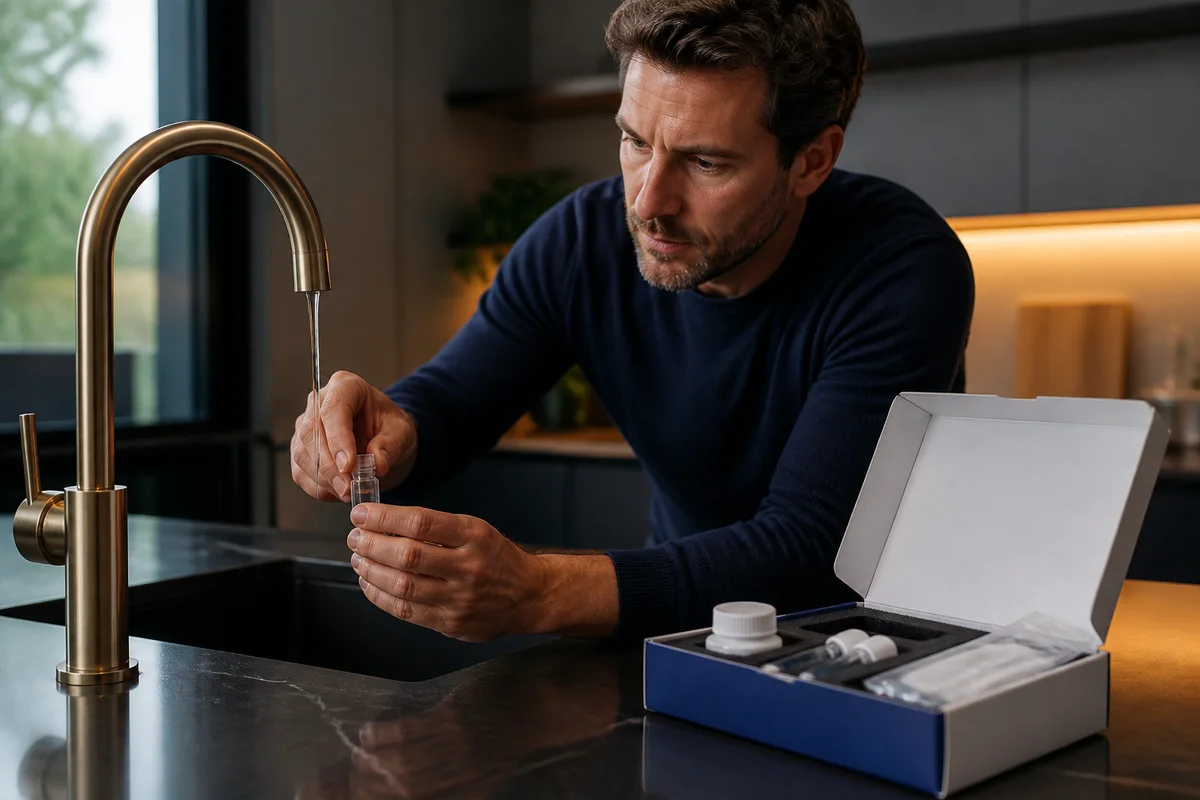
First identify whether the tap receives regulated public water or a private well. For public water, read the current Consumer Confidence Report, then use a certified laboratory if the concern is building plumbing, lead, taste, an advisory or a vulnerable household member. For a private well, test at least yearly for total coliform bacteria, nitrate, total dissolved solids and pH, plus locally relevant contaminants; test again after flooding, repairs or a sudden change. Follow the lab's exact bottle, tap, timing, preservation and transport instructions.See reference 1,See reference 2,See reference 3
The 10 rules to remember
- Start with the water source and a plausible contaminant, not the largest test bundle.See reference 1
- Use the public supplier's quality report for system-level results but remember it may not reflect your building plumbing.See reference 2
- Private-well owners are responsible for testing because federal public-water rules generally do not cover their well.See reference 3
- Use a certified laboratory when health or treatment decisions depend on the result.See reference 4
- Follow sampling instructions exactly; first-draw, flushed and sterile samples answer different questions.See reference 5
- Test private wells annually for coliform, nitrate, total dissolved solids and pH, then add local risks.See reference 6
- Retest after flood, well repair, nearby contamination, unexplained illness or a sudden change in taste, odor or color.See reference 7
- Do not assume clear, odorless water is safe; lead, nitrate and many contaminants cannot be detected by senses.See reference 8
- Do not buy a filter until the contaminant and concentration are known and the treatment is certified for it.See reference 9
- A cheap strip can screen selected chemistry but cannot provide universal clearance that water is safe.See reference 10
First principles: what this tool can actually change
Water quality is a set of distinct microbial, chemical, radiological and aesthetic properties. No single home sensor or total-dissolved-solids number can identify every hazard.See reference 1,See reference 2
The sample is part of the measurement. Water standing in household plumbing can answer a lead-exposure question, while a flushed sample may represent the supply; sterile bacteriology bottles and prompt transport prevent false results.See reference 3,See reference 4
Testing creates value only when a result maps to an action: confirm, stop using, notify the supplier or health department, repair the source, or install a treatment independently certified for that contaminant.See reference 5,See reference 6
Choose the right testing pathway
- Stage
- Identify source
- What to do
- Public supply, private well, rainwater or another source
- Why it matters
- Determines regulation and likely risksSee reference 1
- Stage
- Define concern
- What to do
- Report, plumbing, flood, illness, land use, taste or vulnerable user
- Why it matters
- Selects the right analytes and sampleSee reference 2
- Stage
- Sample
- What to do
- Use certified lab kit and exact collection instructions
- Why it matters
- Protects validity and chain of custodySee reference 3
- Stage
- Act
- What to do
- Compare with local standards and contact the appropriate authority
- Why it matters
- Converts a number into risk managementSee reference 4
Timing and frequency
- When
- Public supply yearly
- Action
- Read the current Consumer Confidence ReportSee reference 5
- When
- Private well yearly
- Action
- Test coliform, nitrate, total dissolved solids and pH at minimumSee reference 6
- When
- Immediately after an event
- Action
- Test after flood, well damage, repair, nearby spill or sudden changeSee reference 7
- When
- After treatment
- Action
- Retest at the specified point and interval to verify performanceSee reference 8
What to measure
- Signal
- Microbial
- How
- Total coliform and E. coli with sterile lab method
- Interpretation
- Indicates contamination and possible fecal pathwaySee reference 7
- Signal
- Nitrate
- How
- Certified quantitative laboratory result
- Interpretation
- Especially important for infants and pregnancySee reference 8
- Signal
- Lead and copper
- How
- Use the specified first-draw or flushed protocol
- Interpretation
- House plumbing and stagnation affect exposureSee reference 9
- Signal
- Local chemicals
- How
- Arsenic, PFAS, pesticides, VOCs or radionuclides as locally indicated
- Interpretation
- Risk depends on geology and land useSee reference 10
What the evidence supports
Risk-based laboratory testing can identify invisible microbial or chemical hazards and guide source repair or effective treatment.See reference 1,See reference 3
Annual well testing provides a repeatable minimum surveillance layer, while event-triggered testing catches changes that a calendar alone would miss.See reference 2,See reference 4
Public reports and local health departments reduce unnecessary testing by identifying known system results, regional geology and current advisories.See reference 5,See reference 6
Evidence strength by claim
- Claim
- Certified lab testing identifies a specified contaminant
- Confidence
- High
- Important boundary
- Only for the analyte and sample testedSee reference 1,See reference 2
- Claim
- Annual core testing protects private-well users
- Confidence
- Strong official guidance
- Important boundary
- Additional local risks may be requiredSee reference 3,See reference 4
- Claim
- TDS proves water is safe or unsafe
- Confidence
- Not supported
- Important boundary
- It is nonspecific and many hazards are invisibleSee reference 5,See reference 6
- Claim
- One large home panel clears all future risk
- Confidence
- Not supported
- Important boundary
- Water, plumbing and events change over timeSee reference 7,See reference 8,See reference 9,See reference 10
Limitations and common overclaims
A negative result applies to the sampled tap, time, analyte and method. It does not exclude untested contaminants or intermittent contamination.See reference 3,See reference 7
Maximum contaminant levels and reporting rules vary by country and water system. Use the health authority responsible for your location rather than importing an internet threshold blindly.See reference 5,See reference 8
Some consumer kits use color matching or nonspecific indicators with limited detection ranges. They may be useful for preliminary checks but not for lead, microbial safety or complex treatment decisions.See reference 9,See reference 10
How to make it stick
Keep a water file with source, plumbing age, supplier reports, laboratory certificates, sampling points, treatment model and filter-change dates.See reference 1,See reference 2
Ask the lab or health department to select the panel from local geology, land use, nearby industry, septic systems and household vulnerability.See reference 3,See reference 4
When buying treatment, verify an independent certification that names the exact contaminant and capacity, then retest to confirm real performance.See reference 5,See reference 6
Troubleshooting
- Problem
- Test kits disagree
- Likely issue
- Different methods, ranges or sampling
- Better next step
- Use a certified laboratory with a defined methodSee reference 2,See reference 3
- Problem
- Lead is high at one tap
- Likely issue
- Fixture or internal plumbing may contribute
- Better next step
- Stop exposure as advised and investigate source-specific plumbingSee reference 4,See reference 5
- Problem
- Bacteria result is positive
- Likely issue
- True contamination or sampling error
- Better next step
- Follow health-department advice, use safe alternate water and confirmSee reference 6,See reference 7
- Problem
- TDS is high
- Likely issue
- Many dissolved ions can raise it
- Better next step
- Identify the specific constituents before choosing treatmentSee reference 8,See reference 9,See reference 10
Safety and when to stop
Do not drink, cook with, brush teeth with or make infant formula from water under a do-not-use advisory or when authorities advise an alternate source. Boiling can kill many microbes but does not remove lead, nitrate, PFAS, salts or most chemicals and can concentrate some contaminants. Infants, pregnant people and immunocompromised users can be especially vulnerable. For suspected contamination, positive E. coli, high nitrate, fuel odor or acute illness, contact the local health or water authority promptly and use a verified safe source.See reference 1,See reference 5,See reference 9
Who is most likely to benefit
Testing is essential for private-well households, especially after events and where infants, pregnancy or vulnerable people increase consequence.See reference 2,See reference 4
Public-water users benefit when building plumbing, a service line, local advisory or unexplained change creates a tap-specific question.See reference 5,See reference 7
Broad routine panels have lower value when the regulated system report and local risk assessment already answer the question; targeted testing is stronger.See reference 8,See reference 10
Track five things
- Water source and exact sampling tap.See reference 1
- Date, stagnation or flush time and recent events.See reference 2
- Certified method and analytes.See reference 3
- Result, unit and local health benchmark.See reference 4
- Corrective action and verification retest.See reference 5
Frequently asked questions
What should I test in a private well?
At least yearly test total coliform bacteria, nitrate, total dissolved solids and pH, then add contaminants based on local geology and land use.See reference 1
Is a home strip enough?
Not when health decisions depend on the answer. Use a certified laboratory for microbial, lead and other consequential testing.See reference 2
Does clear water mean safe water?
No. Lead, nitrate, arsenic, PFAS and many microbes cannot be reliably seen, smelled or tasted.See reference 3
Should public tap water be tested?
Read the supplier report first; tap testing is useful when internal plumbing, a service line, advisory or local event creates an unresolved risk.See reference 4
How often should well water be tested?
At least annually for the core panel and promptly after floods, repairs, contamination events or major sensory changes.See reference 5
Can boiling fix contaminated water?
It helps with many microbes when authorities advise it, but does not remove most chemical contaminants and can concentrate them.See reference 6
Does high TDS mean dangerous water?
Not by itself. TDS is nonspecific; identify the actual dissolved substances and compare them with health standards.See reference 7
Which filter should I buy?
Only after identifying the contaminant; choose a treatment independently certified for that exact substance and verify it after installation.See reference 8
Connect the protocol to your wider health picture
LongevityMate helps organize measurements, habits, symptoms and trends so one tool stays in context instead of becoming the whole plan.
See how LongevityMate worksReferences
- 1. Home Drinking Water Testing
U.S. Environmental Protection AgencyOfficial guidance
- 2. Guidelines for Testing Well Water
Centers for Disease Control and PreventionOfficial guidance
- 3. Protect Your Home's Water
U.S. Environmental Protection AgencyOfficial guidance
- 4. Private Drinking Water Wells
U.S. Environmental Protection AgencyOfficial guidance
- 5. Testing Drinking Water for Lead
U.S. Environmental Protection AgencyOfficial guidance
- 6. Consumer Confidence Reports
U.S. Environmental Protection AgencyOfficial guidance
- 7. Certified Drinking Water Laboratories
U.S. Environmental Protection AgencyOfficial guidance
- 8. Private Well Water and Your Health
Centers for Disease Control and PreventionOfficial guidance
- 9. Water, Sanitation and Hygiene After an Emergency
Centers for Disease Control and PreventionOfficial guidance
- 10. Guidelines for Drinking-water Quality
World Health OrganizationGuideline
Editorial transparency
- Published by
- LongevityMate Editorial Team
- Published
- Updated
Medical disclaimer
This guide provides general health education. It does not diagnose a condition, prescribe treatment, replace individualized medical care, or guarantee a health or longevity outcome.