
One-minute protocol
The simple evidence-based protocol
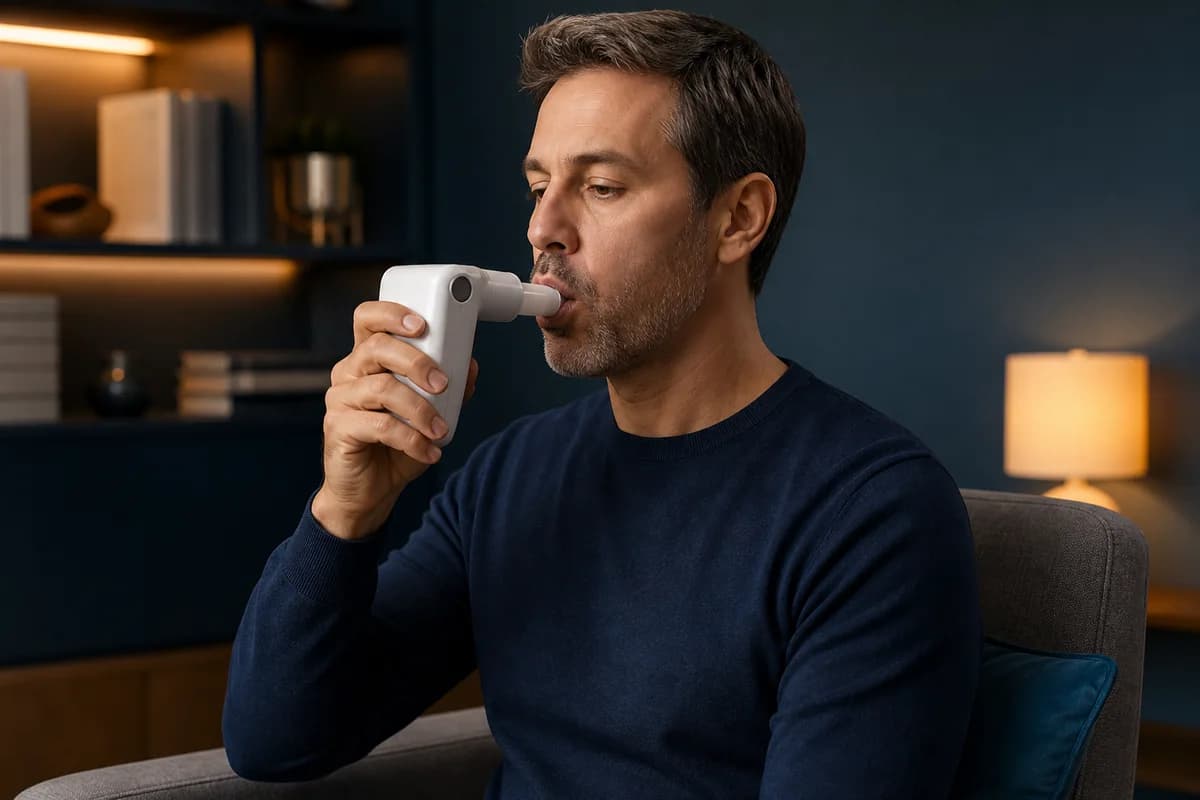
Use home spirometry only after a clinician or respiratory professional has confirmed the device, trained you and set a personal baseline and action plan. At the same time of day, sit or stand upright, attach a clean single-user mouthpiece, inhale completely, seal your lips, then blast out as hard and fast as possible and keep exhaling until no more air comes. Perform at least three acceptable efforts according to the device plan, record the best repeatable FEV1 and FVC, symptoms and medicine timing, and stop if you become faint, develop chest pain or have severe coughing. Never delay urgent care because a reading looks normal.See reference 1,See reference 2,See reference 3
The 10 rules to remember
- High-quality spirometry depends on maximal inspiration, an explosive start and complete expiration.See reference 1
- Unsupervised home results tend to be lower and have wide individual variability versus supervised testing.See reference 2
- Home spirometry is better suited to monitoring than first-time diagnosis.See reference 3
- Clinic and home values may disagree even in trial settings.See reference 4
- A device should provide quality feedback and be compared with supervised reference testing.See reference 5
- Remote monitoring benefits are condition- and program-specific, not guaranteed by owning a device.See reference 6
- Symptoms and an action plan outrank a single FEV1 number.See reference 7
- Regular professional review is required to distinguish technique drift from lung-function change.See reference 8
- Home monitoring has evidence gaps across many chronic lung diseases.See reference 9
- More frequent blowing is not always better and can increase burden or symptom anxiety.See reference 10
First principles: what this tool can actually change
FEV1 is the volume exhaled in the first second of a forced maneuver; FVC is the total forced volume. The ratio and pattern can support clinical interpretation, but diagnosis requires quality control, appropriate reference equations and medical context.See reference 1,See reference 2
The maneuver is effort-dependent. A hesitant start lowers FEV1, an early stop lowers FVC, and leaks, cough or poor seal can distort both—so apparent disease change may be technique change.See reference 3,See reference 4
Monitoring is useful when a personal change threshold triggers a pre-agreed action. A generic predicted percentage is less actionable than a reliable fall from a high-quality personal baseline plus symptoms.See reference 5,See reference 6
A practical protocol
- Stage
- Set baseline
- What to do
- Compare device with supervised quality-controlled spirometry
- Why it matters
- Anchors home values to a trusted measurementSee reference 1
- Stage
- Prepare
- What to do
- Same time, posture, medicine timing and clean mouthpiece
- Why it matters
- Reduces avoidable variationSee reference 2
- Stage
- Blow
- What to do
- Full inhale, explosive start, complete continued exhale
- Why it matters
- Determines FEV1 and FVC validitySee reference 3
- Stage
- Repeat and act
- What to do
- At least three acceptable efforts; use personal action plan
- Why it matters
- Separates random error from a meaningful fallSee reference 4
Timing and frequency
- When
- Baseline visit
- Action
- Receive technique training, contraindication screen and action thresholdsSee reference 5
- When
- Routine monitoring
- Action
- Use the clinician-defined schedule, often same time of daySee reference 6
- When
- Symptom change
- Action
- Measure if the action plan calls for it, but do not delay careSee reference 7
- When
- Review
- Action
- Periodically compare technique and device with clinic spirometrySee reference 8
What to measure
- Signal
- FEV1
- How
- Best acceptable forced-exhalation result
- Interpretation
- Sensitive to airway obstruction and effortSee reference 7
- Signal
- FVC
- How
- Total forced volume after complete exhalation
- Interpretation
- Sensitive to early stopping and restriction patternsSee reference 8
- Signal
- Repeatability
- How
- Difference between best efforts
- Interpretation
- Large spread suggests technique or unstable measurementSee reference 9
- Signal
- Symptoms
- How
- Breathlessness, wheeze, cough and activity limitation
- Interpretation
- Can require action even with a normal valueSee reference 10
What the evidence supports
Home spirometry can provide frequent longitudinal data and improve access for selected patients when it is embedded in a monitored clinical program.See reference 1,See reference 3
It has practical roles in some transplant, cystic-fibrosis, interstitial-lung-disease, asthma and COPD pathways, but evidence and thresholds differ.See reference 2,See reference 4
The strongest benefit is earlier recognition of a meaningful personal change linked to clinician feedback—not self-generated diagnosis from a consumer app.See reference 5,See reference 6
Evidence strength by claim
- Claim
- Provides repeatable personal lung-function trends
- Confidence
- Moderate with training
- Important boundary
- Technique and device quality are criticalSee reference 1,See reference 2
- Claim
- Supports selected disease-monitoring programs
- Confidence
- Variable
- Important boundary
- Requires feedback and an action pathwaySee reference 3,See reference 4
- Claim
- Replaces supervised diagnostic spirometry
- Confidence
- Not supported
- Important boundary
- Home and clinic values are not interchangeableSee reference 5,See reference 6
- Claim
- Improves longevity through routine self-testing
- Confidence
- Not established
- Important boundary
- No direct outcome evidenceSee reference 7,See reference 8,See reference 9,See reference 10
Limitations and common overclaims
A meta-analysis found wide limits of agreement and systematic underestimation for unsupervised FEV1 and FVC, making individual interchangeability unsafe.See reference 3,See reference 7
Reference equations, device algorithms, calibration and mouthpieces differ. A consumer percentage predicted may hide important methodological assumptions.See reference 5,See reference 8
Daily measurements can create false alerts, technique fatigue and anxiety. Monitoring frequency should be the minimum that improves the care plan.See reference 9,See reference 10
How to make it stick
Record a short video of your trained technique if the clinician permits, then use the same posture, instructions and coaching cue at home.See reference 1,See reference 2
Store raw FEV1 and FVC values plus quality grades, not only green or red app zones. Trend context is needed for review.See reference 3,See reference 4
Write urgent symptom rules separately from numerical thresholds so a normal-looking reading never delays care.See reference 5,See reference 6
Troubleshooting
- Problem
- Results vary widely
- Likely issue
- Inconsistent inspiration, start, seal or exhalation
- Better next step
- Repeat after rest and arrange technique reviewSee reference 2,See reference 3
- Problem
- FVC is unexpectedly low
- Likely issue
- Exhalation ended early or restriction is possible
- Better next step
- Check maneuver quality; do not self-diagnoseSee reference 4,See reference 5
- Problem
- Device says good but symptoms worsen
- Likely issue
- Quality algorithm or number misses the clinical change
- Better next step
- Follow symptom action plan and contact careSee reference 6,See reference 7
- Problem
- Values drift down over weeks
- Likely issue
- Technique, device or disease may have changed
- Better next step
- Compare with supervised spirometry promptlySee reference 8,See reference 9,See reference 10
Safety and when to stop
Forced spirometry can cause dizziness, coughing, chest discomfort or fainting and may be inappropriate after recent heart attack, unstable heart disease, pneumothorax, coughing blood, recent eye, chest, abdominal or brain surgery, or an aneurysm—obtain clinician clearance. Test seated if fainting is a concern and stop for chest pain, severe breathlessness, faintness, new neurologic symptoms or prolonged coughing. Seek urgent care for severe breathing difficulty, blue lips, confusion or inability to speak in sentences regardless of the reading.See reference 1,See reference 5,See reference 9
Who is most likely to benefit
Home spirometry is most useful for selected patients whose respiratory clinician will review trends and has defined exactly what change should trigger action.See reference 2,See reference 4
It is less suitable for curious healthy users or first-time diagnosis because poor technique and population reference values can mislead.See reference 5,See reference 7
Children, older adults and people with neuromuscular or cognitive limitations may use it successfully, but coaching, usability and acceptability need individual assessment.See reference 8,See reference 10
Track five things
- Device, mouthpiece and quality grade.See reference 1
- Time, posture and medicine timing.See reference 2
- Best FEV1 and FVC from acceptable efforts.See reference 3
- Symptoms and recent exposures or infection.See reference 4
- Action threshold, contact and outcome.See reference 5
Frequently asked questions
What do FEV1 and FVC mean?
FEV1 is air blown out in the first second; FVC is the total forced exhaled volume. Their quality and relationship require proper interpretation.See reference 1
How many times should I blow?
At least three acceptable maneuvers is a common standard, but follow the device-specific clinician plan and stop if unwell.See reference 2
Can home spirometry diagnose asthma or COPD?
No by itself. Diagnosis requires quality-controlled testing, clinical history and sometimes bronchodilator or additional tests.See reference 3
Should I test before or after an inhaler?
Use the exact timing in the personal plan; medicine timing changes the result.See reference 4
Why are my home values lower than clinic values?
Technique, coaching, device and setting can all contribute; unsupervised values are often lower in studies.See reference 5
How often should I test?
Only as often as the condition-specific plan requires. More data without an action pathway can create noise.See reference 6
Can I share the mouthpiece?
Use single-patient components or validated disinfection exactly as labeled; sharing can transmit infection.See reference 7
What drop in FEV1 is concerning?
Use a clinician-defined personal threshold plus symptoms. There is no safe universal consumer cutoff for every disease.See reference 8
Connect the protocol to your wider health picture
LongevityMate helps organize measurements, habits, symptoms and trends so one tool stays in context instead of becoming the whole plan.
See how LongevityMate worksReferences
- 1. Standardization of Spirometry 2019 Update
American Thoracic Society and European Respiratory SocietyGuideline
- 2. Unsupervised home versus supervised clinic spirometry
European Respiratory ReviewMeta-analysis
- 3. Home Spirometry
Clinics in Chest MedicineEvidence review
- 4. Clinic versus Home Spirometry in Asthma
ChestObservational study
- 5. Assessment of Home-based Monitoring in Chronic Lung Disease
American Thoracic SocietyOfficial guidance
- 6. Remote home monitoring for COPD
BMC Health Services ResearchSystematic review
- 7. Remote home spirometry in adult asthma
Journal of Personalized MedicineSystematic review
- 8. Remote respiratory assessments for COPD
Systematic reviewSystematic review
- 9. Remote monitoring in asthma
European Respiratory ReviewSystematic review
- 10. Feasibility and quality of unsupervised at-home spirometry
Primary care studyObservational study
Editorial transparency
- Published by
- LongevityMate Editorial Team
- Published
- Updated
Medical disclaimer
This guide provides general health education. It does not diagnose a condition, prescribe treatment, replace individualized medical care, or guarantee a health or longevity outcome.