
One-minute protocol
The simple evidence-based protocol
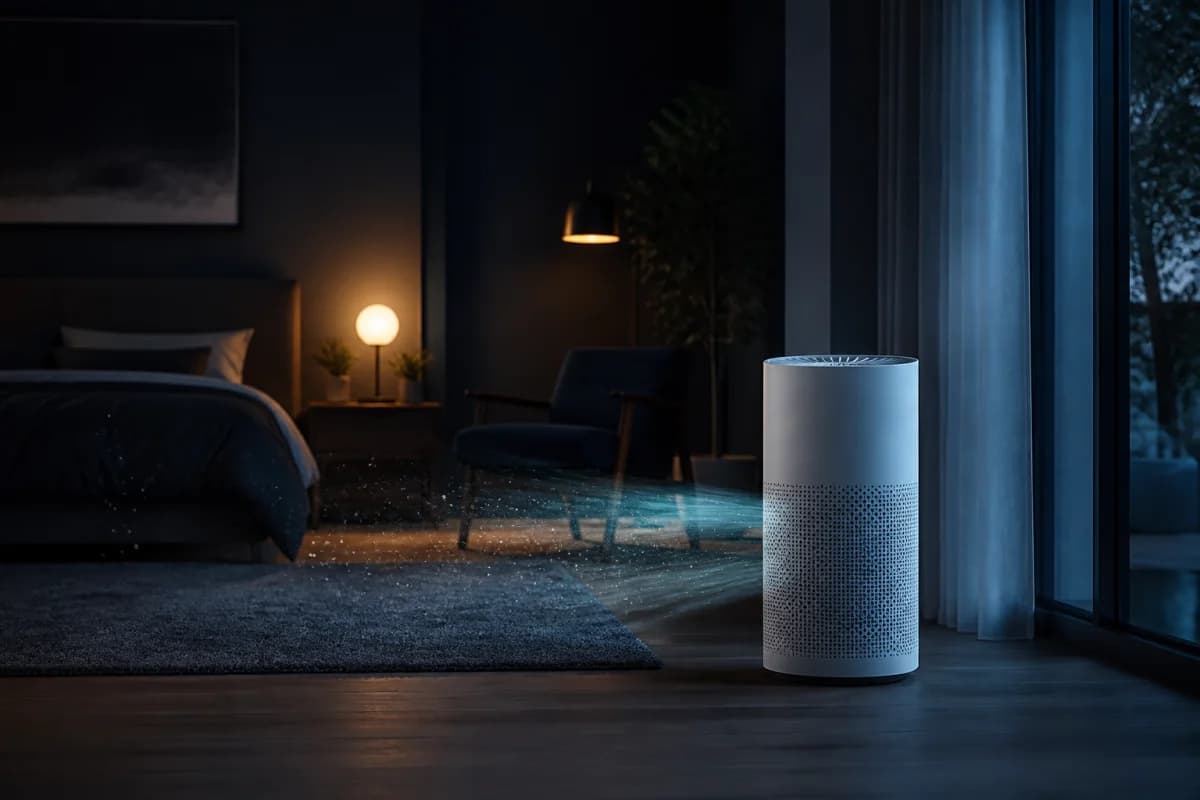
Identify the pollutant first. For particles such as smoke, pollen and fine dust, choose a HEPA unit with a smoke CADR appropriate for the room volume; more clean-air delivery is better if noise remains tolerable. Put it in the room where you spend the most time, away from walls and blocked corners, close doors and windows when outdoor air is polluted, and run it continuously at the highest comfortable speed. Buy replacement filters in advance and avoid devices that intentionally generate ozone.See reference 1,See reference 2,See reference 3
The 10 rules to remember
- Control the pollutant source first.See reference 1
- Ventilate when outdoor air is clean.See reference 2
- Use CADR—not marketing adjectives—to size the unit.See reference 3
- Smoke CADR is useful for fine particles.See reference 4
- HEPA targets particles, not all gases.See reference 5
- More airflow and run time increase filtration.See reference 6
- Place the intake and outlet away from obstructions.See reference 7
- Replace filters when loaded or as directed.See reference 8
- Avoid intentional ozone generation.See reference 9
- A purifier does not repair a mold or moisture problem.See reference 10
First principles: what this tool can actually change
A mechanical filter captures particles that pass through it. Real room performance depends on both filter efficiency and airflow, summarized for portable devices by CADR.See reference 1,See reference 2
Air changes per hour estimate how often an equivalent room volume of clean air is supplied; leakage, mixing and continuing pollution sources affect the actual result.See reference 2,See reference 3
Activated carbon can adsorb some gases, but thin carbon sheets saturate quickly and CADR ratings generally describe particles, not gas removal.See reference 3,See reference 4
A practical protocol
- Stage
- Choose
- What to do
- HEPA or high particle efficiency, adequate smoke CADR
- Why it matters
- Match room volumeSee reference 2
- Stage
- Place
- What to do
- Open airflow, occupied room
- Why it matters
- Avoid blocked cornersSee reference 3
- Stage
- Run
- What to do
- Continuous, highest tolerable speed
- Why it matters
- Use quiet setting for sleepSee reference 4
- Stage
- Maintain
- What to do
- Inspect and replace filters
- Why it matters
- Follow manufacturerSee reference 5
Timing and frequency
- When
- Daily
- Action
- Run while room is occupiedSee reference 5
- When
- Smoke event
- Action
- Start early; keep polluted outdoor air outSee reference 6
- When
- Cooking
- Action
- Use source exhaust firstSee reference 7
- When
- Maintenance
- Action
- Replace loaded filters; clean prefilterSee reference 8
What to measure
- Signal
- CADR
- How
- Clean air delivery per minute
- Interpretation
- Compare particle performanceSee reference 8
- Signal
- Room volume
- How
- Area multiplied by ceiling height
- Interpretation
- Better than area aloneSee reference 9
- Signal
- PM2.5
- How
- Optional particle monitor
- Interpretation
- Useful trend, not complete IAQSee reference 10
- Signal
- Noise
- How
- Decibels at intended speed
- Interpretation
- Affects adherenceSee reference 1
What the evidence supports
Portable filtration reliably lowers indoor particle concentrations when correctly sized and operated.See reference 1,See reference 4
Trials report small, inconsistent improvements in some respiratory and cardiovascular measures; the clearest benefit is exposure reduction, not a guaranteed symptom or longevity outcome.See reference 2,See reference 5
During wildfire smoke or high outdoor pollution, a clean-air room can be a practical protective layer alongside official public-health advice.See reference 3,See reference 6
Evidence strength by claim
- Claim
- The protocol changes its immediate target
- Confidence
- Moderate to strong
- Important boundary
- Depends on correct technique and populationSee reference 1,See reference 2
- Claim
- It improves a clinical or functional outcome
- Confidence
- Variable
- Important boundary
- Effect size and relevance differSee reference 3,See reference 4
- Claim
- It prevents major disease
- Confidence
- Usually limited
- Important boundary
- Surrogate outcomes are not clinical eventsSee reference 5,See reference 6
- Claim
- It extends human lifespan
- Confidence
- Not established
- Important boundary
- Association is not proof of causationSee reference 7,See reference 8,See reference 9,See reference 10
Limitations and common overclaims
One unit may not clean adjacent rooms because walls and closed doors restrict mixing.See reference 5,See reference 7
HEPA filtration does not remove carbon dioxide and cannot substitute for ventilation when outdoor air is safe.See reference 6,See reference 8
A purifier cannot remove settled dust, correct combustion hazards, solve dampness or guarantee protection from infection.See reference 7,See reference 9
How to make it stick
Choose the smallest version you can repeat under normal conditions. Consistency creates a useful signal; a heroic one-off session does not.See reference 1,See reference 2
Change one variable at a time and write down the protocol. Otherwise an apparent improvement may simply reflect different timing, equipment or conditions.See reference 3,See reference 4
Review the result after a pre-defined period. Continue only when the benefit is meaningful, the burden is acceptable and no safety signal has appeared.See reference 5,See reference 6
Troubleshooting
- Problem
- Results vary widely
- Likely issue
- Technique or conditions changed
- Better next step
- Standardize and average repeated observationsSee reference 2,See reference 3
- Problem
- No meaningful benefit
- Likely issue
- Dose, adherence or target may be wrong
- Better next step
- Verify the protocol before escalatingSee reference 4,See reference 5
- Problem
- Symptoms appear
- Likely issue
- The intervention may be unsuitable
- Better next step
- Stop and use appropriate clinical adviceSee reference 6,See reference 7
- Problem
- Tracking creates anxiety
- Likely issue
- Measurement has replaced the goal
- Better next step
- Reduce frequency and focus on functionSee reference 8,See reference 9,See reference 10
Safety and when to stop
Avoid products designed to generate ozone; ozone irritates the lungs. Never block exits or create trip hazards with cords. Do not rely on a purifier for carbon monoxide, gas leaks, radon, severe smoke infiltration or visible mold growth—address the source and follow local safety guidance. People with severe breathing symptoms should seek medical care.See reference 1,See reference 5,See reference 9
Who is most likely to benefit
This tool is most useful when it solves a defined problem, is feasible to repeat and changes a decision. It is less useful when collected or performed only because a score or influencer made it seem mandatory.See reference 2,See reference 4
People with symptoms, diagnosed disease, pregnancy, recent surgery or complex medicines should adapt the protocol with an appropriate health professional.See reference 5,See reference 7
The foundation remains sleep, physical activity, nutrition, tobacco avoidance and evidence-based medical care. Add this tool only where it improves that foundation.See reference 8,See reference 10
Track five things
- The exact protocol, equipment and timing.See reference 1
- The outcome the tool is meant to change.See reference 2
- Symptoms and adverse effects.See reference 3
- Adherence and practical burden.See reference 4
- Whether the result changes a real decision.See reference 5
Frequently asked questions
What does HEPA mean?
A high-efficiency particulate air filter captures at least 99.97% of the most penetrating 0.3-micrometre test particles under its standard.See reference 3
What CADR do I need?
Use room area and ceiling height; EPA's guide provides minimum CADR estimates for typical ceilings.See reference 4
Should it run all night?
Continuous operation improves filtration if noise and safety are acceptable.See reference 5
Where should I place it?
In the occupied room with clear space around intake and outlet.See reference 6
Does it remove VOCs?
HEPA does not; substantial activated carbon or other specific media is needed for some gases.See reference 7
Will it fix mold?
No. Remove the moisture source and remediate the mold.See reference 8
Does it remove CO2?
No. Ventilation is needed.See reference 9
Are ionizers safe?
Some can emit ozone; choose mechanical filtration without intentional ozone generation.See reference 10
Connect the protocol to your wider health picture
LongevityMate helps organize measurements, habits, symptoms and trends so one tool stays in context instead of becoming the whole plan.
See how LongevityMate worksReferences
- 1. Guide to Air Cleaners in the Home
U.S. Environmental Protection AgencyOfficial guidance
- 2. What is a HEPA filter?
U.S. Environmental Protection AgencyOfficial guidance
- 3. Residential Air Cleaners: technical summary
U.S. Environmental Protection AgencyEvidence review
- 4. Indoor air cleaners and health outcomes
Indoor AirSystematic review
- 5. Portable HEPA air cleaners and cardiovascular health
JAMA Internal MedicineRandomized trial
- 6. Air filtration and blood pressure: systematic review
Environmental Health PerspectivesSystematic review
- 7. Portable air filters and asthma outcomes
Cochrane Database of Systematic ReviewsSystematic review
- 8. Wildfire smoke: indoor air filtration
U.S. Environmental Protection AgencyOfficial guidance
- 9. Air quality and health
World Health OrganizationOfficial guidance
- 10. Ventilation in buildings
Centers for Disease Control and PreventionOfficial guidance
Editorial transparency
- Published by
- LongevityMate Editorial Team
- Published
- Updated
Medical disclaimer
This guide provides general health education. It does not diagnose a condition, prescribe treatment, replace individualized medical or dental care, or guarantee a health or longevity outcome.