
One-minute protocol
The simple evidence-based protocol
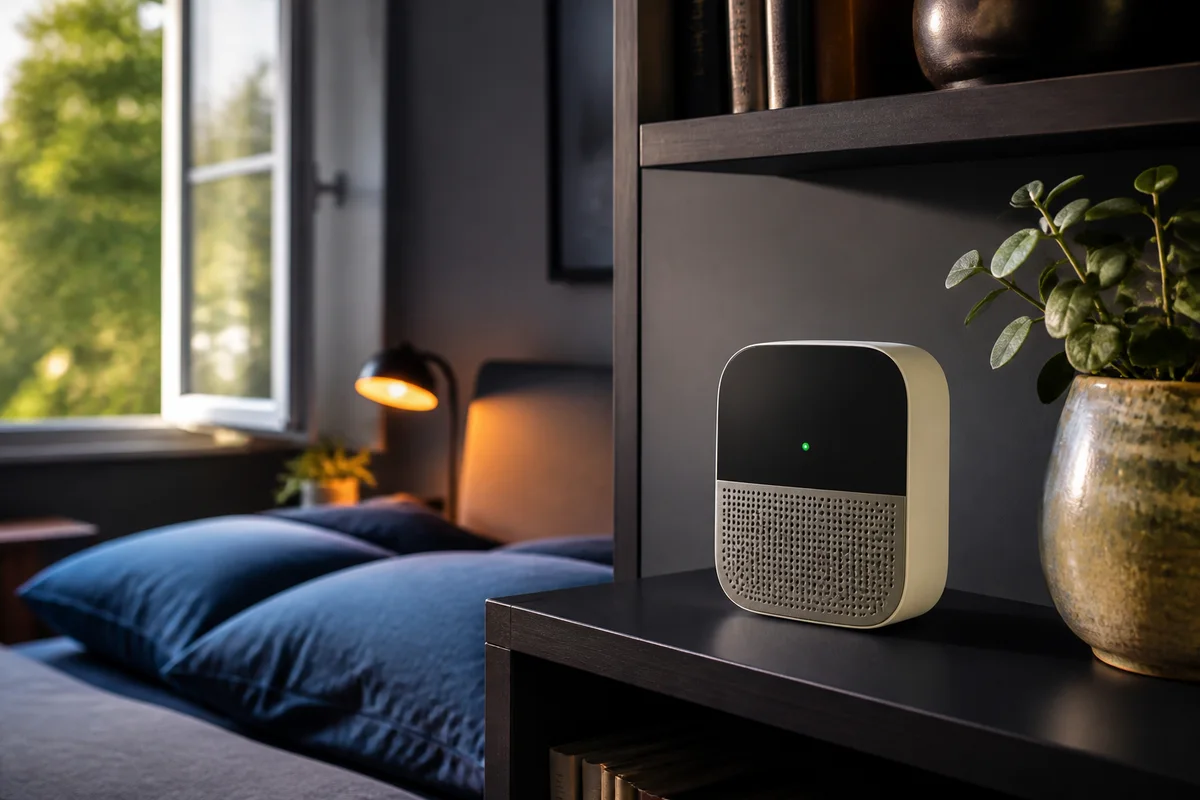
Buy a monitor that specifies a nondispersive-infrared (NDIR) CO2 sensor and an accuracy specification. Place it roughly at breathing height in the occupied zone, at least about 1 meter from a person's face and away from windows, doors, supply vents, heaters and direct sun. Let it stabilize, compare it with outdoor air, then watch occupied 15-30 minute trends. As a practical action point—not a toxicity boundary—sustained readings around or above 1,000 ppm justify checking occupancy and ventilation; aim lower when feasible. Open windows or doors when safe, use mechanical outdoor-air ventilation, or reduce occupancy. A purifier does not remove CO2.See reference 1,See reference 2,See reference 3
The 10 rules to remember
- Indoor CO2 can indicate ventilation relative to occupancy, but it does not measure all air-quality hazards.See reference 1
- Low-cost NDIR sensors can perform well, yet calibration, drift and environmental conditions matter.See reference 2
- Consumer IAQ devices vary in accuracy and many lack standardized performance disclosure.See reference 3
- A single universal CO2 cutoff cannot represent every building, activity and health outcome.See reference 4
- People close to the sensor can create a false spike from exhaled breath.See reference 5
- Outdoor CO2 and building ventilation design determine the indoor baseline.See reference 6
- Particle filters and HEPA purifiers do not remove carbon dioxide.See reference 7
- Common indoor CO2 is not a reliable measure of mold, particles, VOCs, carbon monoxide or infection risk.See reference 8
- Cognitive-performance associations do not prove that reducing one room reading will produce a specific benefit.See reference 9
- A consumer monitor is not a life-safety instrument for confined spaces or combustion hazards.See reference 10
First principles: what this tool can actually change
People exhale CO2. In a room, concentration rises when generation from occupants exceeds removal by outdoor-air exchange. The reading therefore combines occupancy, room volume, ventilation and time.See reference 1,See reference 2
A sensor near a face, open window or supply vent samples a local plume rather than representative room air. Placement and averaging are part of the measurement, not cosmetic details.See reference 3,See reference 4
Ventilation can dilute CO2 and many co-generated indoor contaminants, but source control and filtration may still be needed for particles, smoke, VOCs or moisture. One sensor cannot stand in for an air-quality system.See reference 5,See reference 6
A practical protocol
- Stage
- Verify
- What to do
- Choose NDIR, stated accuracy and accessible calibration instructions
- Why it matters
- Separates real CO2 measurement from estimated eCO2See reference 1
- Stage
- Place
- What to do
- Breathing zone, away from people, vents, windows and heat
- Why it matters
- Makes the reading representativeSee reference 2
- Stage
- Baseline
- What to do
- Compare with outdoor air and an unoccupied room
- Why it matters
- Reveals offset and normal backgroundSee reference 3
- Stage
- Act
- What to do
- Ventilate or reduce occupancy when trends remain high
- Why it matters
- Turns the number into a practical controlSee reference 4
Timing and frequency
- When
- Initial setup
- Action
- Allow the manufacturer's warm-up and stabilization timeSee reference 5
- When
- Occupied room
- Action
- Review 15-30 minute trends, not breath-by-breath spikesSee reference 6
- When
- Bedroom
- Action
- Check the overnight peak and morning level across several nightsSee reference 7
- When
- Monthly or seasonally
- Action
- Recheck outdoor baseline and calibration behaviorSee reference 8
What to measure
- Signal
- CO2 concentration
- How
- ppm from a true NDIR sensor
- Interpretation
- Ventilation proxy relative to occupancySee reference 7
- Signal
- Outdoor baseline
- How
- Short shaded outdoor comparison
- Interpretation
- Indoor-outdoor difference adds contextSee reference 8
- Signal
- Occupancy
- How
- People, duration and room volume
- Interpretation
- Explains generation rateSee reference 9
- Signal
- Ventilation action
- How
- Window, door, fan or HVAC state
- Interpretation
- Shows which change actually lowers the trendSee reference 10
What the evidence supports
EPA and building-science guidance support indoor CO2 monitoring as useful information about ventilation when results are interpreted carefully.See reference 1,See reference 3
A bedroom or meeting-room trend can reveal ventilation that works while empty but fails after prolonged occupancy, enabling a targeted window, fan or HVAC change.See reference 2,See reference 4
Research links ventilation and CO2-related conditions with comfort and cognitive outcomes, but CO2 can also be a marker for other occupant-generated exposures and study designs differ.See reference 5,See reference 6
Evidence strength by claim
- Claim
- Shows ventilation adequacy relative to occupancy
- Confidence
- Moderate to strong
- Important boundary
- Requires representative placement and contextSee reference 1,See reference 2
- Claim
- Helps identify rooms that need more outdoor air
- Confidence
- Moderate
- Important boundary
- Building constraints and outdoor conditions matterSee reference 3,See reference 4
- Claim
- Diagnoses overall indoor air quality or infection safety
- Confidence
- Not supported
- Important boundary
- Does not measure particles, pathogens or many gasesSee reference 5,See reference 6
- Claim
- A specific consumer CO2 target improves longevity
- Confidence
- Not established
- Important boundary
- No direct lifespan evidenceSee reference 7,See reference 8,See reference 9,See reference 10
Limitations and common overclaims
Automatic baseline calibration can be wrong in a continuously occupied space if the algorithm assumes periodic exposure to outdoor-level air.See reference 3,See reference 7
Temperature, humidity, pressure, drift and manufacturing variation affect low-cost sensors; display precision can exceed real accuracy.See reference 5,See reference 8
A low CO2 reading can coexist with smoke, radon, carbon monoxide, ozone, VOCs or mold. Separate hazards require separate source assessment and sensors.See reference 9,See reference 10
How to make it stick
Log one week with occupancy and window or HVAC state. The goal is to identify a repeatable cause-and-effect pattern, not stare at live numbers forever.See reference 1,See reference 2
Test one low-cost action at a time: door position, window opening, exhaust fan or outdoor-air setting. Keep the option that lowers sustained readings without creating another hazard.See reference 3,See reference 4
Use alerts as prompts for action, not as moral grades. A quiet alert near 1,000 ppm is more useful than an alarming red display with no feasible response plan.See reference 5,See reference 6
Troubleshooting
- Problem
- Reading jumps when approached
- Likely issue
- Exhaled breath reached the sensor
- Better next step
- Step away and wait for the trend to settleSee reference 2,See reference 3
- Problem
- Outdoor reading is implausible
- Likely issue
- Calibration, warm-up or sensor fault
- Better next step
- Follow manufacturer recalibration or replace the deviceSee reference 4,See reference 5
- Problem
- Window opening does not help
- Likely issue
- Poor cross-flow or outdoor air path
- Better next step
- Try door plus window or review mechanical ventilationSee reference 6,See reference 7
- Problem
- CO2 is low but symptoms persist
- Likely issue
- Another pollutant or medical cause
- Better next step
- Assess particles, moisture, combustion and clinical contextSee reference 8,See reference 9,See reference 10
Safety and when to stop
A consumer CO2 monitor is not a substitute for a certified carbon-monoxide alarm and must not be used for confined-space entry, industrial safety, combustion diagnosis or emergency rescue. Very high or rapidly rising readings in an occupied enclosed space, especially with headache, dizziness, confusion, breathlessness or loss of consciousness, require leaving for fresh air and contacting emergency or building-safety services. Ventilate only when outdoor smoke, extreme heat or cold, security and fall risks are considered.See reference 1,See reference 5,See reference 9
Who is most likely to benefit
CO2 monitoring is most useful in bedrooms, classrooms, offices, studios and meeting rooms where occupancy changes and ventilation controls are available.See reference 2,See reference 4
It is less useful when the user cannot alter ventilation or when the actual concern is particles, radon, carbon monoxide, mold or a known chemical source.See reference 5,See reference 7
Building managers can use trends to prioritize professional ventilation assessment, but a consumer sensor does not replace commissioning or code compliance testing.See reference 8,See reference 10
Track five things
- Monitor model, sensor type and calibration.See reference 1
- Room, placement and outdoor baseline.See reference 2
- Occupancy and duration.See reference 3
- 15-30 minute trend and overnight peak.See reference 4
- Ventilation action and resulting change.See reference 5
Frequently asked questions
What is a good indoor CO2 level?
Lower than a sustained 1,000 ppm is a practical ventilation aim in many occupied spaces, but it is not a universal health or toxicity boundary.See reference 1
Is 1,000 ppm dangerous?
Not usually as a direct toxicity level in normal buildings. It is commonly used as a signal that ventilation may be low relative to occupancy.See reference 2
Where should I place a CO2 monitor?
At representative breathing height away from faces, windows, doors, vents, heat and direct sun.See reference 3
Does a HEPA purifier reduce CO2?
No. HEPA filters particles; outdoor-air ventilation or specialized gas removal is needed for CO2.See reference 4
Can CO2 show whether a room is COVID-safe?
No. It can inform ventilation, but infection risk also depends on source strength, time, filtration, immunity and other controls.See reference 5
What is eCO2?
It is an estimate often derived from another gas sensor, not a direct NDIR CO2 measurement; do not treat it as equivalent.See reference 6
Why is bedroom CO2 high in the morning?
People exhale CO2 all night while closed doors and windows can limit outdoor-air exchange.See reference 7
Does lower bedroom CO2 improve sleep?
Better ventilation may improve comfort, but a specific CO2 target is not an established treatment for insomnia or sleep apnea.See reference 8
Connect the protocol to your wider health picture
LongevityMate helps organize measurements, habits, symptoms and trends so one tool stays in context instead of becoming the whole plan.
See how LongevityMate worksReferences
- 1. Can I measure CO2 indoors to get information on ventilation?
U.S. Environmental Protection AgencyOfficial guidance
- 2. Performance and Environmental Correction of a Low-Cost NDIR CO2 Sensor
National Institute of Standards and TechnologyObservational study
- 3. Consumer-grade IAQ sensors: limitations and ventilation measurements
National Institute of Standards and TechnologyEvidence review
- 4. ASHRAE Position Document on Indoor Carbon Dioxide
ASHRAEOfficial guidance
- 5. Ventilation in Buildings
Centers for Disease Control and PreventionOfficial guidance
- 6. Indoor Air Quality
U.S. Environmental Protection AgencyOfficial guidance
- 7. Associations of cognitive function scores with CO2 and ventilation
Environmental Health PerspectivesObservational study
- 8. Ventilation rates, CO2 concentrations and health responses
Indoor AirEvidence review
- 9. Low-cost sensors for indoor air quality monitoring
Systematic evidence reviewSystematic review
- 10. Residential Indoor Air Quality Guidelines
Health CanadaOfficial guidance
Editorial transparency
- Published by
- LongevityMate Editorial Team
- Published
- Updated
Medical disclaimer
This guide provides general health education. It does not diagnose a condition, prescribe treatment, replace individualized medical care, or guarantee a health or longevity outcome.