
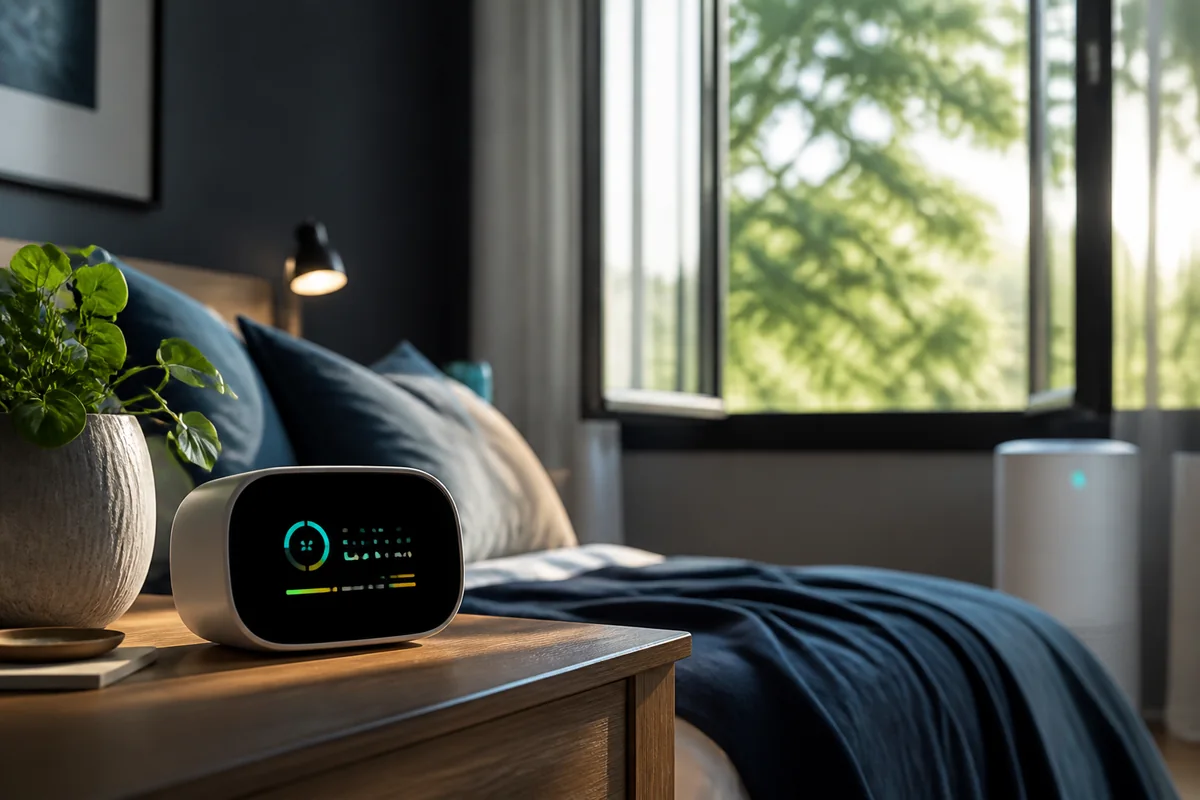
One-minute protocol
The simple evidence-based protocol
Choose a monitor with true nondispersive-infrared CO₂ and, when particles matter, a PM2.5 sensor. Place it in the breathing zone away from windows, doors, vents and direct emissions. Record several normal days, then test changes such as outdoor-air ventilation, kitchen exhaust, source removal or HEPA filtration. Treat consumer VOC values as trends, not chemical identification, and never use a general air monitor instead of certified smoke and carbon-monoxide alarms.See reference 1,See reference 2,See reference 3
The 10 rules to remember
- Choose sensors for a defined question rather than the biggest dashboard.See reference 1
- Use true CO₂ measurement, not an estimated value derived from VOCs.See reference 2
- Place the monitor in the occupied zone away from vents and windows.See reference 3
- Collect a multi-day baseline before changing the room.See reference 4
- Link spikes to occupancy, cooking, smoke, cleaning or outdoor events.See reference 5
- Use ventilation for accumulated CO₂ when outdoor air is suitable.See reference 6
- Use source control and filtration for particles.See reference 7
- Re-measure after every intervention.See reference 8
- Calibrate or co-locate periodically when the device supports it.See reference 9
- A consumer monitor cannot identify every pollutant or certify that a room is medically safe.See reference 10,See reference 9
First principles: what this tool can actually change
Sensors convert a physical or chemical interaction into an estimate; accuracy depends on calibration, humidity, temperature, aging and the target pollutant.See reference 1,See reference 2
CO₂ from occupants is useful as a ventilation proxy, but it is not a complete measure of infection risk or overall air quality.See reference 2,See reference 3
Particle and VOC readings answer different questions: HEPA can reduce particles, while gases require source control, ventilation or specific sorbent media.See reference 3,See reference 4
A practical protocol
- Stage
- Select
- What to do
- NDIR CO₂ plus PM2.5 when relevant
- Why it matters
- Avoids misleading estimated CO₂See reference 2
- Stage
- Position
- What to do
- Breathing height away from vents and sources
- Why it matters
- Makes readings representativeSee reference 3
- Stage
- Baseline
- What to do
- Record occupied and unoccupied periods
- Why it matters
- Shows normal variationSee reference 4
- Stage
- Intervene
- What to do
- Change one source, ventilation or filtration variable
- Why it matters
- Tests whether the action worksSee reference 5
Timing and frequency
- When
- First 3–7 days
- Action
- Observe without changing routineSee reference 3
- When
- During spikes
- Action
- Log occupancy, cooking, smoke and cleaningSee reference 4
- When
- After intervention
- Action
- Compare the same room and conditionsSee reference 5
- When
- Every few months
- Action
- Check calibration, firmware and sensor driftSee reference 6
What to measure
- Signal
- CO₂
- How
- NDIR sensor in ppm
- Interpretation
- Ventilation proxy during occupancySee reference 4
- Signal
- PM2.5
- How
- Optical particle estimate in µg/m³
- Interpretation
- Fine-particle trendSee reference 5
- Signal
- Total VOC
- How
- Metal-oxide or photoionization trend
- Interpretation
- Nonspecific gas changeSee reference 6
- Signal
- Humidity
- How
- Relative humidity percentage
- Interpretation
- Comfort and moisture contextSee reference 7
What the evidence supports
Low-cost monitors can reveal patterns that are invisible to occupants and help target ventilation, filtration and source control.See reference 2,See reference 4
PM2.5 measurements can verify large reductions from effective filtration during smoke or indoor particle events.See reference 3,See reference 5
The health benefit comes from reducing a harmful exposure, not from collecting a better-looking score.See reference 4,See reference 6
Evidence strength by claim
- Claim
- Monitoring detects changes in selected pollutants
- Confidence
- Moderate to strong
- Important boundary
- Consumer accuracy varies by sensor and conditionsSee reference 1,See reference 2
- Claim
- Readings can guide ventilation and source control
- Confidence
- Variable
- Important boundary
- Only when an effective action followsSee reference 3,See reference 4
- Claim
- Owning a monitor prevents respiratory or cardiovascular disease
- Confidence
- Limited or indirect
- Important boundary
- Risk-factor change is not proof of disease preventionSee reference 5,See reference 6
- Claim
- It extends human lifespan
- Confidence
- Not established
- Important boundary
- Association is not proof of causationSee reference 7,See reference 8,See reference 9,See reference 10
Limitations and common overclaims
Many inexpensive products report eCO₂ estimated from VOCs rather than measuring carbon dioxide directly.See reference 5,See reference 7
A single total-VOC number cannot identify a chemical or its toxicity.See reference 6,See reference 8
No general-purpose monitor replaces certified carbon-monoxide and smoke alarms, radon testing or professional assessment.See reference 7,See reference 9
How to make it stick
Choose the smallest version you can repeat under normal conditions. Consistency creates a useful signal; a heroic one-off session does not.See reference 1,See reference 2
Change one variable at a time and write down the protocol. Otherwise an apparent improvement may reflect different timing, equipment or conditions.See reference 3,See reference 4
Review the result after a pre-defined period. Continue only when the benefit is meaningful, the burden is acceptable and no safety signal has appeared.See reference 5,See reference 6
Troubleshooting
- Problem
- Readings jump after cleaning
- Likely issue
- VOC sensor cross-sensitivity
- Better next step
- Ventilate and interpret as a trendSee reference 5
- Problem
- CO₂ seems implausibly fixed
- Likely issue
- Estimated CO₂ or poor placement
- Better next step
- Check sensor type and co-locateSee reference 6
- Problem
- PM rises during cooking
- Likely issue
- Combustion or aerosol source
- Better next step
- Use range hood and verify declineSee reference 7
- Problem
- Different devices disagree
- Likely issue
- Calibration and sensor variation
- Better next step
- Compare trends and use reference-grade data when stakes are highSee reference 8
Safety and when to stop
A general indoor-air monitor is not an emergency alarm. Install certified smoke and carbon-monoxide alarms and follow local requirements. Leave and seek emergency help for a suspected gas leak, carbon-monoxide alarm or acute symptoms. Do not ventilate with heavily polluted outdoor air without considering filtration and public-health advice.See reference 1,See reference 5,See reference 9
Who is most likely to benefit
Homes with gas cooking, wildfire smoke, dampness, crowded bedrooms or poor ventilation gain the clearest actionable information.See reference 2,See reference 6
People with asthma or other respiratory disease can use readings to discuss exposure patterns, not diagnose symptoms.See reference 3,See reference 7
Workplaces and schools need representative placement and a wider ventilation plan rather than one desk sensor.See reference 4,See reference 8
Track five things
- Sensor model, location and calibration state.See reference 1
- Occupancy and room conditions.See reference 2
- CO₂, PM2.5 and humidity trends.See reference 3
- Sources or events linked to spikes.See reference 4
- Measured change after ventilation, exhaust or filtration.See reference 5
Frequently asked questions
What should an indoor air monitor measure?
Start with the pollutant tied to your decision: usually true CO₂ for ventilation and PM2.5 for smoke or particles.See reference 1
What CO₂ level is safe?
CO₂ is mainly a ventilation proxy at ordinary indoor levels; use local guidance and trends rather than treating one universal cutoff as a toxicity line.See reference 2
Where should I place the monitor?
In the occupied breathing zone, away from windows, doors, vents, walls and direct sources.See reference 3
Are VOC readings accurate?
Consumer total-VOC sensors are useful for trends but do not identify specific chemicals or health risk.See reference 4
Does a HEPA purifier lower CO₂?
No. HEPA filters particles; outdoor-air ventilation or another air-exchange strategy is needed for accumulated CO₂.See reference 5
Can it replace a carbon-monoxide alarm?
No. Use a certified carbon-monoxide alarm.See reference 6
Connect the protocol to your wider health picture
LongevityMate helps organize measurements, habits, symptoms and trends so one tool stays in context instead of becoming the whole plan.
See how LongevityMate worksReferences
- 1. Low-Cost Air Pollution Monitors and Indoor Air Quality
U.S. Environmental Protection AgencyOfficial guidance
- 2. Care for Your Air: A Guide to Indoor Air Quality
U.S. Environmental Protection AgencyOfficial guidance
- 3. Guide to Air Cleaners in the Home
U.S. Environmental Protection AgencyOfficial guidance
- 4. WHO global air quality guidelines
World Health OrganizationGuideline
- 5. Ventilation in Buildings
Centers for Disease Control and PreventionOfficial guidance
- 6. Ventilation FAQs: Carbon Dioxide Monitoring
U.S. Centers for Disease Control and PreventionEvidence review
- 7. Performance of low-cost indoor air quality monitors
Building and EnvironmentEvidence review
- 8. WHO global air quality guidelines: particulate matter and other pollutants
World Health OrganizationEvidence review
- 9. Volatile Organic Compounds' Impact on Indoor Air Quality
U.S. Environmental Protection AgencyOfficial guidance
- 10. Carbon Monoxide Poisoning Basics
Centers for Disease Control and PreventionOfficial guidance
Editorial transparency
- Published by
- LongevityMate Editorial Team
- Published
- Updated
Medical disclaimer
This guide provides general health education. It does not diagnose a condition, prescribe treatment, replace individualized professional care, or guarantee a health or longevity outcome.