
One-minute protocol
The simple evidence-based protocol
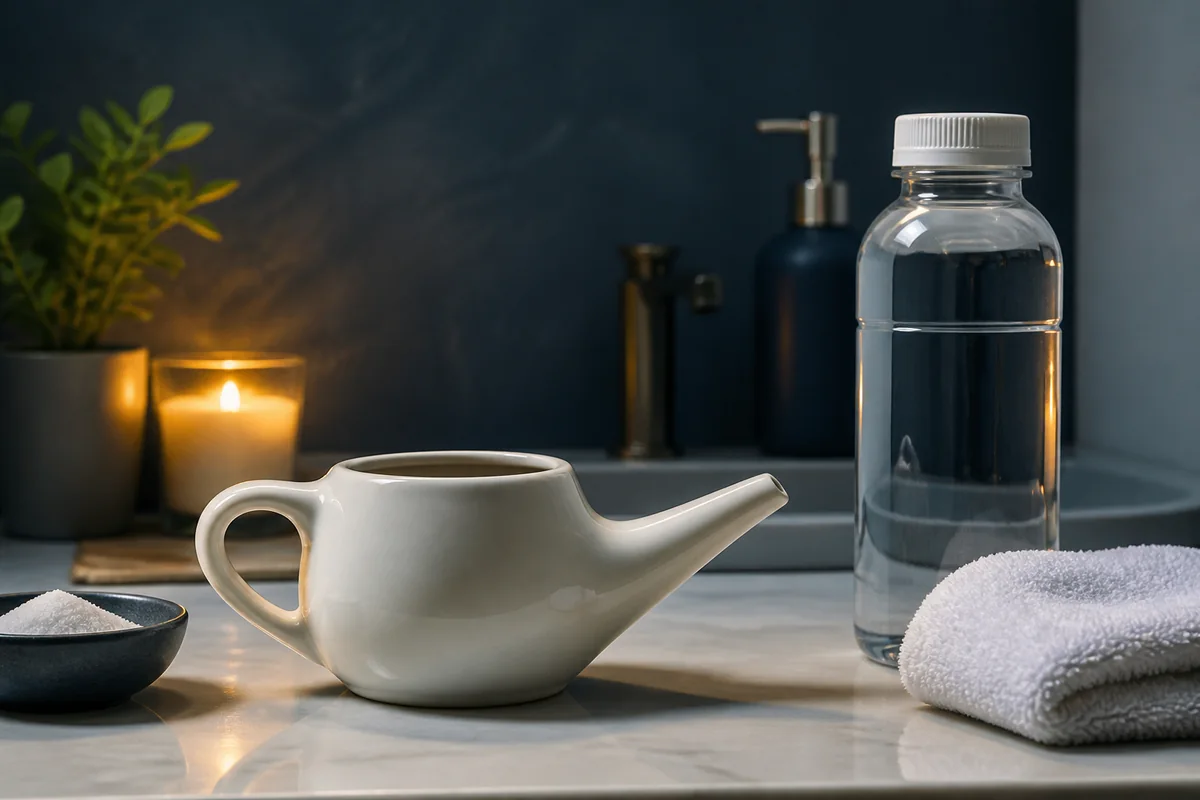
Wash your hands, use a clean device and mix the correct saline with distilled or sterile water, or tap water boiled at a rolling boil and cooled according to public-health instructions. Lean over a sink, keep the mouth open and let the solution flow gently through one nostril and out the other; do not force against a blockage. Clean and completely dry the device after use. Never use untreated tap water.See reference 1,See reference 2,See reference 3
The 10 rules to remember
- Use only distilled, sterile, or correctly boiled and cooled water.See reference 1
- Use the intended saline concentration rather than plain water.See reference 2
- Wash hands and start with a clean device.See reference 3
- Keep the solution comfortably lukewarm.See reference 4
- Lean forward and breathe through the mouth.See reference 5
- Use gentle flow and never force pressure.See reference 6
- Clean and fully air-dry the device after use.See reference 7
- Reduce frequency when symptoms settle.See reference 8
- Stop for severe pain, repeated bleeding or worsening symptoms.See reference 9
- Nasal irrigation can reduce symptoms; it does not cure every cause of congestion or replace evaluation of persistent one-sided blockage.See reference 10,See reference 9
First principles: what this tool can actually change
Isotonic saline mechanically thins mucus, removes allergens and supports mucociliary clearance without the irritation of plain water.See reference 1,See reference 2
Water that is safe to drink is not necessarily sterile enough for nasal use because organisms can bypass normal stomach defenses.See reference 2,See reference 3
Benefits differ by condition: evidence is more supportive for allergic rhinitis and chronic rhinosinusitis than for preventing or curing routine viral infections.See reference 3,See reference 4
A practical protocol
- Stage
- Prepare
- What to do
- Safe water plus measured saline
- Why it matters
- Protects tissue and reduces infection riskSee reference 2
- Stage
- Position
- What to do
- Lean forward over sink with mouth open
- Why it matters
- Limits swallowing and ear pressureSee reference 3
- Stage
- Rinse
- What to do
- Gentle gravity or low pressure
- Why it matters
- Moves saline without traumaSee reference 4
- Stage
- Clean
- What to do
- Wash and fully air-dry device
- Why it matters
- Limits microbial growthSee reference 5
Timing and frequency
- When
- During symptoms
- Action
- Once daily, increasing only if tolerated and advisedSee reference 3
- When
- Allergy season
- Action
- Use around predictable exposure when helpfulSee reference 4
- When
- After surgery
- Action
- Follow the surgeon's exact protocolSee reference 5
- When
- When well
- Action
- Use only if a meaningful benefit remainsSee reference 6
What to measure
- Signal
- Water source
- How
- Distilled, sterile or boiled and cooled
- Interpretation
- Core safety controlSee reference 4
- Signal
- Saline concentration
- How
- Prepared packet or measured recipe
- Interpretation
- Comfort and tissue toleranceSee reference 5
- Signal
- Symptom response
- How
- Congestion and validated symptom score
- Interpretation
- Whether use is worthwhileSee reference 6
- Signal
- Adverse effects
- How
- Pain, bleeding, ear pressure or infection signs
- Interpretation
- Reason to reduce or stopSee reference 7
What the evidence supports
Systematic reviews support symptom improvement as an adjunct for allergic rhinitis and chronic rhinosinusitis, though protocols vary.See reference 2,See reference 4
Hypertonic saline may improve some symptoms more than isotonic saline but also causes more minor irritation.See reference 3,See reference 5
The procedure is low cost, yet benefit should be judged by symptoms rather than claims about detoxification or immunity.See reference 4,See reference 6
Evidence strength by claim
- Claim
- Saline irrigation clears mucus and allergens
- Confidence
- Moderate to strong
- Important boundary
- Technique, solution and diagnosis affect benefitSee reference 1,See reference 2
- Claim
- It can improve rhinitis or sinus symptoms
- Confidence
- Variable
- Important boundary
- Average effects vary and it is usually adjunctiveSee reference 3,See reference 4
- Claim
- Daily rinsing prevents respiratory infections or improves longevity
- Confidence
- Limited or indirect
- Important boundary
- Risk-factor change is not proof of disease preventionSee reference 5,See reference 6
- Claim
- It extends human lifespan
- Confidence
- Not established
- Important boundary
- Association is not proof of causationSee reference 7,See reference 8,See reference 9,See reference 10
Limitations and common overclaims
Trials use different volumes, concentrations, devices and populations, which limits one universal protocol.See reference 5,See reference 7
Rinsing cannot correct a deviated septum, polyp, tumor or every cause of chronic obstruction.See reference 6,See reference 8
Repeated use without benefit adds burden and exposure risk, so routine permanent use is not automatically better.See reference 7,See reference 9
How to make it stick
Choose the smallest version you can repeat under normal conditions. Consistency creates a useful signal; a heroic one-off session does not.See reference 1,See reference 2
Change one variable at a time and write down the protocol. Otherwise an apparent improvement may reflect different timing, equipment or conditions.See reference 3,See reference 4
Review the result after a pre-defined period. Continue only when the benefit is meaningful, the burden is acceptable and no safety signal has appeared.See reference 5,See reference 6
Troubleshooting
- Problem
- Burning
- Likely issue
- Wrong salt concentration or temperature
- Better next step
- Use correctly mixed lukewarm salineSee reference 5
- Problem
- Ear pressure
- Likely issue
- Too much force or blocked passage
- Better next step
- Stop, reduce pressure and seek advice if persistentSee reference 6
- Problem
- Solution will not pass
- Likely issue
- Severe congestion or anatomy
- Better next step
- Do not force; consider clinical evaluationSee reference 7
- Problem
- Device smells or looks dirty
- Likely issue
- Incomplete cleaning or drying
- Better next step
- Replace or disinfect as instructedSee reference 8
Safety and when to stop
Never use untreated tap water for nasal rinsing. Use distilled, sterile, or correctly boiled and cooled water and keep the device clean and dry. Stop and seek care for severe headache, fever, confusion or vomiting after nasal rinsing, or for severe pain, significant bleeding, swelling or worsening infection. Ask a clinician before use after surgery or with major immune compromise.See reference 1,See reference 5,See reference 9
Who is most likely to benefit
People with allergic rhinitis or chronic rhinosinusitis who prefer a non-drug adjunct may benefit.See reference 2,See reference 6
Post-operative patients can benefit when irrigation is specifically prescribed and technique follows surgical guidance.See reference 3,See reference 7
People with persistent one-sided symptoms, fever or severe pain need diagnosis rather than escalating rinses.See reference 4,See reference 8
Track five things
- Water source and preparation.See reference 1
- Device cleaning and drying.See reference 2
- Frequency and solution concentration.See reference 3
- Congestion, discharge and sleep impact.See reference 4
- Pain, bleeding, fever or neurologic symptoms.See reference 5
Frequently asked questions
Can I use tap water in a neti pot?
No. Use distilled, sterile, or properly boiled and cooled water.See reference 1
Is saline better than plain water?
Yes. Correct saline is more comfortable and physiologically suitable than plain water.See reference 2
How often should I rinse?
Use the lowest frequency that meaningfully helps; many protocols use once daily during symptoms, but individual advice differs.See reference 3
Is hypertonic saline better?
It may improve some symptoms more but causes more irritation in some users.See reference 4
Can nasal irrigation cure sinusitis?
It can be a helpful adjunct, especially in chronic rhinosinusitis, but it does not treat every cause or replace indicated medical care.See reference 5
How do I clean the device?
Follow its instructions, wash after each use and let it dry completely; replace damaged or contaminated devices.See reference 6
Connect the protocol to your wider health picture
LongevityMate helps organize measurements, habits, symptoms and trends so one tool stays in context instead of becoming the whole plan.
See how LongevityMate worksReferences
- 1. How to Safely Rinse Sinuses
Centers for Disease Control and PreventionOfficial guidance
- 2. Preventing Waterborne Germs at Home
Centers for Disease Control and PreventionOfficial guidance
- 3. Is Rinsing Your Sinuses With Neti Pots Safe?
U.S. Food and Drug AdministrationOfficial guidance
- 4. Nasal irrigation for allergic rhinitis: systematic review and meta-analysis
American Journal of Rhinology & AllergyMeta-analysis
- 5. Saline irrigation for chronic rhinosinusitis
CochraneSystematic review
- 6. Hypertonic saline for chronic rhinosinusitis: meta-analysis
Brazilian Journal of OtorhinolaryngologyMeta-analysis
- 7. Role of nasal saline irrigation in allergic rhinitis
Allergologia et ImmunopathologiaSystematic review
- 8. Clinical Practice Guideline: Adult Sinusitis Update
American Academy of Otolaryngology–Head and Neck SurgeryGuideline
- 9. Fatal Acanthamoeba encephalitis associated with tap-water nasal irrigation
CDC MMWRObservational study
- 10. Primary amebic meningoencephalitis deaths associated with sinus irrigation
Clinical Infectious DiseasesObservational study
Editorial transparency
- Published by
- LongevityMate Editorial Team
- Published
- Updated
Medical disclaimer
This guide provides general health education. It does not diagnose a condition, prescribe treatment, replace individualized professional care, or guarantee a health or longevity outcome.