
One-minute protocol
The simple evidence-based protocol
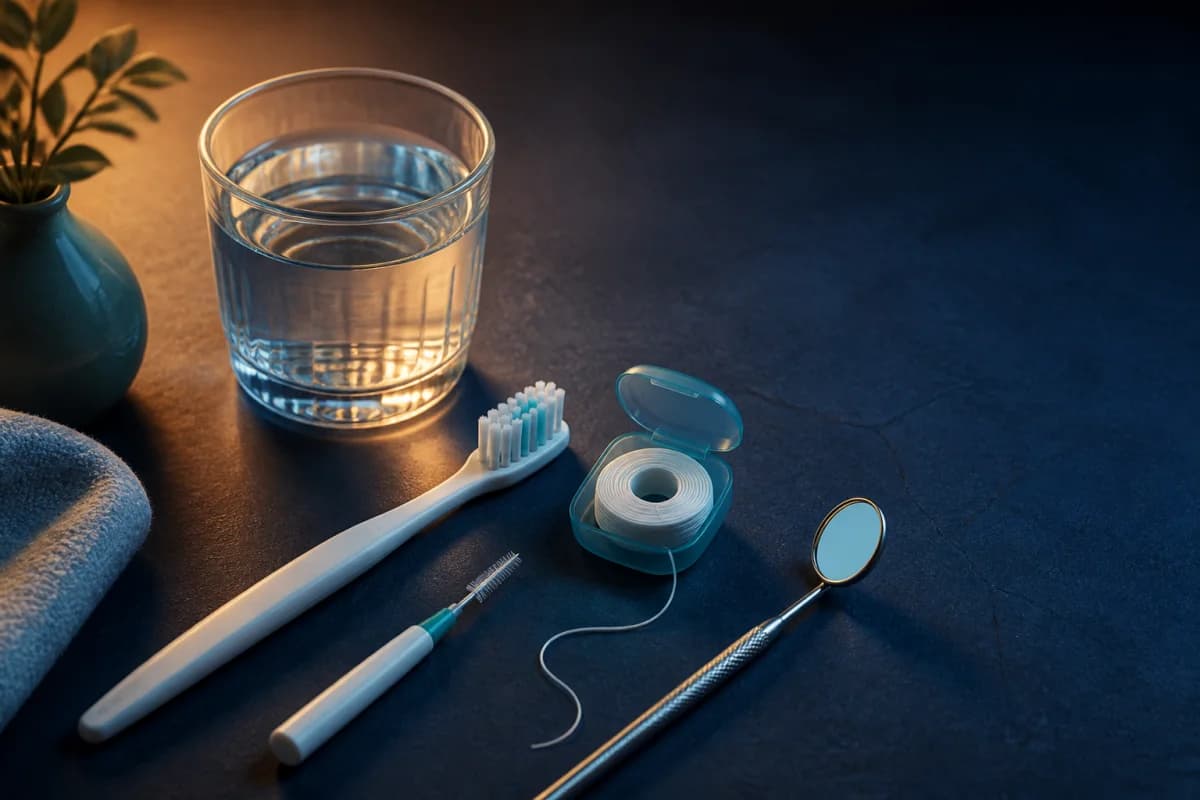
Brush all tooth surfaces twice daily for about two minutes with fluoride toothpaste, using gentle pressure at the gumline. Spit out excess paste and follow local guidance about rinsing. Clean between teeth once daily with floss or correctly sized interdental brushes. Keep sugary drinks and snacks to meals rather than frequent exposures, avoid tobacco, and arrange dental check-ups based on your individual disease risk. Bleeding gums are common but not normal—persistent bleeding deserves dental assessment.See reference 1,See reference 2,See reference 3
The 10 rules to remember
- Brush twice daily with fluoride toothpaste.See reference 1
- Clean between teeth every day.See reference 2
- Use gentle technique; harder brushing is not better.See reference 3
- Frequency of sugar exposure matters.See reference 4
- Avoid tobacco and areca nut.See reference 5
- Replace or clean oral devices as directed.See reference 6
- Dental-visit frequency should match risk.See reference 7
- Persistent bleeding or loose teeth needs care.See reference 8
- Dry mouth raises decay risk.See reference 9
- Do not market dental care as proven cardiovascular treatment.See reference 10
First principles: what this tool can actually change
Dental plaque is a microbial biofilm. Without effective control, acids contribute to tooth decay and an inflammatory response can damage gums and tooth-supporting structures.See reference 1,See reference 2
Fluoride strengthens enamel and promotes remineralization. Interdental cleaning reaches surfaces a toothbrush misses.See reference 2,See reference 3
Periodontitis and systemic disease share risk factors and inflammatory pathways. Association does not prove that periodontal treatment prevents heart attacks or dementia.See reference 3,See reference 4
A practical protocol
- Stage
- Morning
- What to do
- Brush 2 min with fluoride toothpaste
- Why it matters
- Gentle gumline coverageSee reference 2
- Stage
- Evening
- What to do
- Interdental clean, then brush
- Why it matters
- Most complete daily cleanSee reference 3
- Stage
- Meals
- What to do
- Limit frequent free-sugar exposures
- Why it matters
- Water as default drinkSee reference 4
- Stage
- Dental care
- What to do
- Risk-based recall and professional cleaning
- Why it matters
- Individualized intervalSee reference 5
Timing and frequency
- When
- Twice daily
- Action
- Fluoride toothbrushingSee reference 5
- When
- Once daily
- Action
- Interdental cleaningSee reference 6
- When
- After acidic food
- Action
- Avoid immediate aggressive brushingSee reference 7
- When
- Risk-based
- Action
- Dental exam and periodontal reviewSee reference 8
What to measure
- Signal
- Bleeding
- How
- During brushing or cleaning
- Interpretation
- Persistent bleeding needs assessmentSee reference 8
- Signal
- Pocketing
- How
- Measured professionally
- Interpretation
- Periodontal disease markerSee reference 9
- Signal
- Dry mouth
- How
- Symptoms and medication review
- Interpretation
- Raises decay riskSee reference 10
- Signal
- Function
- How
- Pain, chewing, loose teeth
- Interpretation
- Core health outcomeSee reference 1
What the evidence supports
Fluoride toothpaste prevents dental caries, and effective plaque control supports gum health and tooth retention.See reference 1,See reference 4
Maintaining teeth supports nutrition, communication and quality of life as people age.See reference 2,See reference 5
Observational links connect periodontal disease with cardiovascular and metabolic outcomes, but intervention evidence for preventing major systemic events remains insufficient.See reference 3,See reference 6
Evidence strength by claim
- Claim
- The protocol changes its immediate target
- Confidence
- Moderate to strong
- Important boundary
- Depends on correct technique and populationSee reference 1,See reference 2
- Claim
- It improves a clinical or functional outcome
- Confidence
- Variable
- Important boundary
- Effect size and relevance differSee reference 3,See reference 4
- Claim
- It prevents major disease
- Confidence
- Usually limited
- Important boundary
- Surrogate outcomes are not clinical eventsSee reference 5,See reference 6
- Claim
- It extends human lifespan
- Confidence
- Not established
- Important boundary
- Association is not proof of causationSee reference 7,See reference 8,See reference 9,See reference 10
Limitations and common overclaims
Floss is not the only interdental option; correctly sized interdental brushes may work better where spaces allow.See reference 5,See reference 7
Mouthwash can be useful for specific indications but does not replace brushing and interdental cleaning.See reference 6,See reference 8
Bleeding, pain, bad breath or loose teeth cannot be reliably diagnosed from a home routine or photograph.See reference 7,See reference 9
How to make it stick
Choose the smallest version you can repeat under normal conditions. Consistency creates a useful signal; a heroic one-off session does not.See reference 1,See reference 2
Change one variable at a time and write down the protocol. Otherwise an apparent improvement may simply reflect different timing, equipment or conditions.See reference 3,See reference 4
Review the result after a pre-defined period. Continue only when the benefit is meaningful, the burden is acceptable and no safety signal has appeared.See reference 5,See reference 6
Troubleshooting
- Problem
- Results vary widely
- Likely issue
- Technique or conditions changed
- Better next step
- Standardize and average repeated observationsSee reference 2,See reference 3
- Problem
- No meaningful benefit
- Likely issue
- Dose, adherence or target may be wrong
- Better next step
- Verify the protocol before escalatingSee reference 4,See reference 5
- Problem
- Symptoms appear
- Likely issue
- The intervention may be unsuitable
- Better next step
- Stop and use appropriate clinical adviceSee reference 6,See reference 7
- Problem
- Tracking creates anxiety
- Likely issue
- Measurement has replaced the goal
- Better next step
- Reduce frequency and focus on functionSee reference 8,See reference 9,See reference 10
Safety and when to stop
Seek urgent dental or medical care for facial swelling, spreading infection, fever with dental pain, difficulty swallowing or breathing, uncontrolled bleeding, major trauma or a suspicious mouth ulcer that persists. People at high risk of infective endocarditis should follow their cardiology and dental team's antibiotic guidance rather than self-prescribing.See reference 1,See reference 5,See reference 9
Who is most likely to benefit
This tool is most useful when it solves a defined problem, is feasible to repeat and changes a decision. It is less useful when collected or performed only because a score or influencer made it seem mandatory.See reference 2,See reference 4
People with symptoms, diagnosed disease, pregnancy, recent surgery or complex medicines should adapt the protocol with an appropriate health professional.See reference 5,See reference 7
The foundation remains sleep, physical activity, nutrition, tobacco avoidance and evidence-based medical care. Add this tool only where it improves that foundation.See reference 8,See reference 10
Track five things
- The exact protocol, equipment and timing.See reference 1
- The outcome the tool is meant to change.See reference 2
- Symptoms and adverse effects.See reference 3
- Adherence and practical burden.See reference 4
- Whether the result changes a real decision.See reference 5
Frequently asked questions
Should I floss every day?
Clean between teeth daily; floss or interdental brushes should match the space and your dental advice.See reference 3
Why do my gums bleed?
Inflammation is common, but persistent bleeding needs dental assessment.See reference 4
Does gum disease cause heart disease?
They are associated, but causation and prevention of heart events through periodontal treatment are not established.See reference 5
Do I need mouthwash?
Not routinely for everyone; it may help specific risks when chosen professionally.See reference 6
Is fluoride safe?
Fluoride toothpaste is strongly supported when used as directed and not swallowed.See reference 7
How often should I see a dentist?
Use a personalized recall interval based on decay, gum and oral-cancer risk.See reference 8
What about electric toothbrushes?
They can help technique, but consistent thorough cleaning matters most.See reference 9
Can oral health affect nutrition?
Yes. Pain and tooth loss can restrict food choices and reduce quality of life.See reference 10
Connect the protocol to your wider health picture
LongevityMate helps organize measurements, habits, symptoms and trends so one tool stays in context instead of becoming the whole plan.
See how LongevityMate worksReferences
- 1. Oral health fact sheet
World Health OrganizationOfficial guidance
- 2. Global oral health status report
World Health OrganizationEvidence review
- 3. Fluoride toothpastes for preventing dental caries
Cochrane Database of Systematic ReviewsSystematic review
- 4. Interdental cleaning for preventing periodontal disease and caries
Cochrane Database of Systematic ReviewsSystematic review
- 5. Periodontitis and cardiovascular diseases: consensus report
Journal of Clinical PeriodontologyOfficial guidance
- 6. Periodontal treatment for primary or secondary prevention of cardiovascular disease
Cochrane Database of Systematic ReviewsSystematic review
- 7. Sugars intake for adults and children
World Health OrganizationGuideline
- 8. Adult Oral Health
Centers for Disease Control and PreventionOfficial guidance
- 9. Delivering better oral health: prevention toolkit
UK Office for Health Improvement and DisparitiesGuideline
- 10. Periodontal therapy and cardiovascular outcomes
Journal of PeriodontologyMeta-analysis
Editorial transparency
- Published by
- LongevityMate Editorial Team
- Published
- Updated
Medical disclaimer
This guide provides general health education. It does not diagnose a condition, prescribe treatment, replace individualized medical or dental care, or guarantee a health or longevity outcome.