
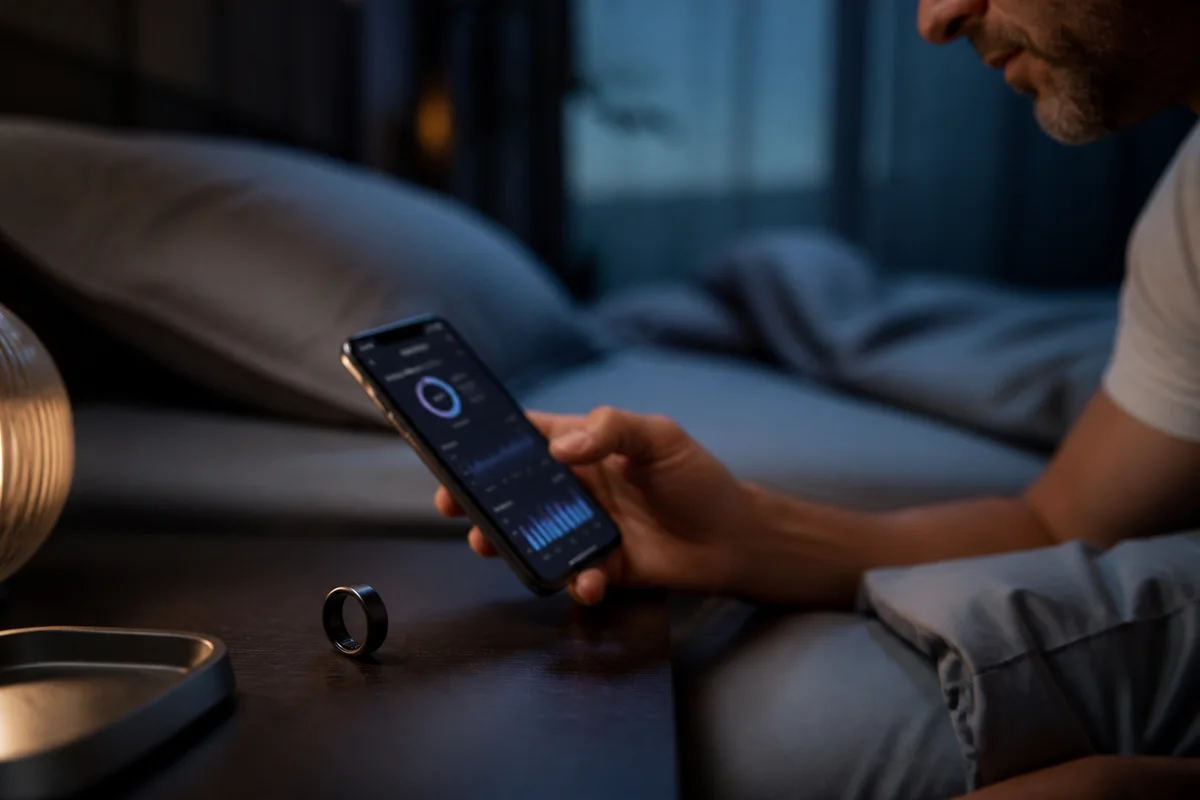
One-minute protocol
The simple evidence-based protocol
Wear the correctly sized ring on the same recommended finger every night, with the sensors against the palm side. Use the first 14 nights to establish a baseline rather than changing behavior from each score. Then review weekly sleep timing, sleep duration, overnight resting heart rate, HRV and temperature deviation alongside symptoms and training. Treat Readiness, Sleep and activity scores as prompts, not medical conclusions; persistent symptoms, irregular rhythm alerts or a marked unexplained trend need appropriate clinical assessment.See reference 1,See reference 2,See reference 3
The 10 rules to remember
- Build a personal baseline for at least 14 nights before interpreting trends.See reference 1
- Prioritize bedtime, wake time, sleep duration and overnight heart-rate patterns over a single composite score.See reference 2
- Use the same well-fitting finger and orientation because motion and poor contact degrade optical signals.See reference 3
- Review seven-day or longer trends; one unusual night usually reflects noise or a temporary stressor.See reference 4
- Do not treat sleep-stage minutes as equivalent to polysomnography or use them to diagnose a sleep disorder.See reference 5
- Interpret HRV against your own baseline, not another person's value or an internet target.See reference 6
- Record alcohol, illness, travel, menstrual cycle, medicines and hard training before assigning a cause to a change.See reference 7
- Do not let a low Readiness score automatically cancel useful planned movement when you otherwise feel well.See reference 8
- Use symptoms and validated clinical testing when the ring and your body tell different stories.See reference 9
- Remember that validation of component signals does not validate every proprietary recommendation or a longevity benefit.See reference 10
First principles: what this tool can actually change
The ring uses optical pulse signals, movement and temperature sensors to estimate physiology during a relatively still period. Finger blood flow can support useful overnight heart-rate and HRV estimates, but fit, motion, circulation and algorithms still affect the result.See reference 1,See reference 2
Sleep stages are inferred from indirect signals rather than brain waves, eye movements and muscle activity measured in laboratory polysomnography. Agreement can look reasonable across a group while an individual's stage labels remain wrong on a particular night.See reference 3,See reference 4
A proprietary score compresses several measurements and company-selected weights into one number. It may help reflection, but it cannot identify the cause of fatigue, distinguish disease from behavior or prove that following the score improves health outcomes.See reference 5,See reference 6
A practical protocol
- Stage
- Fit and setup
- What to do
- Use the sizing process; wear the ring snugly with sensors palm-side
- Why it matters
- Improves signal contact and reduces motion errorSee reference 1
- Stage
- Baseline
- What to do
- Collect at least 14 typical nights without score-driven changes
- Why it matters
- Creates a personal comparison rangeSee reference 2
- Stage
- Weekly review
- What to do
- Review timing, duration, resting HR, HRV and temperature with context
- Why it matters
- Separates patterns from single-night noiseSee reference 3
- Stage
- Act
- What to do
- Change one behavior for 2-4 weeks and compare the same outcomes
- Why it matters
- Turns tracking into a testable experimentSee reference 4
Timing and frequency
- When
- Every night
- Action
- Wear consistently from before sleep until after wakingSee reference 5
- When
- Each morning
- Action
- Add brief context only; avoid repeatedly checking the appSee reference 6
- When
- Once weekly
- Action
- Review rolling trends and choose at most one useful actionSee reference 7
- When
- After 2-4 weeks
- Action
- Judge whether the action improved sleep, symptoms or performanceSee reference 8
What to measure
- Signal
- Sleep timing and duration
- How
- Compare bedtime, wake time and estimated total sleep
- Interpretation
- More actionable than exact stage minutesSee reference 7
- Signal
- Resting heart rate
- How
- Use the overnight level and pattern
- Interpretation
- Persistent deviation may reflect load, illness or other factorsSee reference 8
- Signal
- HRV
- How
- Use a rolling personal median
- Interpretation
- Higher is not universally better and causes are nonspecificSee reference 9
- Signal
- Temperature deviation
- How
- Compare with personal baseline and symptoms
- Interpretation
- A deviation is not a thermometer reading or diagnosisSee reference 10
What the evidence supports
Validation studies suggest useful agreement for overnight heart rate and selected HRV measures under resting conditions, although performance varies by metric and study design.See reference 1,See reference 3
Oura can estimate broad sleep-wake patterns and total sleep reasonably enough for longitudinal self-observation, while stage-level accuracy remains materially lower than laboratory scoring.See reference 2,See reference 4
The practical benefit is behavioral awareness and consistent trend capture. Evidence does not establish that an Oura score itself prevents disease or extends life.See reference 5,See reference 6
Evidence strength by claim
- Claim
- Tracks overnight heart rate and selected HRV measures
- Confidence
- Moderate
- Important boundary
- Best during still sleep and as personal trendsSee reference 1,See reference 2
- Claim
- Estimates sleep timing and total sleep
- Confidence
- Moderate
- Important boundary
- Individual-night errors remain possibleSee reference 3,See reference 4
- Claim
- Accurately labels every sleep stage
- Confidence
- Low
- Important boundary
- Not equivalent to polysomnographySee reference 5,See reference 6
- Claim
- Readiness score improves health or longevity
- Confidence
- Not established
- Important boundary
- Proprietary score lacks outcome validationSee reference 7,See reference 8,See reference 9,See reference 10
Limitations and common overclaims
Several Oura validation studies include manufacturer funding, equipment or authorship. That does not invalidate the findings, but independent replication and transparent conflict disclosure matter.See reference 3,See reference 7
Firmware and algorithms change faster than peer-reviewed studies. Evidence for one ring generation or software version may not transfer perfectly to the current product.See reference 5,See reference 8
Feedback can produce orthosomnia—an unhealthy effort to perfect tracker-defined sleep. A device that increases checking, anxiety or time awake may be reducing rather than improving sleep health.See reference 9,See reference 10
How to make it stick
Create a five-minute weekly review: note the trend, write one plausible explanation and choose either one change or no action.See reference 1,See reference 2
Run simple within-person experiments, such as a consistent bedtime for three weeks, while keeping other major behaviors reasonably stable.See reference 3,See reference 4
Export or summarize trends for a clinician when symptoms persist; do not hand over only a readiness number without dates, symptoms and context.See reference 5,See reference 6
Troubleshooting
- Problem
- Missing or erratic data
- Likely issue
- Loose fit, cold hands, motion or low battery
- Better next step
- Adjust fit, warm hands and check wear orientationSee reference 2,See reference 3
- Problem
- Low score but you feel normal
- Likely issue
- Algorithmic weighting or temporary deviation
- Better next step
- Follow symptoms and review the longer trendSee reference 4,See reference 5
- Problem
- Good score but severe fatigue
- Likely issue
- Wearable cannot exclude illness or sleep disorder
- Better next step
- Seek appropriate assessment rather than trusting the scoreSee reference 6,See reference 7
- Problem
- Tracking worsens sleep anxiety
- Likely issue
- Excessive monitoring or perfectionism
- Better next step
- Hide scores or stop wearing it and address sleep clinicallySee reference 8,See reference 9,See reference 10
Safety and when to stop
The ring is a consumer wellness tool and must not delay urgent care. Seek urgent medical assessment for chest pain, fainting, severe breathlessness, new neurologic symptoms or a sustained fast or irregular heartbeat, regardless of the app score. Remove the ring for swelling, numbness, skin breakdown or any activity where jewelry could catch. Discuss persistent sleepiness, loud snoring, witnessed breathing pauses, insomnia or major unexplained trend changes with an appropriate clinician.See reference 1,See reference 5,See reference 9
Who is most likely to benefit
It is most useful for people who want low-effort overnight trends and can respond to data calmly with small, testable behavior changes.See reference 2,See reference 4
It is less suitable for anyone seeking diagnosis, precise sleep-stage measurement or certainty from a proprietary recovery number.See reference 5,See reference 7
People prone to health anxiety, obsessive checking or disordered exercise should use fewer metrics, disable feedback or avoid the device if it worsens behavior.See reference 8,See reference 10
Track five things
- Nights worn and signal gaps.See reference 1
- Sleep timing and estimated duration.See reference 2
- Seven-day resting-heart-rate and HRV trends.See reference 3
- Temperature deviation plus symptoms.See reference 4
- The single behavior changed and its result.See reference 5
Frequently asked questions
Is Oura Ring accurate?
It is reasonably useful for some overnight trends, especially heart rate and broad sleep timing, but no consumer wearable is accurate for every metric or night.See reference 1
How long does Oura need for a baseline?
Use at least 14 nights; longer baselines are more representative when schedules or health vary.See reference 2
Can Oura diagnose sleep apnea?
No. Symptoms or suspected apnea require a validated clinical assessment and sleep study pathway.See reference 3
Is a higher HRV always better?
No. HRV is highly individual and changes with age, physiology, measurement method and context.See reference 4
Should I train when Readiness is low?
Use the score as one input. Symptoms, planned load and longer trends matter more than one number.See reference 5
How accurate are Oura sleep stages?
Stage estimates are less reliable than broad sleep-wake patterns and are not a substitute for brain-wave-based sleep testing.See reference 6
Can temperature deviation detect illness?
It may flag a nonspecific change but cannot identify the cause or replace a clinical thermometer and assessment.See reference 7
Does Oura improve longevity?
No direct evidence shows that wearing the ring or following its scores extends human lifespan.See reference 8
Connect the protocol to your wider health picture
LongevityMate helps organize measurements, habits, symptoms and trends so one tool stays in context instead of becoming the whole plan.
See how LongevityMate worksReferences
- 1. Accuracy of Oura Gen3 Against Polysomnography
Sleep MedicineObservational study
- 2. Evaluation of Six Consumer Sleep Trackers
SleepObservational study
- 3. Oura Ring Against Polysomnography
Behavioral Sleep MedicineObservational study
- 4. Nocturnal Heart Rate and HRV Validity of Oura
SensorsObservational study
- 5. Validity of Oura Ring for Nocturnal HR and HRV
European Journal of Sport ScienceObservational study
- 6. Effect of Signal Filtering on Oura HRV
Physiological MeasurementObservational study
- 7. Oura and WHOOP for Nocturnal HR and HRV
Journal of Clinical Sleep MedicineObservational study
- 8. Accuracy of Consumer Sleep Trackers
Sleep Medicine ReviewsSystematic review
- 9. Consumer Sleep Technology Position Statement
American Academy of Sleep MedicineOfficial guidance
- 10. Wearable Activity Trackers and Health Outcomes
Lancet Digital HealthSystematic review
Editorial transparency
- Published by
- LongevityMate Editorial Team
- Published
- Updated
Medical disclaimer
This guide provides general health education. It does not diagnose a condition, prescribe treatment, replace individualized medical care, or guarantee a health or longevity outcome.