
The short answer
An interesting mechanism is not a proven benefit
Quercetin is a plant flavonoid found in foods including apples and onions. Human supplement research is limited and results vary. Short blood-pressure studies, laboratory antioxidant effects and an early prescription-drug combination study do not establish that over-the-counter quercetin extends life or prevents disease.See reference 1,See reference 2,See reference 3,See reference 4
Food sources, extracts and products are not interchangeable
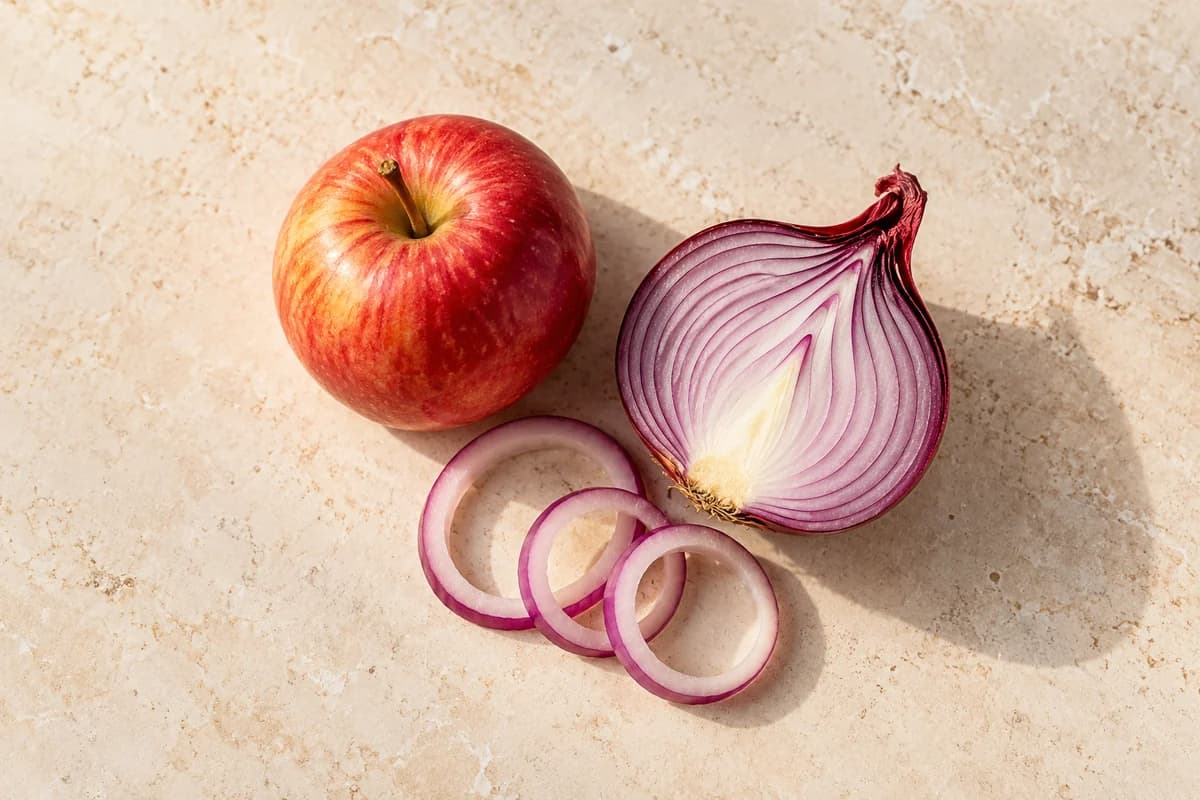
A food contains many substances alongside quercetin. A concentrated capsule is a different exposure, and research formulations can differ from retail products. The apple and onion artwork represents dietary sources; it does not show a food amount equivalent to a supplement dose.See reference 1,See reference 3
When evaluating a claim, identify the preparation, participants, duration and measured outcome. A finding for one extract cannot certify a different product, and a change in a blood marker cannot automatically establish fewer heart attacks or longer life.See reference 2,See reference 3
Keep the human evidence at its tested level
- Evidence
- 2022 blood-pressure meta-analysis
- What was studied
- Ten trials with 841 participants; average systolic-pressure reduction of about 2.4 mmHg.
- What remains unproved
- A small pooled marker change does not prove disease prevention or a predictable personal effect.See reference 2
- Evidence
- 2015 onion-skin extract trial
- What was studied
- Seventy people randomised in a six-week crossover study; no significant overall ambulatory or office-pressure effect.
- What remains unproved
- A subgroup signal does not establish a benefit for everyone.See reference 3
- Evidence
- 2019 dasatinib-plus-quercetin pilot
- What was studied
- Nine people with diabetic kidney disease; open-label research measured senescence-related markers.
- What remains unproved
- Not a quercetin-only trial or proof of longer life in healthy adults.See reference 4
- Evidence
- Laboratory and animal work
- What was studied
- Mechanisms and potential effects under experimental conditions.
- What remains unproved
- Not evidence that a retail capsule provides the same effect in people.See reference 1
Why the blood-pressure result needs context
The 2022 meta-analysis estimated an average systolic-pressure change of −2.38 mmHg (95% confidence interval −3.80 to −0.96). This pooled estimate combines particular trials and populations. It does not tell an individual which product to take or establish that a supplement can replace prescribed blood-pressure care.See reference 2
The 2015 study used a specific onion-skin extract in overweight or obese adults with pre-hypertension or stage I hypertension. Its overall group had no significant blood-pressure benefit; a hypertensive subgroup showed a modest ambulatory systolic signal. The trial did not test heart attacks, survival or healthy lifespan.See reference 3
Early senolytic research does not validate a supplement protocol
The small 2019 pilot combined quercetin with dasatinib, a prescription medicine, in people with diabetic kidney disease. It measured changes in tissue and circulating markers after a short intervention. It had no blinded placebo comparison and did not isolate quercetin’s contribution.See reference 4
Those findings are early biological evidence. They do not establish that quercetin alone is an effective anti-ageing treatment, and they do not justify copying a prescription-drug research protocol or applying it to healthy adults.See reference 4
Limited evidence does not establish long-term safety
Memorial Sloan Kettering describes potential interactions with medicine-metabolising enzymes from laboratory experiments and with some medicines from preclinical work. Their clinical importance is uncertain. It also reports a warfarin case with increased INR, a clotting-test result, after quercetin supplementation. One case is a safety signal, not a measured risk for all users.See reference 1
Bring the exact product and ingredient list to a pharmacist or clinician, especially if taking prescription medicines or receiving cancer treatment. Do not stop prescribed treatment to use quercetin. Short studies and preliminary signals do not establish a universally safe long-term dose.See reference 1
Questions that make a supplement claim clearer
- Was the study in people, and were its participants similar to the intended users?See reference 2,See reference 3
- Did it test quercetin alone, a specific extract or a combination with another medicine?See reference 3,See reference 4
- Was the outcome a short-term marker or an actual health benefit? Keep that distinction in the conclusion.See reference 2,See reference 4
Common questions
Can quercetin replace blood-pressure medicine?
The cited trials do not establish it as a substitute. A pooled average pressure change is not a personalised treatment plan.See reference 2,See reference 3
Has quercetin been shown to extend human life?
The studies cited here did not establish that outcome. The senolytic pilot examined a combination and biological markers, rather than lifespan.See reference 4
Does quercetin in an apple mean a capsule is equally safe?
No. Ordinary food and concentrated products are different exposures. A food source does not establish the safety, interactions or efficacy of a supplement formulation.See reference 1,See reference 3
References
- 1. Quercetin: clinical summary and herb-drug interactions
Memorial Sloan Kettering Cancer CenterEvidence review
- 2. The Effects of Quercetin Supplementation on Blood Pressure - Meta-Analysis
Current Problems in Cardiology; indexed in PubMedMeta-analysis
- 3. Quercetin-rich onion-skin extract and 24-hour blood pressure: randomised crossover trial
British Journal of Nutrition, full text in PubMed CentralRandomized trial
- 4. Dasatinib plus quercetin in diabetic kidney disease: preliminary clinical pilot
EBioMedicine; indexed in PubMedNon-randomised trial
Editorial transparency
- Published by
- LongevityMate Editorial
- Published
- Updated
Medical disclaimer
General education only. This guide does not diagnose a condition, interpret your personal result, choose a treatment or recommend a supplement dose. Discuss testing, symptoms, medicines and supplements with a qualified health professional.