
What this result means
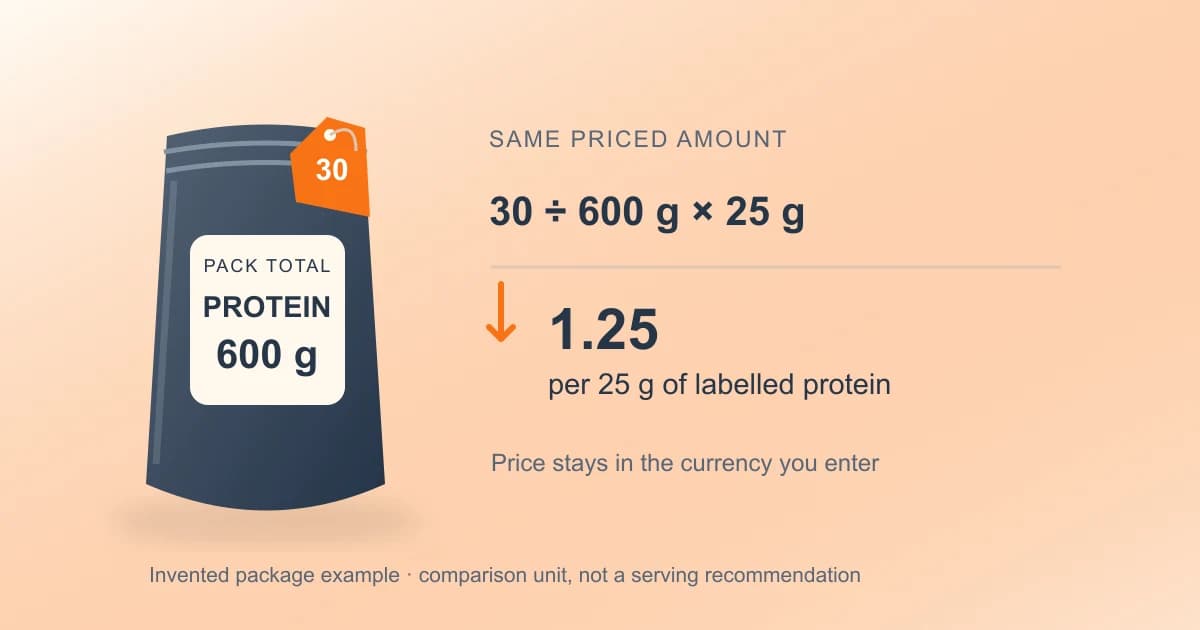
Divide the price by the total protein in grams for the same priced amount, then multiply by 25. An invented package priced at 30 with 600 g total labelled protein costs 1.25 in the same currency per 25 g protein. The 25 g basis is a comparison unit, not a recommended serving or intake. [1][2]
Match the protein to the price
A nutrition label usually gives nutrient amounts for a stated serving, and some labels also give a whole-package column. Read the serving size and number of servings before using a package price. A serving size on a label is not a recommended intake. [1][2]
For an invented powder package with 30 servings and 20 g protein per serving, the total labelled protein is 30 × 20 = 600 g. Use 600 with the whole-package price. If you use one serving’s protein, use the price of that same serving instead.
A scoop containing 30 g of powder is not automatically 30 g of protein. Use the protein line, not the serving’s product weight. For a per-100-g label, multiply the protein amount by the number of 100-g portions in the priced package. [1][2]
A lower package price can still cost more per protein
Invented Package A costs 30 and contains 600 g total protein: 30 ÷ 600 × 25 = 1.25. Invented Package B costs 24 and contains 400 g total protein: 24 ÷ 400 × 25 = 1.50. B has the lower package price; A has the lower cost per 25 g of stated protein.
This comparison answers a price question. It does not establish that A is the better food or supplement. Ingredients, allergies, preparation, other nutrients, taste and suitability are outside the calculation.
Package and serving calculations should agree
For Package A, one of its 30 servings costs 30 ÷ 30 = 1 and contains 20 g protein. The serving calculation is 1 ÷ 20 × 25 = 1.25, the same as the package calculation. This is a useful check that price and protein describe the same quantity.
Mixing the whole-package price of 30 with one serving’s 20 g protein would give 37.50. That number is mathematically correct for the entries but compares mismatched amounts. Changing the basis fixes the comparison; changing the rounding does not.
Use a consistent currency and cost basis
Enter the actual price you want to compare. If shipping, discounts or other costs are included for one product, decide how to handle them consistently for the other. Offers may change before purchase, and a required multi-pack purchase should be matched to that multi-pack’s protein.
The calculator accepts one numeric price, without a currency symbol. It does not know whether that price is in AUD, USD or another currency. A result of 1.25 remains 1.25 in the currency entered; prices in different currencies need conversion outside this tool.
What the result cannot rank
The 25 g multiplier simply puts prices on a common protein basis. It is not a serving instruction or personal daily target. Dividing by a different positive comparison amount would change the displayed scale, not the ordering of otherwise identical price ratios.
Protein grams alone do not specify amino-acid composition, digestibility, other nutrients or whether a product suits you. The tool also cannot infer protein from a product name, check preparation losses or decide whether a label is accurate.
If a label lists zero protein or the amount is unknown, the calculation has no valid protein denominator. Do not enter an invented tiny value to force an output. Use a stated, matching positive amount if one is available.
Rounding and privacy
The result rounds once to two decimal places. An original arithmetic boundary example, price 4.02 and protein 100 g, gives exactly 1.005 per 25 g and displays as 1.01. Rounded label amounts and servings-per-container estimates can limit precision; more displayed digits would not make the label more accurate.
Calculations run in your browser. Entered prices, protein amounts and results are not included in the shared page address or analytics details. Reset clears the calculation.
Formula and assumptions
- Version
- Cost per 25 grams of labelled protein, protein-cost-per-25g-v1
- Rounding
- Use exact fractions from decimal inputs and integer factor 25. Round the nonnegative result once to two decimal places, with exact halfway values rounded up.
- Worked example
- An invented package priced at 30 with 600 g total labelled protein: 30 ÷ 600 × 25 = 1.25 in the same currency per 25 g of protein.
Who this is for — and when not to use it
Intended use
Neutral price and food-label arithmetic for comparing cost relative to matching amounts of stated protein.
Not intended for
This tool does not recommend a protein intake, compare amino-acid quality or absorption, rank a whole food or supplement, choose a clinical diet, convert currency or certify labels and promotional prices.
Exclusions
- Personal protein intake or serving targets
- Clinical diet planning and food or supplement recommendations
- Protein-quality, amino-acid or absorption estimates
- Mixing a whole-package price with protein from one serving
- Treating scoop or product weight as protein weight
- Currency conversion and zero or invented protein denominators
Evidence sources
- 1. Serving Size on the Nutrition Facts Label — U.S. Food and Drug Administration. Accessed Sep 29, 2026.
- 2. How to Understand and Use the Nutrition Facts Label — U.S. Food and Drug Administration. Accessed Sep 29, 2026.